



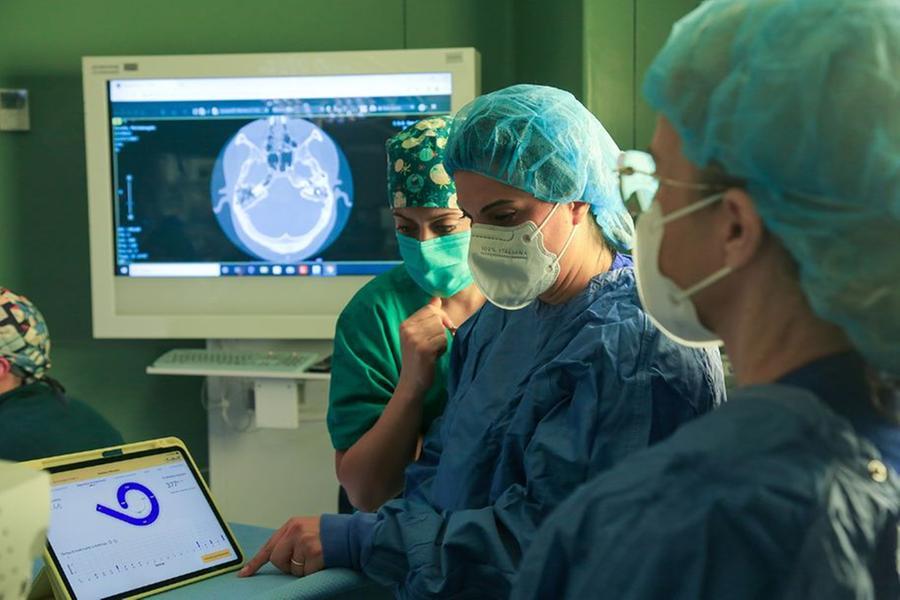


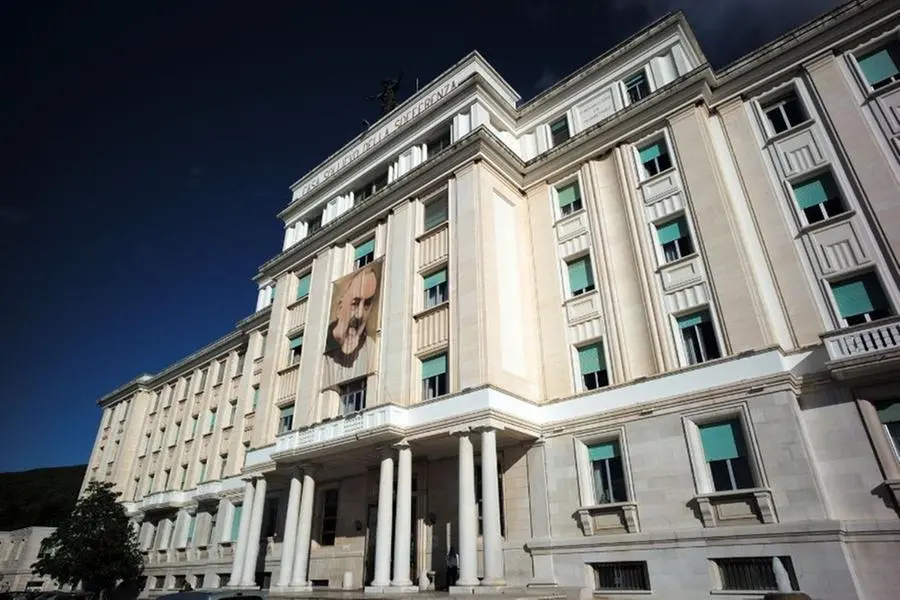
For the first time in the “Casa Sollievo della Sofferenza” hospital in San Giovanni Rotondo, Puglia, the hospital wanted and founded by Padre Pio, a bionic ear equipped with internal memory was implanted in a young deaf patient. “Nucleus Nexa” is a latest generation intelligent multi-channel cochlear device which makes clinical follow-up (checks and monitoring) easier.

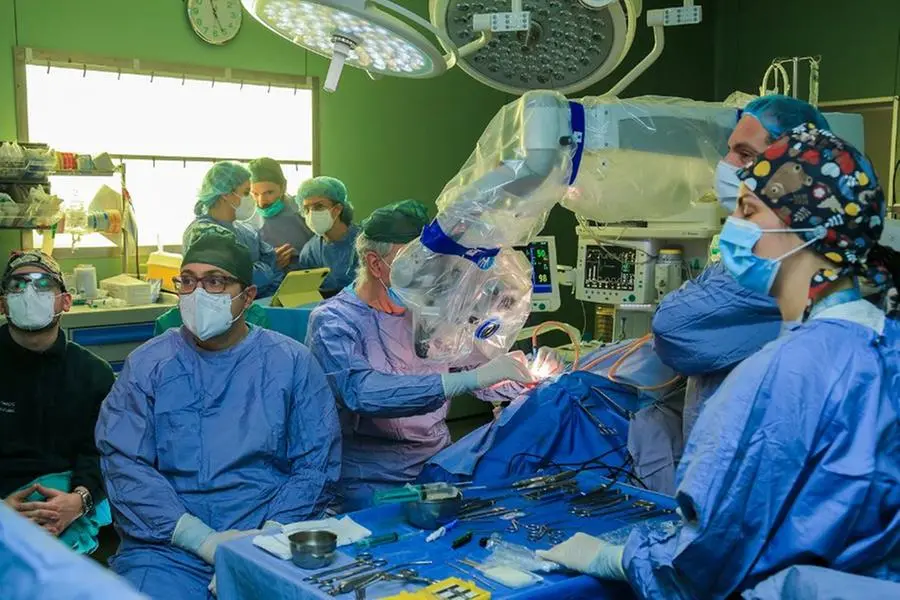
The medical team
The San Giovanni Rotondo socio-health center is among the first in Italy to use the innovative technological and scientific tool that is unique in the world. The intervention carried out on a 28 year old from the province of Foggia with profound bilateral deafness, from the Maxillofacial Surgery-Otorhinolaryngology Unit, was performed by surgeonsthe Lucio Vigliaroli and Rocco Pio Ortore, with the support of anesthetist Aldo Manuali, director of Anesthesia and Resuscitation 2, together with audiology technicians Francesca Cavalluzzo, Denis Curatolo and to all operating room staff. The traditional cochlear implant, also called “bionic ear”, bypasses the damaged cells of the ear: a microphone captures the sound and a processor transforms it into digital signals. In parallel, a subcutaneous receiver transmits these signals to electrodes implanted in the cochlea.
Finally, the electrodes directly stimulate the auditory nerve with electrical impulses allowing the brain to hear.
«The Nucleus Nexa system, however, it is equipped with internal memory, a feature that allows advanced management of the software, making it ready to accommodate all future technological updates», explains Lucio Vigliaroli, ENT surgeon, «the “smart technology” of the system also extends to the surgical phase, since in the operating room, thanks to Wi-Fi and a tablet, it is possible to verify the correct insertion of the implant, the impedance of the electrodes and the functionality of the acoustic nerve, improving the precision and safety of the procedure».
The young patient, selected using specific criteria, was already well at the end of the operation. He had an excellent recovery, all the peri-operative checks carried out gave positive results and, after the radiological check-up, he was discharged.
This type of intervention is dedicated to people suffering from severe deafness and
deep, of any nature and cause, which have caused irreversible damage to the cochlea, leaving the auditory nerve intact. «The age range actually affects the entire life cycle, starting from 10-11 months up to 85 years», he underlines Lucio Vignaroli, «It is obvious that in the study of these patients, from an audiological, radiological, laboratory and genetic point of view, all the factors that lead to the construction of an operation that is increasingly tailored to the individual patient must be evaluated. It is not an invasive operation and, in particular cases, it can also be conducted under local anesthesia.”
In general, the patient carries out the tests on an outpatient basis or during a short weekend recovery. He is then operated on and can leave the hospital the next day. The removal of the sutures takes place a week later, while the system is expected to be switched on in approximately 30 days, as well as some subsequent re-education sessions.
«With the new system», says the ENT surgeon Rocco Ortore«clinical follow-up will be simpler which will allow more efficient controls and adjustments, with direct benefits for patients who will be able to reduce the need to frequently go to hospital thanks to remote assistance through telemedicine and teleaudiology».
The San Giovanni Rotondo hospital is increasingly at the forefront of cochlear implants and implantable prostheses, with cases of interventions on a weekly basis.
«The installation of the “smart” bionic ear equipped with internal memory follows another very innovative intervention, carried out last October», he declares Lazzaro Cassano, director of the Maxillofacial Surgery-Otolaryngology Unit, «during which, for the first time in Puglia, a multi-channel cochlear implant was applied with robotic assistance on a patient suffering from bilateral degenerative cochleolabyrinthopathy. With 30 years of activity behind it in the sector, the IRCCS “Casa Sollievo della Sofferenza” confirms itself as one of the most advanced multi-implantology centers at a national level in the treatment of profound deafness”.