

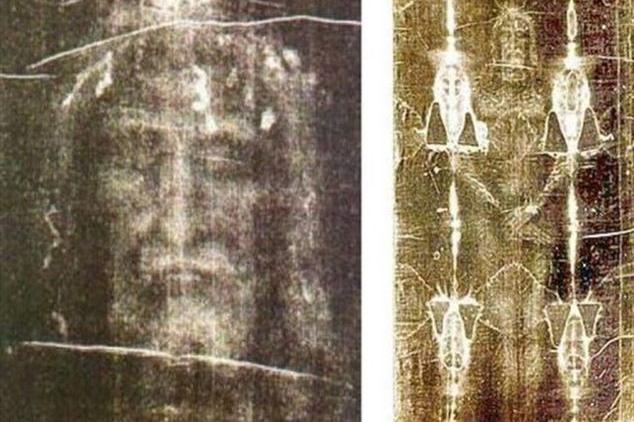


The Shroud is a linen sheet woven in a herringbone pattern. It is 441 centimeters long and 113 centimeters wide. It has been preserved in Turin since 1578. On the cloth – light yellow ocher in color – there are visible footprints reproducing images (frontal, on the left; dorsal, on the right) of a man who died following a series of tortures culminating in crucifixion. Two singed black lines and a series of white patches are also clearly visible: they are the damage caused by the fire that occurred in Chambéry in 1532.
According to Tradition, it is the sheet mentioned in the Gospels that was used to wrap the body of Jesus in the tomb. The object of constant scientific research, it represents a direct and immediate reference that helps to understand and meditate on the dramatic reality of the Passion of Jesus. John Paul II defined it as a “mirror of the Gospel”. On 2 May 2010, during his pastoral visit to Turin, Pope Benedict XVI he called it the “icon of Holy Saturday”. Here is the full text of his meditation:
Dear friends,
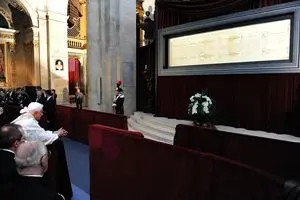
this is a long-awaited moment for me. On several other occasions I have found myself in front of the Holy Shroud, but this time I experience this pilgrimage and this stop with particular intensity: perhaps because the passing of the years makes me even more sensitive to the message of this extraordinary Icon; perhaps, and I would say above all, because I am here as Successor of Peter, and I carry in my heart the whole Church, indeed, all humanity.
I thank God for the gift of this pilgrimage, and also for the opportunity to share with you a short meditation, which was suggested to me by the subtitle of this solemn Exposition: “The mystery of Holy Saturday”. It can be said that the Shroud is the Icon of this mystery, the Icon of Holy Saturday. In fact it is a burial cloth, which wrapped the body of a crucified man in full correspondence with what the Gospels tell us about Jesus, who, crucified around midday, died around three in the afternoon.
When the evening came, since it was the Preparation Day, that is, the eve of the solemn Easter Saturday, Joseph of Arimathea, a rich and authoritative member of the Sanhedrin, courageously asked Pontius Pilate to be able to bury Jesus in his new tomb, which he had had dug into the rock not far from Golgotha. Having obtained permission, he bought a sheet and, having taken the body of Jesus off the cross, he wrapped it in that sheet and placed it in that tomb (see Mark 15:42-46).

This is what the Gospel of Saint Mark reports, and the other Evangelists agree with him. From that moment, Jesus remained in the tomb until dawn on the day after the Sabbath, and the Shroud of Turin offers us the image of what his body was like lying in the tomb during that time, which was short chronologically (about a day and a half), but was immense, infinite in its value and meaning.
Holy Saturday is the day of God’s hidingas we read in an ancient Homily: “What has happened? Today on earth there is great silence, great silence and solitude. Great silence because the King sleeps… God died in the flesh and came down to shake the kingdom of hell” (Homily on Holy Saturday, PG 43, 439). In the Creed, we profess that Jesus Christ “was crucified under Pontius Pilate, died and was buried, descended into hell, and on the third day rose again from the dead.”
The hiddenness of God is part of the spirituality of contemporary man
Dear brothers and sisters, in our time, especially after having crossed the last century, humanity has become particularly sensitive to the mystery of Holy Saturday. The hiddenness of God is part of the spirituality of contemporary man, in an existential, almost unconscious way, like a void in the heart that has continued to widen more and more.
At the end of the 19th century, Nietzsche wrote: “God is dead! And we have killed him!”. This famous expression, upon closer inspection, is taken almost literally by the Christian tradition, we often repeat it in the Via Crucis, perhaps without fully realizing what we are saying.
After the two world wars, the concentration camps and gulags, Hiroshima and Nagasaki, our era has increasingly become a Holy Saturday: the darkness of this day challenges all those who question themselves about life, in a particular way it challenges us believers.
We too are dealing with this darkness. And yet the death of the Son of God, of Jesus of Nazareth, has an opposite aspect, totally positive, a source of consolation and hope. And this makes me think of the fact that the Holy Shroud behaves like a “photographic” document, equipped with a “positive” and a “negative”. And in fact it is exactly like this: the darkest mystery of faith is at the same time the brightest sign of a hope that has no boundaries.
Holy Saturday is the “no man’s land” between death and resurrection, but One, the Only One, entered this “no man’s land” and crossed it with the signs of his Passion for man: “Passio Christi. Passio hominis”. And the Shroud speaks to us exactly about that moment, it testifies precisely to that unique and unrepeatable interval in the history of humanity and the universe, in which God, in Jesus Christ, shared not only our dying, but also our remaining in death. The most radical solidarity.
In that “time-beyond-time” Jesus Christ “descended into hell”. What does this expression mean? It means that God, having become man, reached the point of entering the extreme and absolute solitude of man, where no ray of love reaches, where total abandonment reigns without any words of comfort: “the underworld”.
Jesus Christ, remaining in death, crossed the door of this ultimate solitude to guide us too to cross it with Him. We have all sometimes felt a frightening sensation of abandonment, and what scares us most about death is precisely this, just as as children we are afraid of being alone in the dark and only the presence of a person who loves us can reassure us.

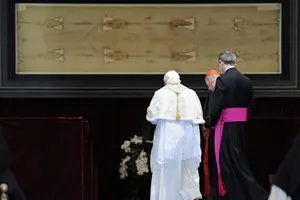
Behold, this is exactly what happened on Holy Saturday: the voice of God resounded in the kingdom of death. The unthinkable has happened: that is, that Love has penetrated “the underworld”: even in the extreme darkness of the most absolute human solitude we can hear a voice calling us and find a hand that takes us and leads us out. The human being lives because he is loved and can love; and if love has penetrated even into the space of death, then life has arrived there too. In the hour of extreme solitude we will never be alone: ”Passio Christi. Passio hominis”.
Life now pulsates within death, as love dwells there.
This is the mystery of Holy Saturday! Right there, from the darkness of the death of the Son of God, the light of a new hope emerged: the light of the Resurrection. And behold, it seems to me that looking at this sacred Cloth with the eyes of faith we perceive something of this light. In fact, the Shroud was immersed in that deep darkness, but is at the same time luminous; and I think that if thousands and thousands of people come to venerate it – without counting those who contemplate it through images – it is because they not only see darkness in it, but also light; not so much the defeat of life and love, but rather the victory, the victory of life over death, of love over hate; they see the death of Jesus, but they glimpse his Resurrection; life now pulsates within death, as love dwells there.
This is the power of the Shroud: from the face of this “Man of Sorrows”which carries within itself the passion of man of every time and every place, even our passions, our sufferings, our difficulties, our sins – “Passio Christi. Passio hominis” -, from this face emanates a solemn majesty, a paradoxical lordship. This face, these hands and these feet, this side, this whole body speaks, it is itself a word that we can listen to in silence. How does the Shroud speak? Speak with blood, and blood is life!
The Shroud is an Icon written in blood; blood of a man scourged, crowned with thorns, crucified and wounded in the right side.
The image imprinted on the Shroud is that of a dead man, but the blood speaks of his life. Every trace of blood speaks of love and life. Especially that abundant stain near the side, made of blood and water that came out copiously from a large wound caused by a blow from a Roman spear, that blood and that water speak of life.
It is like a spring that murmurs in the silence, and we can hear it, we can listen to it, in the silence of Holy Saturday. Dear friends, let us always praise the Lord for his faithful and merciful love. Starting from this holy place, we carry the image of the Shroud in our eyes, we carry this word of love in our hearts, and we praise God with a life full of faith, hope and charity. Thank you.