



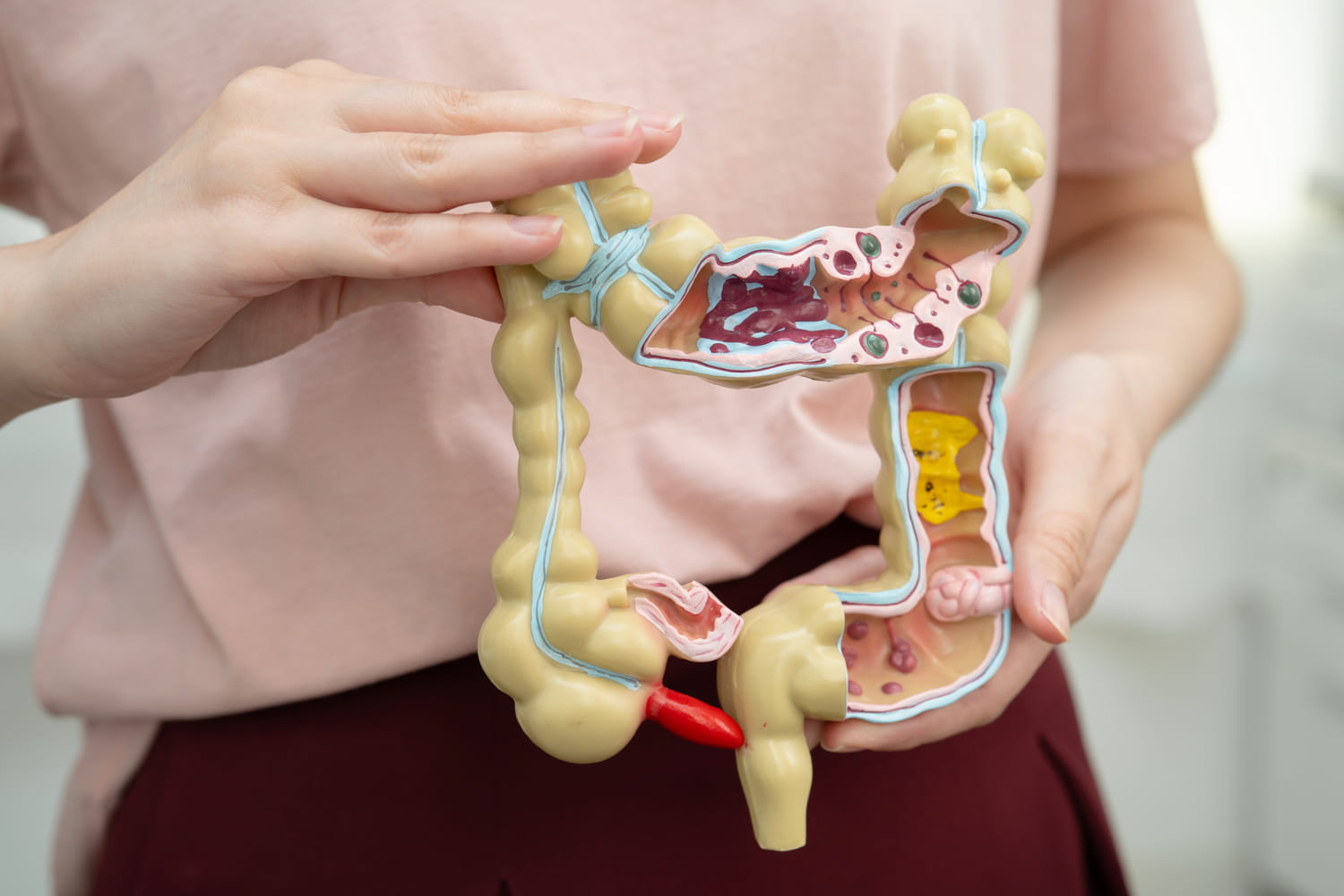


Colorectal cancer is the 2nd deadliest cancer in France. However, when it is diagnosed early, it can be cured in 90% of cases. Everything you need to know about colorectal cancer.
With more than 47,000 new cases diagnosed each year in France, colorectal cancer is among the most common cancers in adults: it ranks 3rd in men and 2nd in women. He is responsible for more than 17,000 deaths per year, making it the second cause of cancer mortality in men and the third in women. In total, it is today the second deadliest cancer in the country. However, when it is detected at an early stage, it can be cured in 9 out of 10 cases. Hence the importance of screening.
Definition: what is colorectal cancer?
“It is a malignant tumor that affects the colon or rectumexplains Professor Philippe Marteau, hepato-gastro-enterologist at Saint-Antoine Hospital in Paris. Colon cancer is a cancer that develops from mucosal cellsthe inner wall, of the colon. Nine times out of 10, it occurs degeneration of a lesion benign: a polyp adenomatous. Polyps are potentially precancerous lesions, hence their frequent removal as a preventative measure. “Chronic inflammatory bowel diseases such as Crohn’s disease or ulcerative colitis also carry a high risk of developing colorectal cancer.“, adds the practitioner.
Colorectal cancer stage 0, 1, 2, 3 or 4: what does it mean?
The stage (extent or degree of extension of the cancer) is understood on a scale from 0 to 4. Stages 0, I and II correspond to localized cancers, limited to the colon. In this case, no lymph nodes are affected and there are no metastases.
- stage 0: the tumor is small and non-threatening, it has not progressed beyond the mucosa
- stage 1: the tumor has invaded the superficial layers of tissue of the colon or rectum, but has not reached surrounding tissues
- stage 2: the tumor has penetrated the wall and invaded neighboring organs without affecting the lymph nodes;
- stage 3: cancers that have reached one or more lymph nodes close to the colon or rectum but without reaching distant organs
- stage 4: cancers that have metastasized, meaning the tumor has spread to distant locations, most often to the liver, lungs or ovaries.
At what age especially?
The average age of diagnosis of colorectal cancer is 71 years for men and 72 years for women. France is among the regions at high risk of colorectal cancer, as are other countries in Western Europe, North America and Australia. Africans and Asians are much less affected.
What are the causes of colorectal cancer?
Most colorectal cancers are adenocarcinomas and result from the cancerization of an adenoma, that is to say a benign tumor. This transformation can be favored by many external factors such as:
- age (from 50 years old),
- overweight and obesity
- sedentary lifestyle,
- excessive alcohol consumption,
- smoking,
- a diet rich in red meat and cold meats and poor in plants,
- history of colorectal cancer,
- inflammatory bowel diseases,
- heredity
“There is a very high risk of colorectal cancer in cases of genetic diseases such as Lynch syndrome or familial adenomatous polyposis.“, adds Philippe Marteau.
What are the symptoms of colorectal cancer?
“The symptoms are late: they only appear when the disease is advanced. In particular, you should be very careful about blood in the stools. We may also observe intestinal transit disorders, constipation or diarrhea and stomach pain.“, explains Philippe Marteau. Often, at this stage, the presence of metastases is detected. As in many cancers, the symptoms are not specific. Their chronicity, the increase in their frequency and their intensity requires medical advice. Colorectal cancer, when untreated, can spread to the liver, lymph glands and other parts of the body (metastases).
“Screening is done differently depending on the patient’s risk level”recalls Philippe Marteau. For people without symptoms or particular risk factors, the national program provides for screening organized every two years.between 50 and 74 years old. Both men and women receive an invitation by Health Insurance letter. The proposed test is an immunological test of testing for occult blood in stools. It can simply be done at home using a kit. The sample is then sent by post to the laboratory. The result is generally communicated within a fortnight. In the event of a positive test, a colonoscopy should be scheduled quickly to look for a polyp or tumor.
To facilitate participation, several methods of access to the kit exist: it can be given by the attending physician, ordered directly online after receipt of the invitation letter, or delivered in pharmacy. If there is a personal or family history or digestive symptoms, a colonoscopy may be offered immediately, outside of organized screening. “For the high risk patients (ulcerative colitis, first-degree family history), or at very high risk (Lynch syndrome or familial adenomatous polyposis), screening is carried out earlier and repeated more regularly“, specifies the gastroenterologist.
In the event of suggestive symptoms, the doctor may be required to perform a rectal examination, because the Rectal tumors are sometimes palpable with the finger. But the most important examination in this context of suspicion is colonoscopy, which visualizes the interior of the rectum and colon. Often performed under general anesthesia, it allows the study of the mucosa and the location of polyps or other suggestive lesions. It also allows samples to be taken to study the lesion, but also to remove polyps, lesions that potentially develop into cancer. After analysis, if cancer is confirmed, an extension assessment is carried out, which corresponds to carrying out various examinations to look for involvement of lymph nodes or other organs through migration of cancer cells.
What are the treatments to treat colorectal cancer?
Surgery and operation: Therapeutic management of colorectal cancer depends on several parameters: age and general condition of the patient, typology of the cancer, size and location of the tumor, possible presence of metastases, etc. When this is possible, the use of surgery is preferred. This method makes it possible to remove the tumor as well as part of the surrounding tissues in order to limit the risk of recurrence. It is most often performed laparoscopically. “We can be satisfied with this intervention if the tumor has not spread“, explains Philippe Marteau.
Colostomy: creation of an artificial anus: Only in very rare cases is a colostomy, the creation of an artificial anus, necessary. It is possible that chemotherapy sessions may be recommended before, or especially after, the operation in order to reduce the size of the tumor or avoid recurrence. Radiotherapy is only used for rectal cancer.
Radiotherapy and chemotherapy: “There are now targeted therapies, which block the receptors of molecules necessary for the survival of the tumor“, explains the gastroenterologist. Maintaining regular physical activity and a diversified diet is obviously recommended. In addition, research is underway on the intestinal microbiota. But for the moment, neither probiotics nor food supplements have proven effective.
What is the life expectancy?
According to figures from the National Cancer Institute, survival from colorectal cancer is 63% at 5 years (62% in men, 65% in women). The mortality rate decreased by -2% per year on average for men and -1.5% for women between 2012 and 2022.
It is possible to avoid colorectal cancer in particular by adopting an appropriate lifestyle with a healthy diet (little red meat, cold meats and grilled meats, but rather fish, whole grains, fruits and vegetables), regular exercise, and stopping smoking and alcohol. The development of screening by looking for blood in stools from the age of 50 allows early suspicion of these cancers. Furthermore, a colonoscopy in case of the slightest doubt or if a person in the family has had colorectal cancer also allows this early discovery. In certain familial forms such as familial adenomatous polyposis, early removal of the polyps is essential.
Thanks to Professor Philippe Marteau, hepato-gastroenterologist at Saint-Antoine Hospital in Paris.