


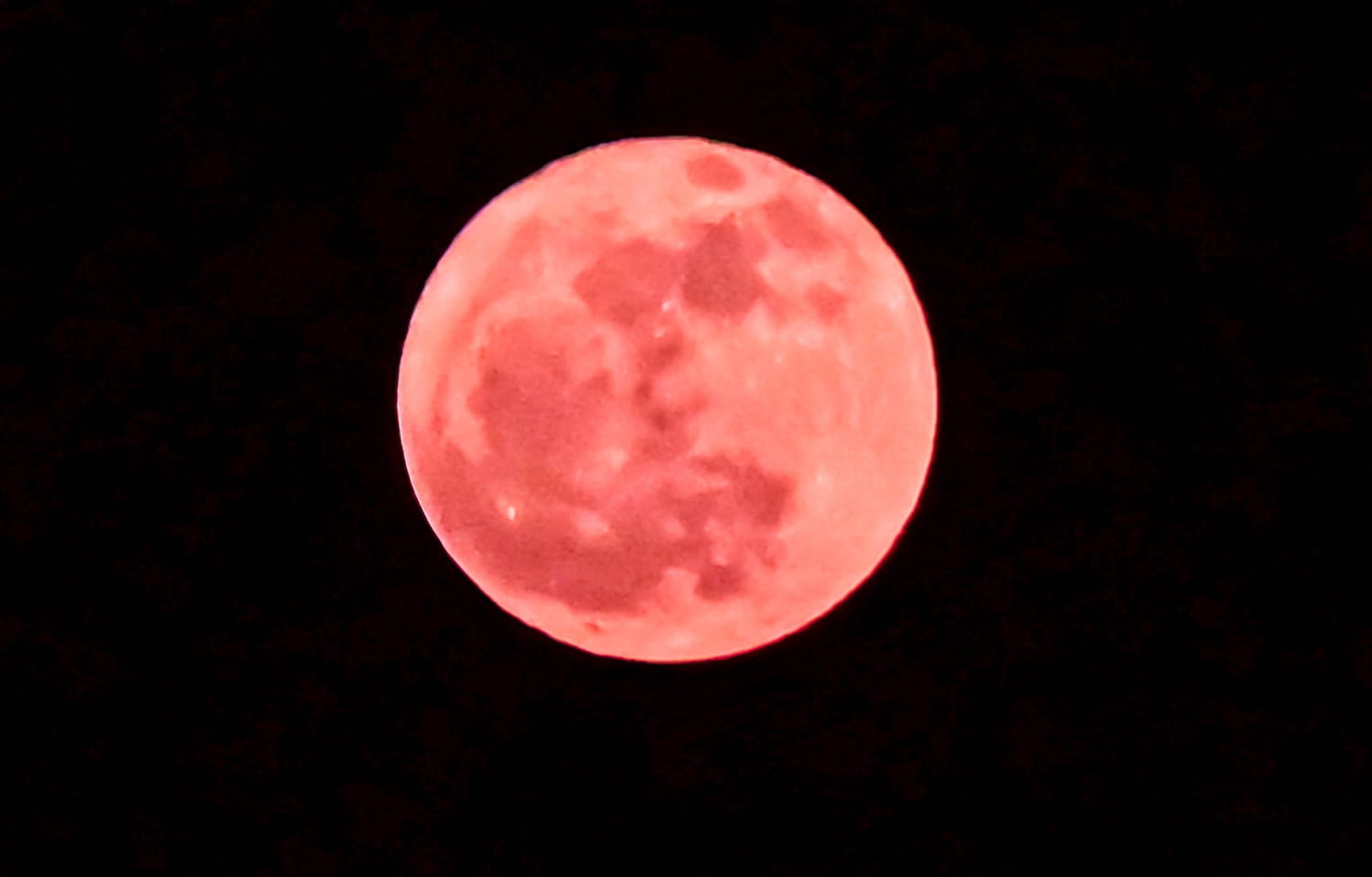
The night sky will host the traditional “Strawberry Moon”, a flamboyant celestial event with amber reflections which beautifully celebrates the arrival of summer.
Every month, astronomy enthusiasts impatiently await the Full Moons. After the Pink Moon of April or the famous Blue Moon of May, a new astronomical event is preparing to light up the night sky: the appearance of the Strawberry Moon. This phenomenon, which traditionally marks the arrival of summer, is an unmissable event for sky observers. The last time we were able to admire this setup was in June of last year, providing a spectacle that is always highly anticipated.
We call the Full Moon “Strawberry Moon” which traditionally occurs during the month of June. The origin of this name comes from Native American tribes who used this celestial landmark to mark the wild strawberry harvest period in North America. Contrary to what its poetic name suggests, the Moon will not suddenly transform into a giant fruit or turn a bright scarlet red. In fact, due to its low trajectory on the horizon at this time of year, its light passes through a thicker layer of atmosphere, which can give it a nicely golden, coppery, or slightly amber hue when it rises.
This celestial meeting will take place on the night of Monday June 29 to Tuesday June 30, 2026 according to astronomical data from the IMCCE (Institute of Celestial Mechanics and Ephemeris Calculation) of the Paris Observatory. That night, the night star will be particularly visible and will reach its ideal fullness for observation. To enjoy the spectacle, no special precautions are necessary: observing the Moon is completely harmless to the eyes, unlike solar eclipses. We can therefore admire it with the naked eye, without any instrument or special glasses.
For the best experience, it’s best to stay away from the light pollution of big cities, although the Moon is bright enough to be seen from anywhere. A simple pair of binoculars or a small amateur telescope helps you admire the details of craters and lunar “seas” tinged with warm reflections. To spot it, simply look up towards the southeast horizon as soon as the Sun sets, the Moon crossing the sky at low altitude throughout the night.
Since this Full Moon almost coincides with the summer solstice (which takes place on June 21), it celebrates the entry into the summer season in style. It’s a perfect opportunity for a night out or a wake with family or friends, before handing over to the next Full Moon of the summer, the Deer Moon, which will take place in July.