
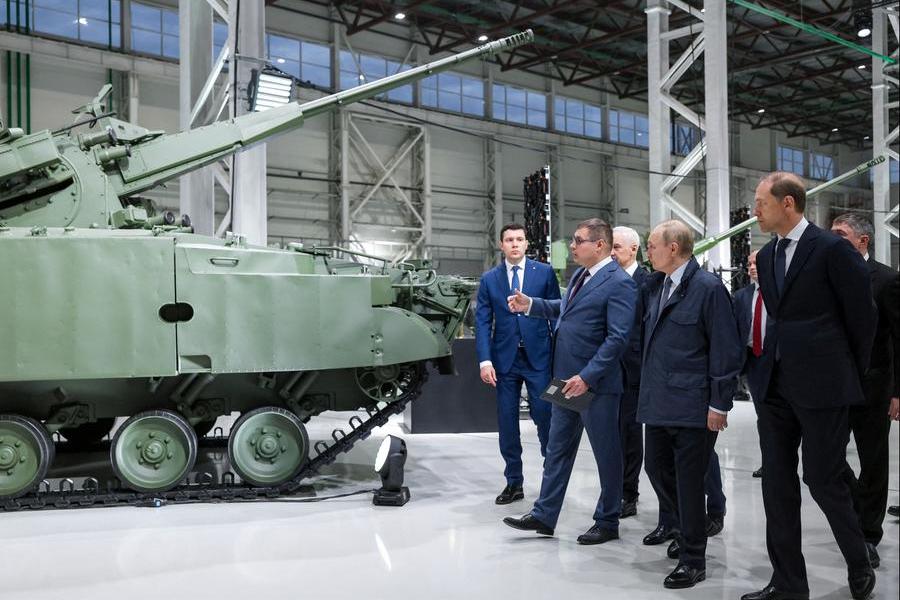




The global arms trade continues to grow and has been driven primarily by Europe in recent years. According to the new report published by Stockholm International Peace Research Institute (Sipri), the volume of international arms transfers increased by 9.2% comparing the five-year period 2016-2020 with that of 2021-2025.
The overall figure is mainly pushed up by European imports, which have more than tripled compared to the previous period, making the continent the main area in the world for the volume of weapons received.
The war in Ukraine and the perception of the Russian threat
The main factor explaining this increase is the war unleashed by Russia against Ukraine. Kyiv alone absorbed 9.7% of all global arms transfers in the analyzed period.
The conflict and the fear of a possible expansion of the war have pushed many European countries to rapidly strengthen their defense systems.
“While tensions in Asia, Oceania and the Middle East continue to drive high demand, the jump in supplies to European states has increased the global total by almost 10%,” he explains Mathew George, director of the Sipri Arms Transfers program.
“Deliveries to Ukraine starting in 2022 are the most obvious factor, but most individual EU states have nevertheless initiated significant rearmament in response to the perceived threat from Russia,” he adds.
Increasingly dominant United States
The report also highlights the strengthening of US leadership in the global arms market. In the five-year period 2021-2025, Washington covered 42% of all international arms transfers, compared to 36% in the previous period, supplying 99 countries on five continents.
U.S. exports increased 27% overall, with particularly marked growth towards Europe, where deliveries rose by as much as 217%. “European states continued to purchase American systems, in particular combat aircraft and long-range air defenses, despite the growth of domestic production and the European Union’s new incentives for the defense industry,” observes researcher Katarina Djokic. Second Pieter Wezemansenior researcher at Sipri, «the United States has further strengthened its leadership».
«For buyers, American weapons offer advanced technologies and a privileged channel for diplomatic relations; for Washington, exports are a foreign policy tool and a driving force for the defense industry”, he underlines. For the first time in twenty years, the largest share of US exports went to Europe (38%) and not the Middle East (33%). However, the single largest customer remains Saudi Arabia, with 12% of purchases.

The collapse of Russian exports and the rise of Israel
Among the world’s major suppliers, Russia is the only country to have recorded a sharp decline. Its arms exports fell by 64%, with the global share falling from 21% to 6.8%. However, the trajectory of Israel is different, as it has become the seventh largest arms exporter in the world. Its share rose from 3.1% to 4.4%, overtaking the UK for the first time. “Despite the war in Gaza and operations on multiple fronts, the Israeli arms industry has continued to grow,” comments researcher Zain Hussain.
Asia still the second largest import area
On the regional import front, Asia and Oceania remain the second world area with 31% of the total, even if they recorded a 20% decline compared to the previous five years.
The figure is mainly due to the sharp reduction in purchases from China, whose imports collapsed by 72% thanks to the development of domestic production. For the first time since the period 1991-1995 Beijing has thus left the world top ten importers.
Purchases from South Korea (-54%) and Australia (-39%) also decreased. “Fears about China’s intentions influence the rearmament of many Asian countries, which remain largely dependent on foreign supplies,” observes the senior researcher Siemon Wezeman. “The imported weapons also played a direct role in the 2025 clash between India and Pakistan, both equipped with nuclear arsenals,” he adds.
The other regions of the world
In the rest of the world the trends are more differentiated. In the Middle East, imports fell by 13%, while in Africa purchases of heavy weapons fell by 41%. In the Americas, however, there was an overall increase of 12%, with the United States absorbing 52% of the regional total. South America recorded an increase of 31%, driven above all by Brazil, whose imports grew by 150%.
Weapons as an instrument of foreign policy
According to SIPRI researchers, the arms trade cannot be interpreted only as an economic activity. It is also a central tool in international relations. The institute’s database, the scholars explain, “is the only public resource that provides consistent information on all international transfers of heavy weapons, including sales, donations and licensed production, between states, international organizations and non-state groups since 1950.” The data, further specifies, “they reflect the volume of arms transfers, not their financial value.”
The report just released is the second of three data releases that will be included in the Sipri yearbook, the new edition of which will be published in mid-2026.


Peace and Disarmament Network: «Unprecedented arms race»
The Sipri data also sparked a reaction from the Italian Peace and Disarmament Networkwhich he reads in the new statistics «a merciless mirror of the direction taken by Europe and Italy: that of an unprecedented arms race, which enriches the military-industrial-financial complex but builds neither real security nor autonomy.”
According to the pacifist network, the 9.2% increase in international arms transfers between the five-year period 2016-2020 and 2021-2025 represents «the most significant leap of the last decade» and has European rearmament at its center. Armaments imports into the continent have in fact grown by 210%, more than tripling compared to the previous period, leading Europe to represent 33% of the global total and to become, for the first time since the 1960s, the main area of the world for military acquisitions.
Military support to Ukraine, which alone absorbed 9.7% of global transfers, has certainly accelerated this dynamic. However, observes the Peace and Disarmament Network, the data shows that “almost all European states have massively and autonomously increased their armament imports”. In particular the 29 European NATO countries increased purchases by 143%, sign of a structural tendency towards rearmament.
The pacifist network also contests the political narrative according to which this process is part of a path towards European strategic autonomy. “The Sipri numbers demonstrate exactly the opposite,” he states. Almost half of the weapons imported by European states (48%) come from the United States, a share that rises to 58% among European NATO countries alone. At the same time, Washington strengthened its global leadership, increasing its share of exports from 36% to 42% of the global total. For the first time in twenty years, the network underlines, “the main destination of American military exports is no longer the Middle East but Europe”, with an increase in supplies to the continent of 217%. An emblematic example is represented by the acquisition programs for the fifth generation Lockheed Martin F-35 Lightning II fighter: twelve European countries have ordered or selected 466 examples.
The case of Italy
In this scenario the Italian case also emerges strongly. Sipri data indicates that Italy has recorded one of the fastest growths among large arms exporters: exports increased by 157% between the two five-year periods analysed. This leap took the country from tenth to sixth place in the world ranking of arms suppliers, with a share of 5.1% of the global market. Italy thus ranks ahead of countries such as Israel, the United Kingdom, South Korea and Spain.
The main destinations of Italian military exports, observes the Peace and Disarmament Network, also show how the majority of sales are directed outside Europe: 59% of exports go to the Middle East, in particular to Qatar (26%) and Kuwait (17%). Another 16% is destined for Asia and Oceania, with Indonesia playing a significant role (12%), while only 13% remains in Europe.
For the pacifist network, these numbers “disprove the thesis according to which the Italian military industry would be penalized by stricter controls than other European countries”. On the contrary, activists point out, «Italian exports have grown faster than those of many international competitors, a sign that there is no competitive disadvantage linked to the control rules”.
The reference is to the discussion on the possible revision of the law regulating Italian military exports, the Law 185/1990. According to the Peace and Disarmament Network, «using the argument of competitiveness to reduce transparency and controls means ignoring the data. If the Italian military industry is growing at record rates what is needed is no less control, but if anything more transparency and greater political responsibility on the destinations of the weapons”.
In light of these data, the network relaunches the campaign “No more favors for arms dealers”asking to maintain and strengthen the control mechanisms provided for by Italian legislation. «At a time when the global arms market is booming», they conclude, «weakening the rules on transparency and exports to countries involved in conflicts or responsible for human rights violations would be a politically and morally irresponsible choice».