






We publish the full text of Pope Leo XIV’s Message for Lent 2026 entitled Listen and fast. Lent as a time of conversion.
Dear brothers and sisters,
Lent is the time in which the Church, with maternal solicitude, invites us to put the mystery of God back at the center of our lives, so that our faith regains momentum and our hearts are not lost among the anxieties and distractions of every day.
Every path of conversion begins when we allow ourselves to be reached by the Word and we welcome it with docility of spirit. There is a link, therefore, between the gift of the Word of God, the space of hospitality that we offer it and the transformation that it brings about. For this reason, the Lenten itinerary becomes a favorable opportunity to listen to the voice of the Lord and renew the decision to follow Christ, traveling with Him on the road that leads to Jerusalem, where the mystery of his passion, death and resurrection is fulfilled.
Listen
This year I would like to draw attention, first of all, to the importance of giving space to the Word through listening, since the willingness to listen is the first sign with which the desire to enter into relationships with others is manifested.
God himself, revealing himself to Moses from the burning bush, shows that listening is a distinctive trait of his being: “I have observed the misery of my people in Egypt and I have heard their cry”. Listening to the cry of the oppressed is the beginning of a story of liberation, in which the Lord also involves Moses, sending him to open a way of salvation for his children reduced to slavery.
He is an engaging God, who today also reaches us with thoughts that make his heart vibrate. For this reason, listening to the Word in the liturgy teaches us to listen more truly to reality: among the many voices that cross our personal and social life, the Holy Scriptures enable us to recognize the one that arises from suffering and injustice, so that it does not go unanswered. Entering into this interior disposition of receptivity means letting oneself be taught today by God to listen like Him, to the point of recognizing that “the condition of the poor represents a cry which, in the history of humanity, constantly challenges our lives, our societies, political and economic systems and, last but not least, also the Church”.
Fast
If Lent is a time of listening, fasting is a concrete practice that prepares us to welcome the Word of God. Abstention from food, in fact, is a very ancient and irreplaceable ascetic exercise on the path to conversion. Precisely because it involves the body, it makes more evident what we are “hungry” for and what we consider essential for our sustenance. It therefore serves to discern and order the “appetites”, to keep alive the hunger and thirst for justice, taking it away from resignation, instructing it to be prayerful and responsible towards others.
Saint Augustine, with spiritual finesse, allows us to glimpse the tension between the present time and the future fulfillment that runs through this custody of the heart, when he observes that: «During earthly life it is up to men to hunger and thirst for justice, but being satisfied by it belongs to the other life. The angels are satisfied with this bread, this food. Men, on the other hand, are hungry for it, they are all eager for it. This reaching out in desire expands the soul, increases its capacity.” Fasting, understood in this sense, allows us not only to discipline desire, to purify it and make it freer, but also to expand it, in such a way that it turns to God and is oriented towards doing good. However, in order for fasting to preserve its evangelical truth and avoid the temptation to make the heart proud, it must always be lived in faith and humility. It asks us to remain rooted in communion with the Lord, because “those who do not know how to nourish themselves with the Word of God do not truly fast”. As a visible sign of our interior commitment to escape, with the support of grace, from sin and evil, fasting must also include other forms of deprivation aimed at making us acquire a more sober lifestyle, since “only austerity makes the Christian life strong and authentic”.
For this reason I would like to invite you to a very concrete and often little appreciated form of abstention, that is, from words that strike and hurt our neighbors. Let’s begin to disarm language, giving up sharp words, immediate judgement, speaking badly of those who are absent and cannot defend themselves, slander. Instead, let us strive to learn to measure words and cultivate kindness: in family, among friends, in the workplace, in social media, in political debates, in the media, in Christian communities. Then many words of hate will give way to words of hope and peace.

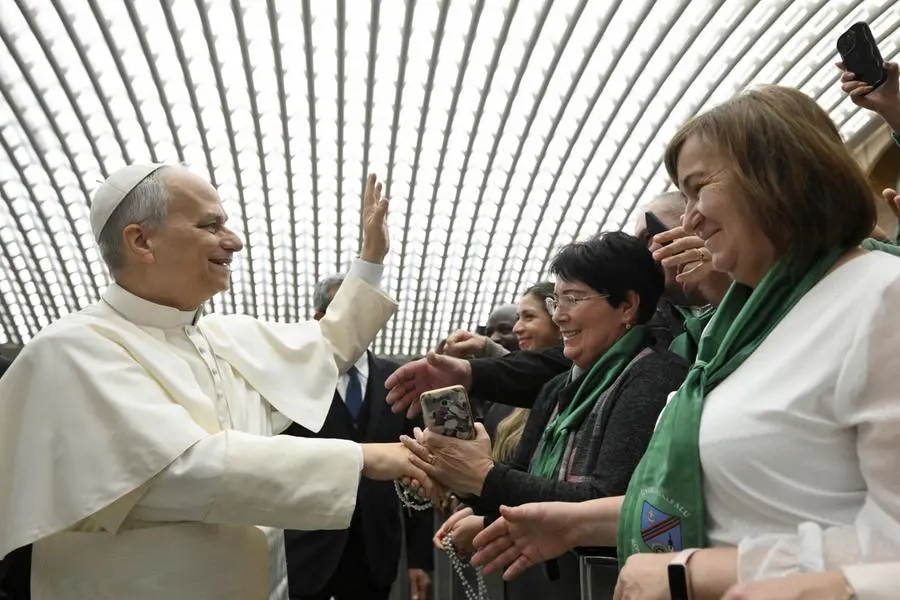
The Pope greeting some faithful
(HANDLE)
Together
Finally, Lent highlights the community dimension of listening to the Word and practicing fasting. Scripture also highlights this in many ways. For example, when it narrates, in the book of Nehemiah, that the people gathered to listen to the public reading of the book of the Law and, practicing fasting, prepared themselves for confession of faith and adoration, in order to renew the alliance with God.
In the same way, our parishes, families, ecclesial groups and religious communities are called to undertake a shared journey in Lent, in which listening to the Word of God, as well as the cry of the poor and the earth, becomes a form of common life and fasting supports real repentance. In this horizon, conversion concerns, in addition to the conscience of the individual, also the style of relationships, the quality of dialogue, the ability to allow oneself to be questioned by reality and to recognize what truly guides desire, both in our ecclesial communities and in humanity thirsty for justice and reconciliation.
Dear ones, let us ask for the grace of a Lent that makes our ears more attentive to God and to the least. We ask for the strength of a fast that also crosses the tongue, so that the words that hurt decrease and the space for the voice of the other grows. And let us commit ourselves to ensuring that our communities become places where the cry of those who suffer is welcomed and where listening generates paths to liberation, making us more ready and diligent in contributing to building the civilization of love.
I heartily bless all of you and your Lenten journey.
From the Vatican, 5 February 2026, memory of Saint Agatha, virgin and martyr.
LEO PP. XIV