




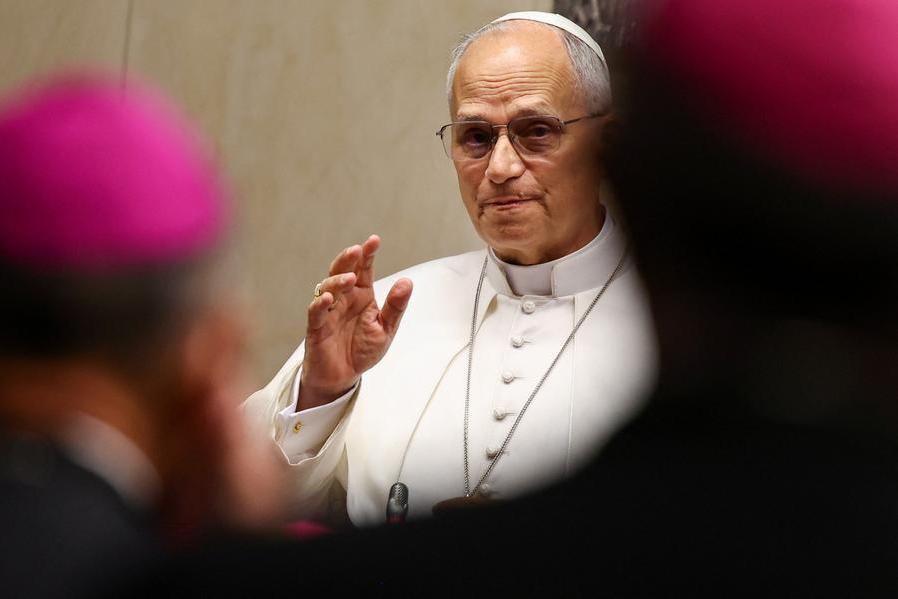
How to be “presence and dialogue in a society marked by rapid changes and strong secularization”? The bishops of the 69 dioceses that welcome the Pope to their headquarters are asking themselves this question, 60 years after the establishment of the Spanish Episcopal Conference. After his speech to Parliament, Leo XIV speaks to the Church. To say that the dialogue is part of the “synodal path undertaken by the Church”. A process of “deep listening” that makes us “welcome all the good that the Lord tells us through our brother”.
The Pope takes up the questions that the Church is asking itself through its Congresses which focus the theme on essential questions: «How can we face the current challenges? And who is called to accept this challenge?
Prevost proposes the image of a journey towards God “towards whom we lift our gaze”. For this journey we must avoid the temptation to be “obsessed with what we leave behind, places, things, forms, without opening ourselves, in docility to the Spirit, to the newness of what we find. Added to this temptation is that of luggage, which, for similar reasons, we fill with useless things that end up being a burden.” We learn something from the vicissitudes of migrants: «a single person, without roots and without resources, is someone who suffers terribly and who with great difficulty manages to establish solid bonds in the place where he arrives. In this way, in this first phase of our journey, our answer to the question of how we can face this challenge we have set ourselves must prudently combine freedom and courage, to abandon structures that do not help us, do not respond or even distance us from our goal, with the strength to preserve as a treasure what facilitates it”.
He underlines that Spain’s great Christian heritage must be included in the baggage. A heritage which, “with its beauty”, also reaches non-believers. And the pilgrim’s Viaticum must also be placed in the luggage. The Bread of the Word and of the Eucharist is even more necessary than material food, because it opens the path to salvation for us. It is not a question of how to make the celebration more or less attractive, but of feeling that, if we are partakers of that Bread, its absence causes us discomfort that we can compare to material hunger”. Another important thing during the journey is communication. Something that costs effort “both because of the different language and culture, and because of the distrust towards the unknown, and because of the arguments and misunderstandings that can occur even between close people, we feel limited in expressing ourselves or in understanding our interlocutor”.
And if it is true that we must abandon “everything that holds us back and distances us, now the task must be that our heritage is always a tool and an opportunity for dialogue with those we meet on our path”. Furthermore, as happens to the pilgrims of the Camino de Santiago, on our journey we can encounter those immense Castilian plains, empty in our eyes. The few meetings of these pilgrims with some elderly people or with foreign workers can be a metaphor for many social situations that unfortunately are perceived in some of your ecclesial realities”.
Even in the past, Spain found itself facing difficult challenges, such as when “the Church had to rebuild its presence in areas of devastated land, and models of evangelization emerged which were then exported to America”. Today those models can help us “build a new reality, through respectful dialogue and the use of new languages”,
The Pontiff aims for an outgoing Church, capable of mission and ecclesial reorganization. To recognize that “even the languages in this digital age are different and the cultures that now make up the mosaic of our realities, with migrants from all parts of the world, have changed, but the spirit must remain”. And the essential points of this spirit are “the ability to communicate, to speak with every reality present in our territory, to lower ourselves not only to understand, but to share”. Secondly, the Church “is the call to create realities capable of communicating their own experience of faith” through “listening, understanding, respect, generosity and frankness”.
In a time of increasingly harsh contrasts and polarizations, the Church is asked to bear witness to “unity in plurality: a communion capable of welcoming the richness of the gifts, of the charisms, of the sensitivities that the Holy Spirit arouses in the People of God. The face of Christ can be recognized in the living mosaic of the Church, where many pieces, without becoming confused, converge to manifest the beauty of the one Lord”.
In this composition the ministry of the bishop «takes on a peculiar responsibility. We are called to be a visible principle of communion, first and foremost of communion with Christ, safeguarding with love the faith received, in docility to the Word of God and the living Tradition of the Church; then, in communion with the Successor of Peter and with the universal Church, with the presbyterate and with one’s own diocesan community, with consecrated life, with movements, with associations and with every authentic charism that the Spirit gives for common edification”.
The mission of the bishops is “to safeguard unity, encourage dialogue, heal fractures and accompany the journey of the people entrusted to your care”. Furthermore, a reconciled Church will also be able to “speak with greater freedom to brothers of other Christian confessions and other religions, to those who do not believe, to civil authorities and to all men of good will who work for the common good”.
Another challenge is that of the «difficulty of making definitive commitments and making vital decisions. In many young people, and not only them, the question: “Who am I for?” resonates as a sincere search for meaning, belonging and gift. The human heart is not filled by accumulating experiences, possibilities or temporary guarantees: it is filled when it discovers a calling, when it understands that life reaches its fullness only if given.”
So vocational pastoral care «cannot be reduced to a simple search for numbers. It is born from living communities, from joyful priests, from families capable of bearing witness to the beauty of fidelity, from a Church that knows how to show with simplicity that following Christ does not impoverish existence, but expands it. Where the Gospel is lived with joy, service and communion, the call of the Lord can also be heard again as a promise of life.”
Returning to the image of the journey, the Pope recalls that «the pilgrims of the Camino de Santiago
they know well that only the essentials should be loaded into the backpack.” For this reason, in the current vocational context «it must be said that the conservation of structures cannot prevail over the good of the vocation. Seminarians have the right to the best possible training and the Church, for its part, has the right to well-trained priests. The criterion for seminaries to be authentic houses of formation is that they guarantee an adequate experience of community life; who have trainers totally dedicated to study and teaching, with experience in spiritual accompaniment; and that they have Higher Theology Centers equipped with the necessary means to carry out their function. To this end, it is essential, in addition to joining forces, to learn to work together in managing these challenges.”
We must also valorise the lay vocation. «We see how in many works, traditionally managed by religious people, lay collaborators are used in order to continue carrying out the work. It is a difficulty that we can transform into opportunities for meeting, dialogue and communication. It depends on us that these lay people come to perceive their participation in this ecclesial service as a call that God addresses to assume responsibilities as Christians, internalizing the spirit, feeling part of the mission that the Lord has entrusted to the religious who carried it out”.
Furthermore, the journey is made up of encounters, in particular with those who are wounded. The Pope speaks of moments of darkness, in particular the most painful one of all, when he meets «those who have been hurt by those who were supposed to care for them, even by members of the clergy. Faced with this plague, the ecclesial community is called to respond with listening, truth, justice, reparation and an increasingly decisive commitment to prevention and a culture of care. Every wounded person must be able to find sincere listening, acceptance, protection and real paths to healing.”
A logic that also applies to those who carry in their hearts «a profound thirst for meaning, for truth, for belonging and for hope, even when they cannot give it a name. The Church is called to recognize these desires, to listen to them with respect and to offer, like Peter and John to the paralytic near the door of the temple, the treasure that has been entrusted to her: Jesus Christ, in whose name man can rise and walk.”
It is necessary to restore to every person “the conviction of being loved”.
Finally, the Pontiff recalls that “the strength of the Church does not arise from the greatness of its means, but from the holiness of its children, from the communion of its pastors, from the humble and persevering faithfulness of those who allow themselves to be guided by the Spirit”. He asks us to look to Saint John of Ávila, patron saint of the Spanish clergy to accompany the clergy. «Our journey with them should convey the value of that essence: being priests in love with Christ, rooted in prayer, faithful to the Church, close to the people and capable of uniting solid doctrine, apostolic zeal and pastoral charity. Priests who find in the bishop not only a recognized authority, but a father who accompanies them; and in the other brother priests with whom we can share the hardships and joys of this pilgrimage full of encounters, in which we all seek Christ.”