




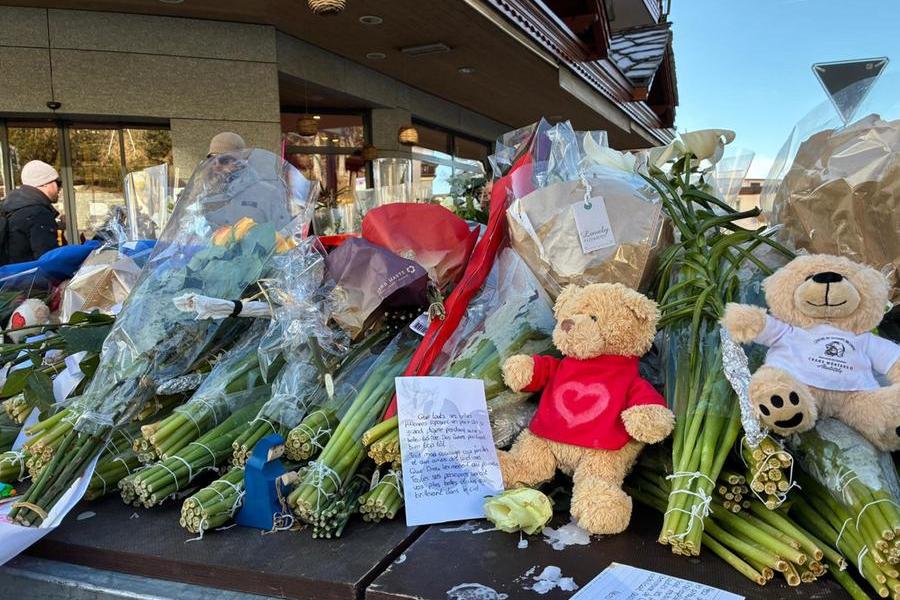
Yesterday, on the day of the funeral in Milan of the five victims of the Crans-Montana tragedy, a minute of silence passed through all Italian schools. It is precisely around this word – silence – that today they invite experts to pause, as a first step to accompany children through their paineven before looking for explanations, responsibilities, truths, even if they are necessary. “Pain has no voice, but it weighs,” wrote Cesare Pavese. And yesterday that weight was all in the classrooms of the Virgilio high school in Milan, in the first return after the Christmas holidays.
He entered the school, together with a task force of colleagues Ivan Giacomelpsychologist of the Order of Psychologists of Lombardy, called to support the classmates and teachers of the four Crans-Montana victims currently hospitalized: three at the Niguarda hospital, one in Zurich. «In this first phase of going through pain – he explains – the most important thing is not to talk or not talk about what happened, but to let the kids know that, if there is a need, there is someone willing to listen to them. It is essential to respect each other’s space and time, without forcing emotional openness: they will do it when and if they feel it.”
The third graders remained in class until the end of lessons. They did not attend the funeral. «I understand them», observes Giacomel. «Their companions are still alive, although seriously injured. Going to the funeral would have meant looking more closely at the possibility that they might die. It’s too big an emotional step right now.”
The atmosphere in the classroom was tense, full of an emotion that was difficult to name. Words struggled to find space. «There was more silence than language. They cried. And rightly so. He’s human.” The boys appeared exhausted, some immersed in deep emotional confusion. Yet, in that silence, unexpected reflections emerged: the theme of the fragility of the human being, of vulnerability. «These are thoughts that usually arrive in adulthood – underlines Giacomel – not at sixteen. Adolescence is the time of building identity, strength and security. Yesterday, however, we were on another level.” Precisely for this reason, the psychologist warns, it will be necessary to carefully monitor in the coming weeks how the children will process their emotions, in the dialogue between school and family.
The first meeting also served to outline some guidelines for the futureincluding what is best to avoid. “Telling kids ‘you have to be strong’ or ‘don’t cry’ is a directive and judgmental communication,” he explains. «If a child cries or doesn’t feel strong, he risks adding to the pain the fear of disappointing the adult. Emotions must be allowed to flow. Likewise, saying “everything will be fine” is often an unconscious way to avoid naming what is scary.”
The work also involved teachers. Many of them had been accompanying these kids for over two years; a deep bond had been created. «Some teachers were crying. It’s natural: the school is a community.” When asked how to behave – whether to continue the program or stop – Giacomel responded by inviting authenticity: «They have to do what they feel, explaining it to the kids. If a professor wants to address the topic that’s fine, if he prefers not to, that’s fine too. Children are perfectly capable of recognizing and understanding the fragility of adults.”
Mourning in adolescence has specific characteristics. «The brain of a teenager is not that of an adult. The ability to mentalize is still under construction, as is emotional regulation.” Emotions are more intense, overwhelming: anger, apathy, sadness can take on an absolute dimension. «For a teenager the emotion is eternal: if today I am sadI will always be. The world becomes a definitively hostile place.” Over time, trauma of this type can insinuate deep doubts in identity: can I trust the world? Can I feel safe? The risk is that the wound becomes a lens through which to read all of reality.
In this framework, the role of the peer group is crucial. «For a teenager, friends are fundamental, more than for an adult. But be careful: not all peers are friends.” The peer can be a powerful resource if there is an authentic connectionbut also a source of anxiety if the fear of judgment prevails. «In this class I perceived that they were friends in life too. And this is precisely what makes the pain even deeper.”
The next meeting at school is scheduled in two weeks. In the meantime, there remains that dense, necessary silence that does not require immediate answers. A silence that does not deny the pain, but preserves it.