

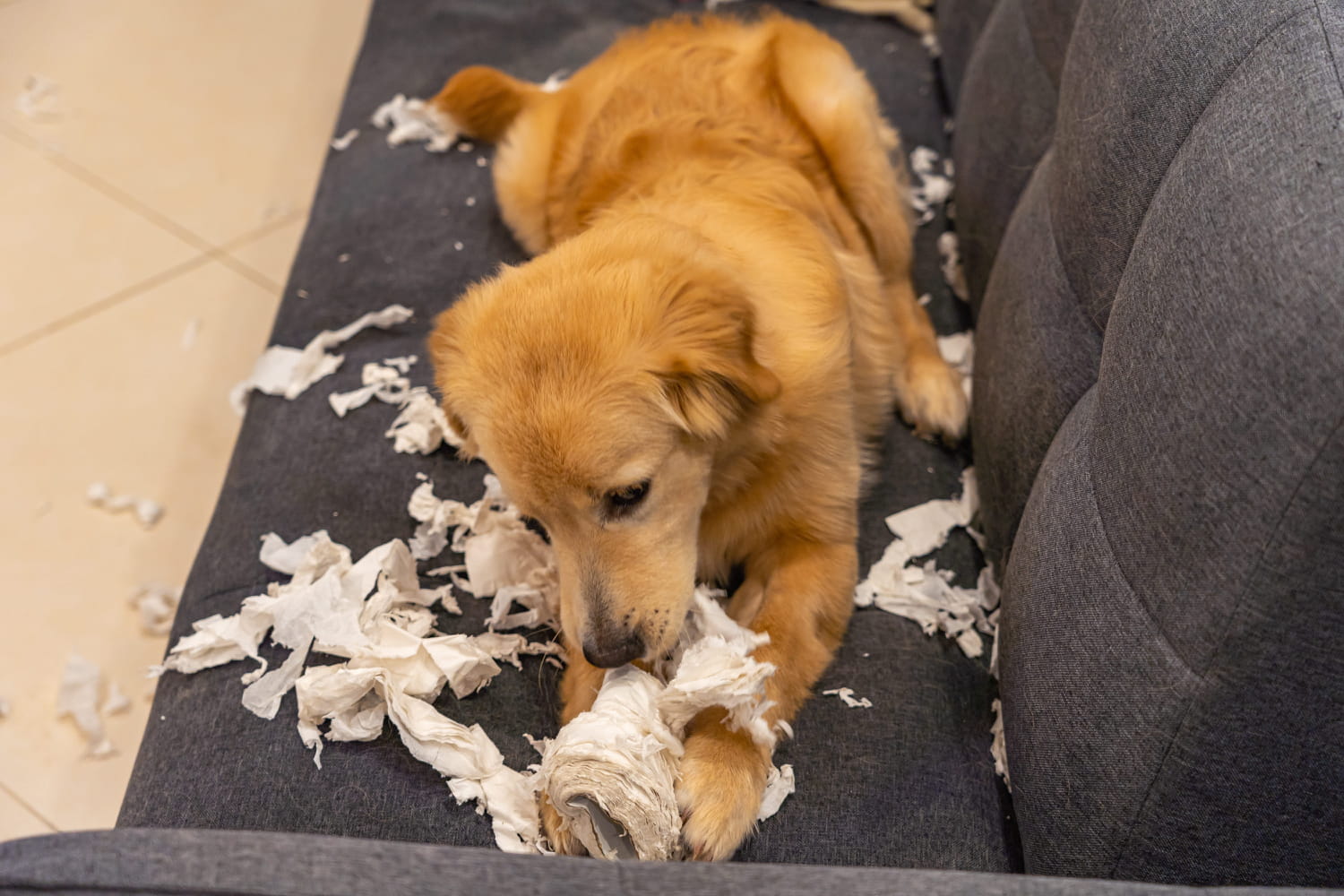




Sofa, shoes, trash can… A dog that destroys everything around him can be very difficult for his owner to manage. Dr Pierre Fabing explains the most common cause behind this behavior, and how to remedy it.
It’s a behavior that all dog owners dread. As adorable as it is, a doggie who chews the sofa, who tears up the cushions, who knocks over the trash can, who eats the shoes, or who tears down the curtains… It’s an ordeal for his master to bear. Especially when this destructive attitude continues into adulthood. Because when a puppy attacks furniture, we hope that it is just a phase that will pass over time, when he becomes calmer and has learned to manage his excess energy. However, some adult dogs still present this behavioral problem, and this is not trivial. Regardless of breed – some are more feisty than others by nature – this is a sign of real unhappiness in the dog.
“Destruction becomes a poison in the handler-dog relationship. We can tend to no longer have the right reactions, to want to yell at him when we come home. We have to come to understand that a dog that destroys is a dog that is doing badly”explains Dr Pierre Fabing. Destruction is not a simple matter of education: the cause is often much deeper.
“In 90 % of cases”the cause of destruction in dogs is loneliness, explains the emergency veterinarian. He is bored, and therefore fills a void by venting on the environment around him: “That means he doesn’t have enough daily interaction with his master.” Indeed, if a dog can stay alone for several hours during our working days, he still needs real quality and “active” with his master, for at least one hour per day. But Pierre Fabing reveals to us that we must also “teach him to be alone”. And it’s not just about leaving him alone regularly so that he gets used to it, it’s mainly about knowing how to implement these absences.
Contrary to what we all think, celebrating your dog when you come home is not always beneficial. “There is a way to leave the house, and there is a way to return. These outpourings of joy upon returning, or sadness upon leaving, are not necessarily good for the dog. It does not teach him the loneliness of the day. When he must be left alone, he must remain calm at that time”specifies the veterinarian. Thus, one of the solutions is in particular to “stay fairly neutral” when we leave and when we come back: “We sit down, we take off our shoes, we don’t even necessarily touch him. We sit down. The dog comes to see us, comes to sniff us. And once things have calmed down, we’ll move on to an exchange. There, we can cuddle.” But when the problem of destruction is already deeply established, Pierre Fabing offers other solutions.
First, it’s about spending a lot more time with your dog in the morning and evening: “If the dog is tired, because we ran with him, gave him orders, learned new things… It will stimulate him enough so that he accepts this period in the middle where he will have to be calmer.” But you also need to offer him something to do while his owner is away, including toys in which treats are hidden, for example, or other games that will require time and thought.
And for owners who have the budget, there is also the alternative of a dog-sitter, a person who will spend time with the dog during the day so that he is alone for less time. In cases where destructive behavior remains a real problem, the veterinarian recommends installing a dog park as a last resort: “Sometimes, for a while, it can be essential. But if there’s no stimulation, it’s just locking him into something where he can’t do anything, and that’s not going to help anything. It can be toys, but also music, TV channels, etc.” The key is to attack the cause, that is to say boredom, to remedy the dog’s discomfort… rather than arguing with him to save his sofa.