
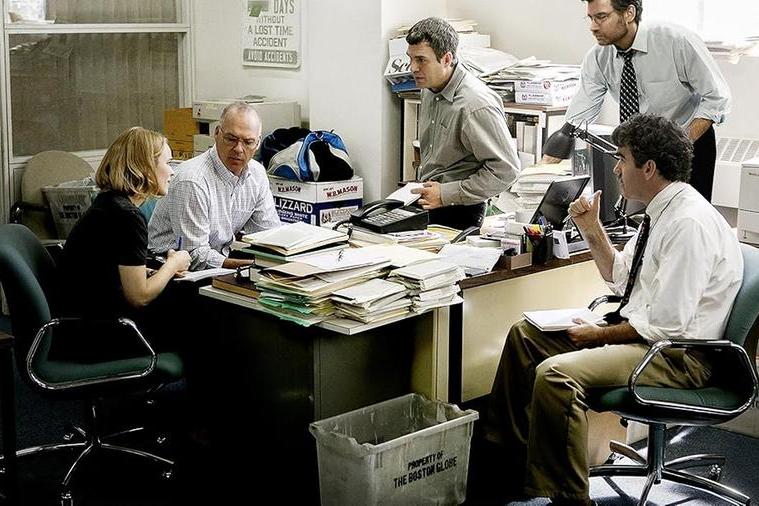




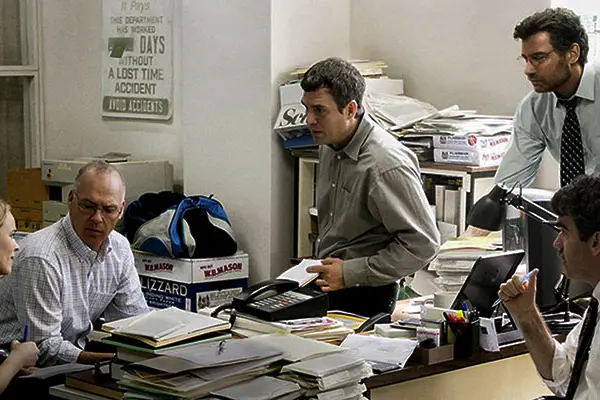
There is a watershed that marks a before and an after in the history of the contemporary Church with regards to the crime until which time it was tolerated and kept quiet, of pedophilia in ecclesiastical dress: the journalistic investigation carried out by the Spotlight team of the newspaper Boston globe in 2002 and which is reconstructed in the film Ithe Spotlight case of 2015, directed by Tom McCarthy, and winner of two Oscars (airing tonight on La 7 cinema). The S teampotlight (literally “reflector”) was created in 1970 by the journalist Timothy Leland, who had proposed to the director of the Boston Globe to create a team dedicated to investigative journalism. Despite initial skepticism, the group achieves great success investigating corruption and abuse. Then the initiative decayed but was relaunched in 2001 when he became executive director of Boston Globe Martin Baron, precisely for the investigation that later became known as the “Spotlight Case”, and for which in 2003, the Boston Globe received the Pulitzer Prize for service.

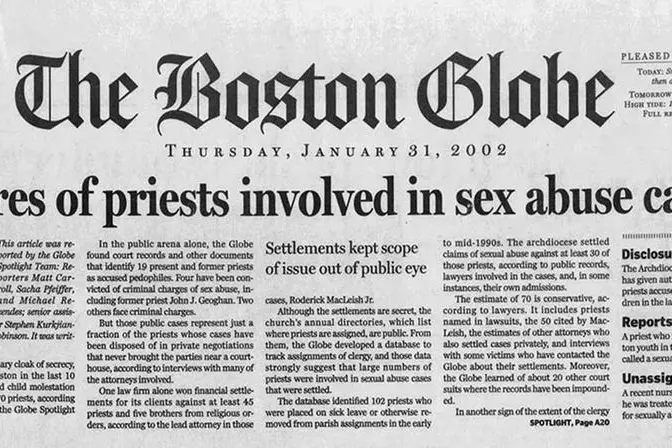
CHow Globe reporters brought the abuse to light
A very accurate reconstruction of how they actually took place was published in the international theological journal Concilium 4/2002 by Donald Dietrich, professor of Church history at Boston College (USA), and published in Italy on the website of Queriniana Editrice. We report a large excerpt of this precious reconstruction which was able to draw on first-hand documents:
On Saturday, July 29, 2001, Eileen McNamera wrote an article in the Boston Globe noting that a judge had sealed documents in a civil lawsuit filed against the Archdiocese of Boston and John Geoghan, a former priest accused of abusing more than 100 boys. By closing the cases in this way, McNamera rightly stated, the details of the archdiocese’s guilt would perhaps never have emerged. Up to that point, no Massachusetts newspaper had challenged the judge’s decision to seal the documents seven months earlier. Martin Baron, the new editor of the Globe, thought his newspaper should do it.
The Globe and Boston’s Catholic community had had a tense relationship since the 1970s, when the paper prioritized child abuse in its coverage of segregation issues, a problem that had a heavy impact on blue-collar Catholic communities close to the church. The accusations against Catholics reached a peak in 1992, following the Globe’s report on James Porter, a former priest accused of sexually abusing 28 children. Cardinal Bernard Law spoke angrily of sensationalism and complained, threatening: “We will invoke the power of God on the media, especially the Globe.”
In response to the Geoghan issue, the Globe staff reviewed nearly two decades of issues of the Boston Catholic Directory, an annual publication that listed about a thousand priests and their assignments. An unusual number of priests were reported to be “sick” or “awaiting assignment” for a year or two. Staff wondered whether “being out sick” might in some cases be a euphemism to hide sexual harassment issues. Geoghan seemed to fit the picture and so the basic parameters were set. By January 2002 it became clear that the list appeared to be an accurate indicator of problem priests.
On January 6, 2002, a front-page Globe article used internal documents from the archdiocese itself to show that Cardinal Law and others were aware of Geoghan’s serial sexual abuse.and yet they continued to put this priest in contact with boys. The Globe’s “Spotlight” team was flooded with a deluge of nearly 2,000 calls and emails from anguished people. Soon dIt became clear that over the past thirty years over 90 priests had allegedly been involved in cases of sexual harassment. Towards the end of January the Globe won its case and managed to have the Geoghan file opened. At this point almost ten thousand documents were available. ….

…. This is not just a problem for the United States. In Ireland for example (January 2002) the church agreed to pay 110 million dollars to compensate almost three thousand children victims of sexual abuse.
The Archdiocese of Boston therefore can be considered simply the tip of the iceberg, and the Globe together with the courts has studied the dimensions of the scandal hidden beneath the surface.
…. In January 2002 the Globe found that Geoghan had been transferred from one parish to another for thirty years, even though his superiors, theCardinal Law and Cardinal Madeiros knew with growing certainty that he was an incorrigible and serial sex offender.. It soon emerged that over the years in Boston alone, nearly 90 priests had been accused and protected. It later came to light that in the USA approximately 2,000 priests had been accused of sexual harassment over the past three decades and then transferred from one parish to another within their respective archdioceses.
…Cardinal Law and other prelates apologized for transferring these priests who had carried out criminal activities. Amid rumors of his resignation, Cardinal Law assured the faithful of his diocese (24 January 2002) that he would not resign. His decision was endorsed by the Vatican and other US cardinals, who met with the pope last April. In general, they feared that Law’s resignation would lead to a significant number of resignations of other bishops. Besieged by protesters and members of the media in front of his residence, and outside the Cathedral of the Holy Cross where he says mass on Sundays, the cardinal had increasingly become a “prisoner” and was forced to transfer to private planes or depart from non-Boston airports when he undertook his travels in the spring.
THEOn March 3, the Globe estimated that the cost to the archdiocese of settling all the lawsuits that were erupting would be around $100 million. QThis fact led the Archdiocese of Boston to announce, on June 17, that it would settle the cases for $30 million by choosing to address them through litigation, in which case the maximum criminal fine could not exceed twenty thousand dollars per person, rather than through private settlements. It has become clear that sexual abuse has been part of “church life” throughout the United States for decades. In March a bishop from Florida resigned from his position. When he was bishop of Bridgeport, Connecticut, Edward Egan, cardinal of New York, had admitted that about five years earlier he had encouraged a priest to continue his activity and had said he was willing to write a letter of recommendation for him, despite knowing that that priest had committed sexual abuse and was a self-confessed criminal….

How the story ended
THEand investigations by the Spotlight team led, among other things, to criminal charges against five priests Roman Catholics in the Boston, Massachusetts area (John Geoghan, John Hanlon, Paul Shanley, Robert V. Gale, and Jesuit priest James Talbot) who were all convicted and sentenced to prison. The Archdiocese of Boston agreed to pay $10 million to Geoghan’s victims, and in 2003 paid another $85 million to 552 victims and parents who had filed civil lawsuits over the ignored abuse. Overwhelmed by scandal Bernard Francis Law, who had been archbishop of Boston since 1984, resigned. Law resigned – after much pressure – because he was accused of not having publicly denounced the cases of pedophilia reported by the Boston Globe. In his place came Sean O’Malley, who had already dealt with cases of pedophilia in other dioceses. He remained archbishop until 2024. From 2014 to 2025 he was president of the Pontifical Commission for the Protection of Minors established by Pope Francis.