


There are now few direct witnesses of the Vatican Council II, those who can say “I was there”. One of these is Monsignor Severino Dianich, 91 years old, among the most authoritative voices of theological reflection in Italy over the last fifty years. At the time of the great ecumenical council, of which 8 December marks the 60th anniversary of its conclusion, he was only a young priest, not even thirty years old, but he was able to breathe deeply the climate of those days. Credere met him to share those memories with him.
Young theologian
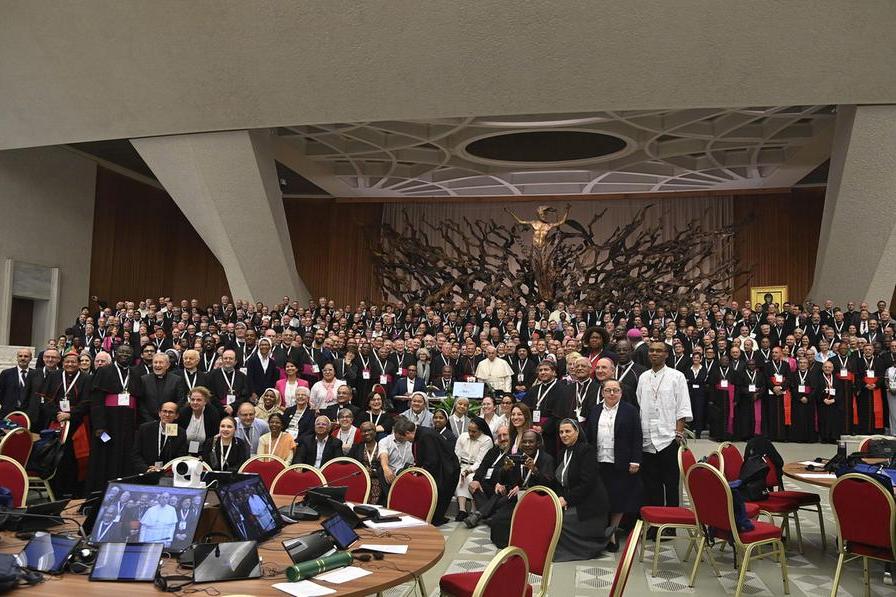
During the second session of the Council, which took place from 29 September to 4 December 1963, Don Severino was in the Vatican as secretary to the Archbishop of Pisa, Monsignor Ugo Camozzo. «I was a greenhorn», jokes Dianich, «but the secretaries were allowed to enter the basilica during the general assemblies. The effect was majestic: in the main nave the stands were set up on both sides with seats for the Council Fathers. The bishops wore the mozzettone, a very elegant purple cloak, open at the front, which covered the person up to the knees. The assemblies were long and it happened that we saw some bishop getting up to stretch his legs or go for a drink. And, I remember, many queued in front of the confessionals in the side aisles.” Precisely during the second session of the Council, on November 22, 1963, President Kennedy was assassinated. «The next day an atmosphere of terror was cut into slices. These were the years of the Cold War and the Catholic Church placed many hopes in him. Anything could happen following his death. I crossed the Cardinal Spellman, the archbishop of New York, who among other things was a family friend of the Kennedys. The anguish that came from his face remained in my eyes.” But, «to tell the truth», continues Dianich, «in addition to the hours spent in St. Peter’s, what happened around there was interesting. There were informal meetings of the different groups of bishops and theologians with lively and complex debates. Every day was a surprise. The Dominican Yves Congar, one of the most esteemed theologians, did not spare very harsh criticisms of the speeches he heard in the classroom and he did not like them. And then there was, for the first time, a debate among ecclesial public opinion, which followed the work of the Council with interest in the newspapers.”
A novelty for the Church
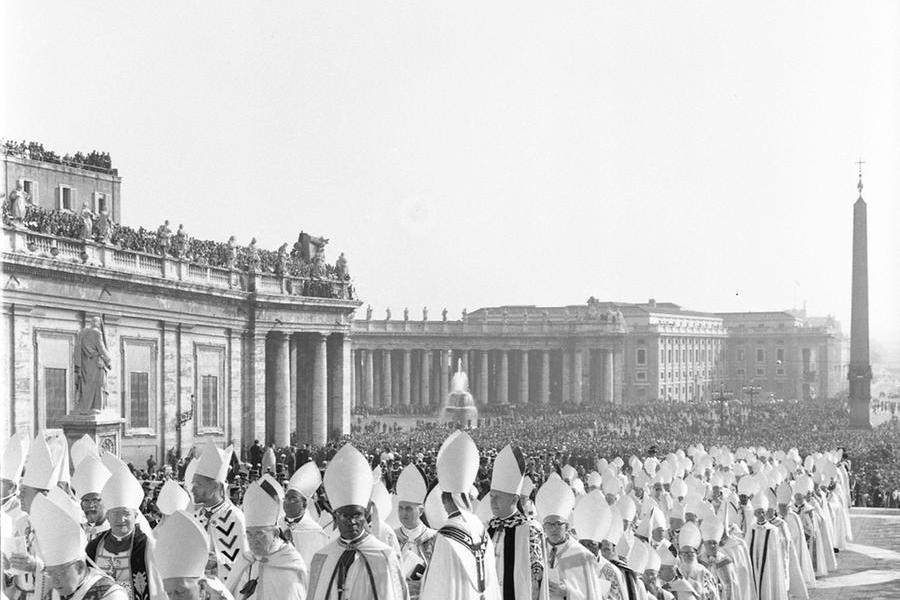
Instead, on the day of the opening of Vatican II, 11 October 1962, Don Severino followed him on TV: the spectacular procession with the bishops from the square to St. Peter’s Basilica was the first broadcast worldwide. There were pastors of all nations, with the liturgical vestments of the different Catholic rites. «On October 13th the first surprise of the Council arrived», he recalls. «That day the members of the working commissions had to be chosen, confirming the names proposed by the Roman Curia, which had already prepared the outlines of texts to be voted on without too much debate. And instead the archbishop of Lille, Achille Liénart, stood up and said: “No, gentlemen, we want to choose the members of the commissions ourselves and to do this we need to get to know each other, to meet, to discuss. Give us some time”. The proposal was welcomed with applause which denoted very broad consensus.” It was the new spirit of the Council that was beginning to manifest itself. A more participatory style of Church government, what is today called “synodality”. At the Second Vatican Council, different positions were compared: there was debate, even very heated ones. «There was never a lack of opportunity to say what everyone thought», confirms Dianich. «It is also true that Pope Paul VI», who took over in June 1963 after the death of John XXIII, «was concerned about avoiding ruptures and did not want some issues to be discussed, such as that of priestly celibacy, but for the rest, once the discussion was opened, freedom of judgment was absolute».

New doctrine?
A freedom that not everyone liked, accustomed to a Church that made indisputable statements. In this regard, Monsignor Dianich says: «Among the jokes that circulated, there was the one about Cardinal Alfredo Ottaviani, secretary of the Holy Office, a man of extraordinary intelligence and preparation but of an absolutely traditional nature in his theological and canonical training. It was said that he prayed every day to die before the end of the Council so that he could die a Catholic. Joking aside, the fear of some that the Church would lose something of its heritage of faith remains true. There was behind it a theoretical problem that is still debated today: the evolution of dogma. Those who say that the Council changed nothing of the doctrine are wrong, because at least on one topic, that of religious freedom, the conciliar declaration Dignitatis humanae it has nothing to do with nineteenth-century teaching. And Vatican II decisively refutes Pope Gregory XVI, according to whom freedom of conscience was a horror. For the Council, however, freedom of conscience is a fundamental principle of Christian ethics.” At the time, Don Severino Dianich was at the beginning of his mission, fresh from updated and innovative studies. What hopes did the young people have towards the Council? «None of us had the ambition of drawing up some kind of program. But there was certainly an aspiration to recover the evangelical spirit and therefore a critical and demystification operation of many superstructures”, explains to us. «Furthermore, we young theologians had read with concern the encyclical Humani generis of Pius XII which placed limits everywhere on the development of theology. Instead, we aspired to free Christian thinking.”
No to prophets of doom
Why is Vatican II considered the most important ecclesial event of the last century? According to Dianich, «the Council, ultimately, did like all the other councils in history (both ecumenical and local): deciding on the basis of the fundamental principles of faith the Church’s response to the needs of the moment and place in which it finds itself. The transition from Latin to the language spoken in the liturgy is the first and simplest reform of a Church that no longer wanted to be the prerogative of the clergy but the life and action of the entire body of believers. But, most of all, the Council forced the overcoming of old antagonisms: we were at the time of the Cold War, the Church was strongly committed to the fight against communism. The Council placed the Church on a different, broader, more complex level… so many previous problems have lost their luster. And the climate dissolved… The Church wanted to overcome the lack of communication with the civil society that had been created after the French Revolution.” John XXIII had said it: there are those who in the present time see only “ruins and troubles”. To us, Pope Roncalli added, “it seems that we must resolutely disagree with these prophets of doom.”
Refugee family
When he speaks of communism, Don Severino does not do so based on hearsay. Born in Fiume in 1936, when those territories were a province of fascist Italy, dfter the Second World War he experienced what it meant to be refugees, leaving his city annexed to Yugoslavia with his family, and taking refuge in Italy to escape Marshal Tito’s communism. «Since I was a child I wanted to become a priest», he says, «and so I was welcomed, together with other boys from Fiume, into the seminary of Pisa where the former bishop of Fiume had become archbishop”. And so Tuscany became his second homeland.
Ordained a priest in 1958, he studied at the Pontifical Gregorian University in Rome, was a parish priest in the Pisan area for a long time and, above all, he became a professor at the Theological Faculty of Florence and one of the most lucid and authoritative exponents of reflection on the post-Council, also thanks to the Italian Theological Association, which he helped to found. And so, in addition to being a direct witness of the Council, Don Severino was, throughout his long life, its testimonial: convinced defender of a non-restrictive reception of the innovations introduced by the assembly.