



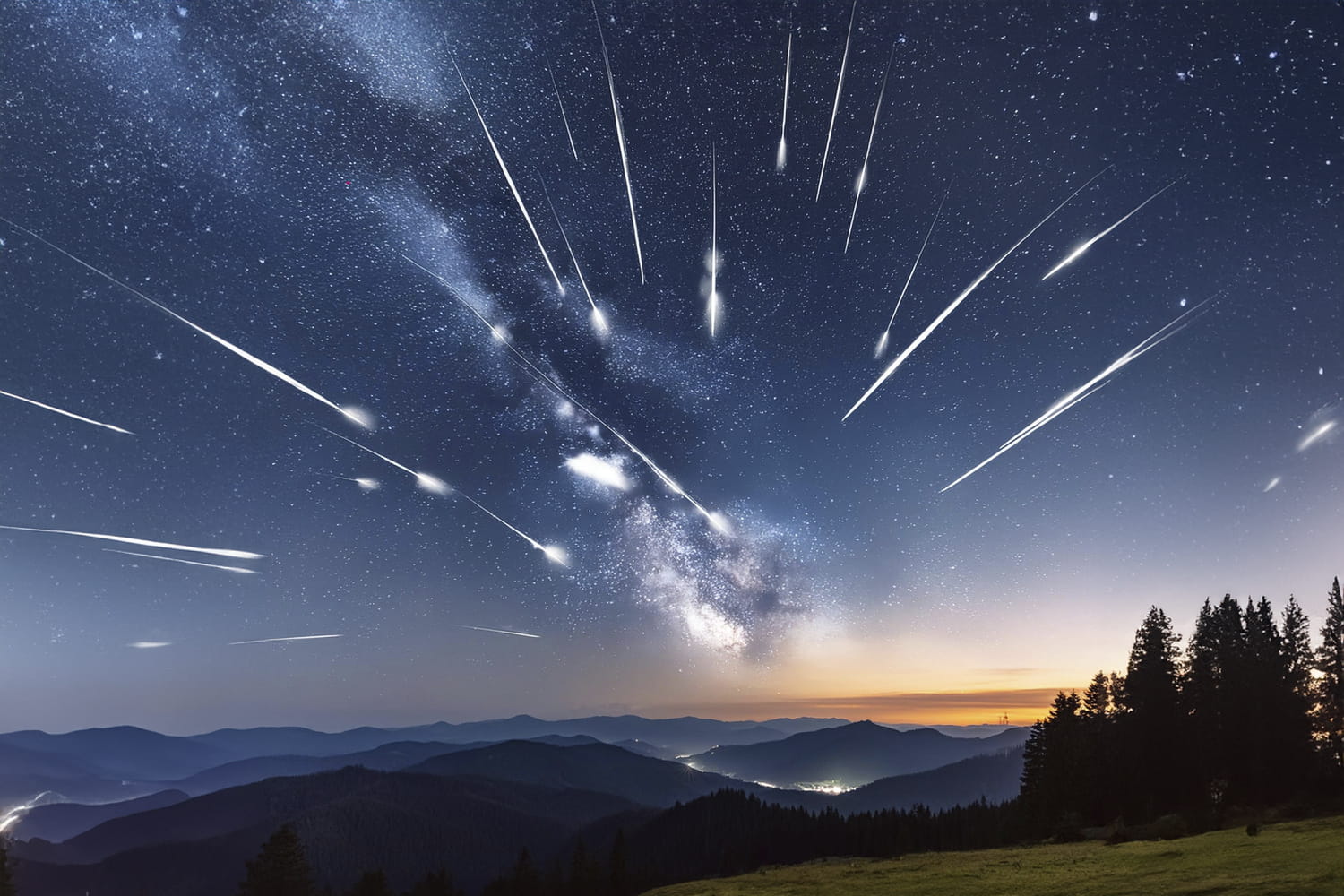
“This is the annual meeting not to be missed”, according to the French Astronomical Association.
Every year, as Christmas approaches, the sky reserves a spectacle of unequaled intensity, even surpassing the famous Perseids of August. The December Geminid meteor shower is considered by astronomers to be the most beautiful and reliable of all shooting star showers. Its exceptional character comes in particular from its origin: while most swarms come from fragments of icy comets, the Geminids are the debris of the enigmatic asteroid 3200 Phaethon, an ancient comet. The orbit of this unique rocky object potentially offers hundreds of visible meteors in a single night. “You will have to be patient and well covered to brave the December cold, but the spectacle is well worth it. This is the annual meeting not to be missed“, explains the French Astronomical Association (AFA).
Under ideal conditions, you can expect to see more than 100 meteors per hour. What distinguishes the Geminids is their relatively slow entry speed into the atmosphere (around 35 km/s), compared to other meteor showers. This slowness often results in longer and brighter light trails, sometimes tinged with green or blue. Shooting stars appear to spring from a point in the constellation Gemini, the radiant of the swarm, which is conveniently located high in the sky during the period of peak activity. The peak will take place on the night of Saturday December 13 to Sunday December 14. The most favorable observation time in France will be between midnight and dawn, when the constellation Gemini will be at its zenith.
According to the AFA, “To enjoy these shooting stars, the best means of observation remains the naked eye. Find a vantage point with as clear a view as possible. The best thing is to be able to lie down in a deckchair. You can look in any direction. The meteors appear to come from the constellation Gemini, towards the west at the end of the night. Looking in this direction, you will see meteors with a relatively slow apparent speed and a short trajectory, as the object is moving towards you. On the contrary, looking at 90° from Gemini, the speed of the shooting stars is maximum, they “fly over you“. Optimal conditions require getting as far away as possible from light pollution in cities. The darker the sky, the more the number of visible meteors will increase. In addition, the Moon will only be in its first quarter (around 35% illuminated) and will set early, leaving most of the night without its annoying glare and thus guaranteeing excellent viewing conditions.
The next major meteor shower to watch out for will be the Quadrantids. This swarm, which sometimes rivals the intensity of the Geminids (December) and the Perseids (August), takes place at the very beginning of the year, with a peak reached on January 3 around 10 p.m. This will be the first major astronomical event of this new year.