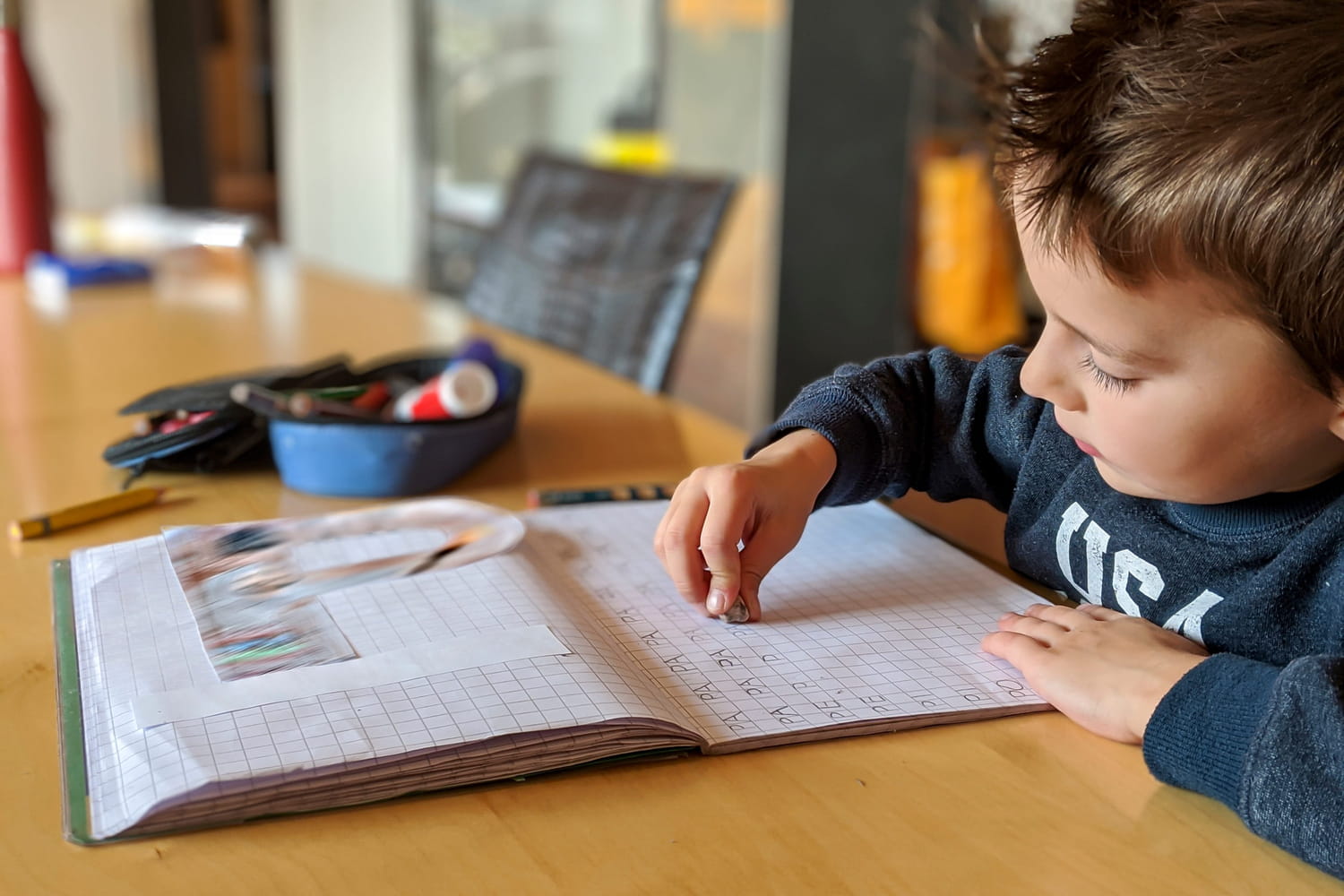
Between children who dream of going outside to play and parents who try to squeeze in dictation, showers and dinner before 9 p.m., evenings can quickly turn into a sprint. Especially since, according to several teachers, there is a time limit that should not be exceeded for homework.
At the end of the school year, many families have the same feeling: the days are already busy, so when the notebooks come out after school, patience is sometimes limited. Especially when it’s still broad daylight at 8 p.m. and everyone would rather be on the terrace than reviewing the multiplication tables. In some homes, homework is done quickly. In others, it drags on, with the famous “but I already did that at school” launched after eight minutes flat. And often, parents no longer really know where to place the cursor between helping, monitoring and even making people recite the lesson ten times in a row.
Many teachers point out that a tired or stressed child does not retain better because he stays longer in front of his exercises. On the contrary. What really works is consistency. Better a little work every day than a huge session on Sunday afternoon while everyone is already depressed at the thought of Monday morning. Stanislas Brunet-Lecomte, co-founder of the Parkours tutoring platform, sums it up clearly: “Many students work a lot on weekends and not during the week. However, we know how memory and the forgetting curve work, and this technique is not effective”. The brain prefers small, repeated doses rather than large, prolonged sessions.
For Lucas Schildknecht, a former teacher who became a creator of educational content with his YouTube channel Maître Lucas, there is also a time limit given to homework depending on the level. “I recommend around fifteen minutes a day in CP, mainly reading and poetry, 20 to 30 minutes in CE1/CE2, adding things like multiplication tables, up to 45 minutes in CM1/CM2, even if that starts to be a lot.” He continues: “In middle school, we increase little by little, until we reach one to two hours per day in the rush of preparing for the certificate. Then, in high school, it all depends on the periods: it can go up to three hours per day as the baccalaureate approaches.”
Note that organization also plays a huge role. Experts advise avoiding screens on in the background, notifications that flash every thirty seconds and the notebook placed in the middle of the table while the family watches “Don’t Forget the Lyrics”. No need to transform the bedroom into a university library either. A quiet place, a clear routine and above all a real break between school and homework are more than enough.
Many parents now establish a decompression chamber: snack, discussion, sometimes a little sport or just fifteen minutes of doing nothing before opening the diary. And frankly, after six or seven hours of class, it’s not completely absurd.