
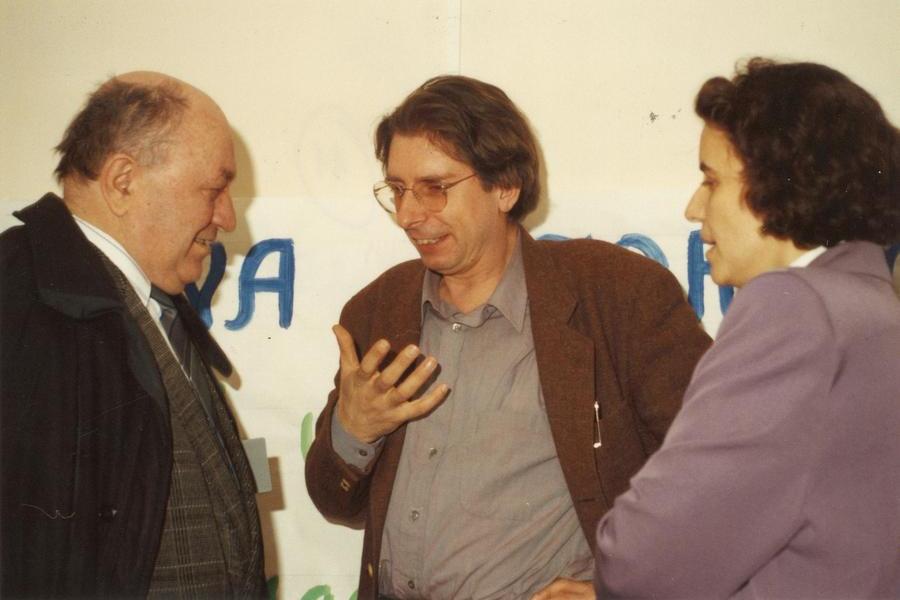




There is a thin thread that connects the mountains of South Tyrol to the rubble of the Balkans, passing through the halls of the European Parliament and arriving, today, in the heart of Verona. That thread is the thought of Alexander Langer, one of the most prophetic figures in politics of the last century.
Teacher, journalist, founder of the Greens and tireless bridge builder, Langer he dedicated his life to themes that then seemed like utopias and which today are daily emergencies: coexistence between ethnic groups, nonviolent peace and ecological conversion. A visionary.

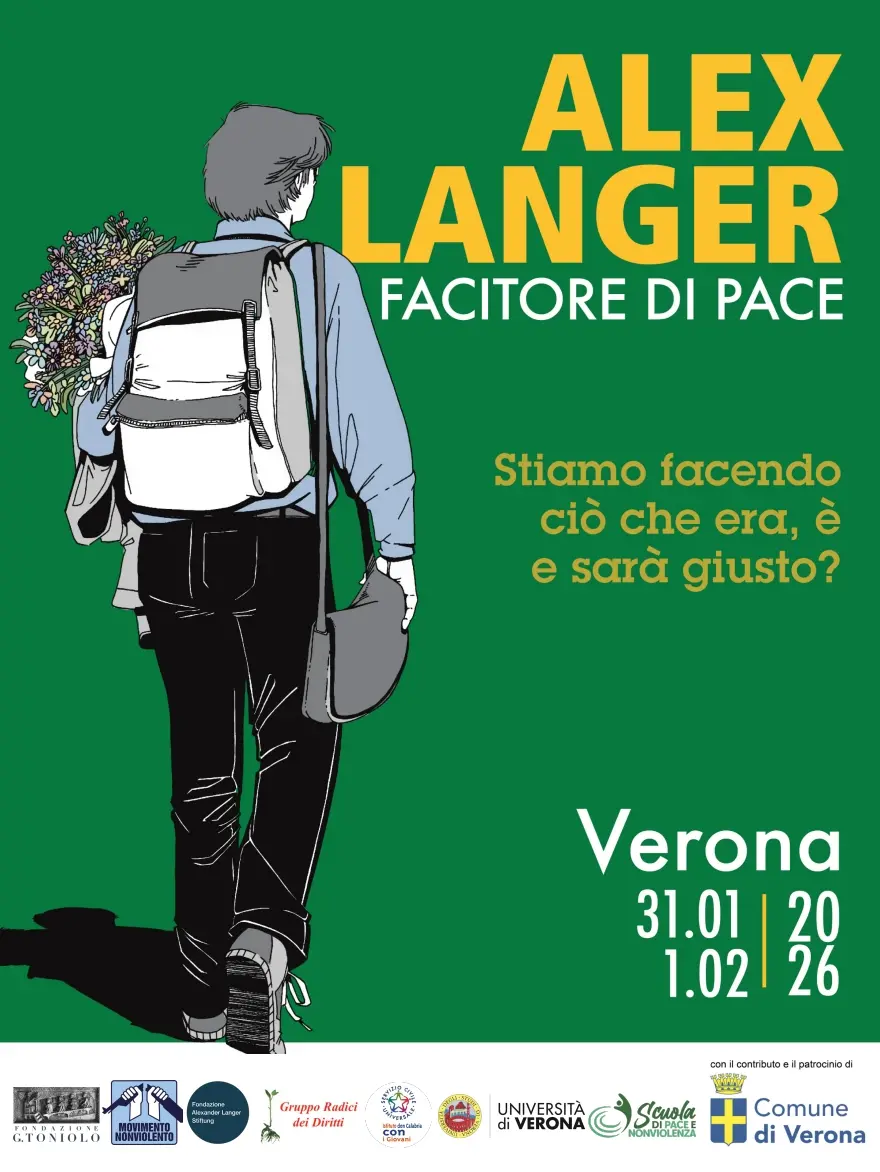
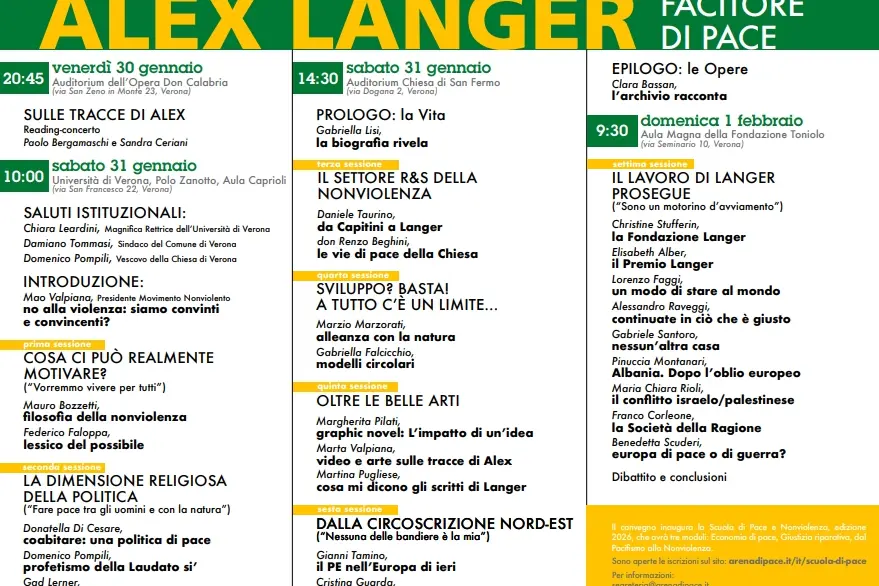
To celebrate the eightieth anniversary of his birth and the thirty years since his death, Verona hosts from 30 January to 1 February a conference of international importance, organized by the Nonviolent Movement together with the Toniolo Foundation. The event is not intended to be a commemoration, but a laboratory to extract concrete solutions for the conflicts and crises of 2026 from that “unexplored mine” that is Langer’s legacy.
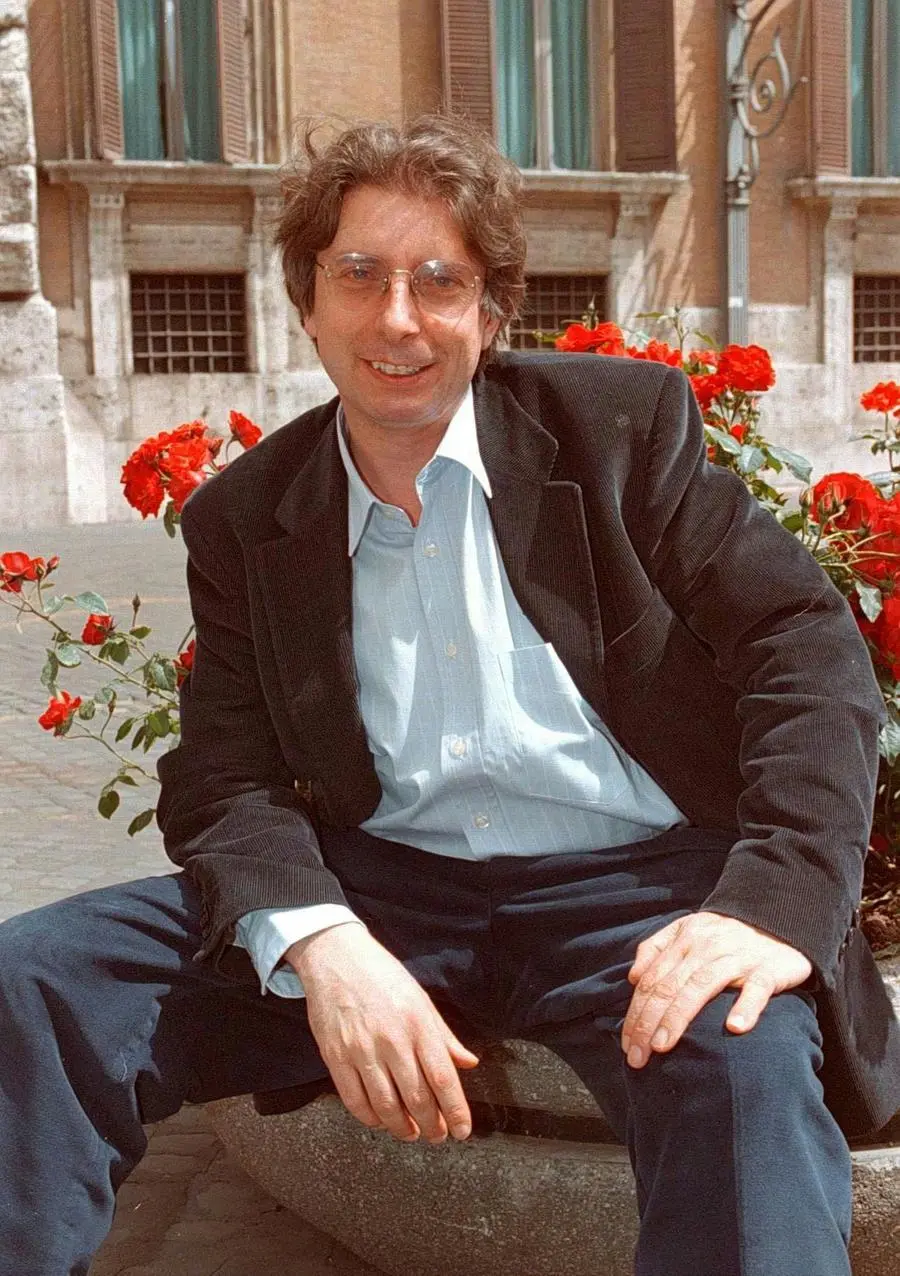
Mao Valpiana, president of the Nonviolent Movement and Langer’s traveling companion, who helps us understand why, today more than ever, we need to talk about “Alex” again.
What is the most urgent legacy that Langer left us?
«He left us leaving an invitation: “Continue in what was right”. And this invitation today, thirty years after his death and eighty years after his birth, tells us that it is time to take stock. What have we been up to in these 30 years? Did we really achieve what was right? And what was right then, is it also right today? These are the underlying questions of the conference. Langer had committed himself and hoped that all of us would commit ourselves to three specific lines, the three main ones on which he worked: ecological conversion, inter-ethnic coexistence and non-violent pacifism. Here, these are three lines of work, three absolutely urgent and very current issues. This is the heart of the conference, we want to ask ourselves questions above all starting from these three areas.”
There are important speakers on each of these topics.
«The bishop of our city, Domenico Pompili, will speak about the prophetism of Laudato Si’ and therefore on ecological conversion and integral ecology. The philosopher Donatella Di Cesare will talk about cohabitation as a policy of peace, which is the actualization of what Langer called the necessary interethnic coexistence. And finally, the journalist Gad Lerner will talk about hate and love for Israel, entering directly into the burning issue of Israel-Palestine and therefore the perspective of vision of nonviolent pacifism.”

Precisely speaking of the conflicts that have damaged the world order and civilized people in recent years, what is Langer’s lesson that could help break this impasse of violence?
«I think that one of the legacies that Langer left us is that of the method of nonviolence. Even if he did not make it explicit – in his writings he never mentioned Gandhi or Aldo Capitini – it is clear by reading his texts that he knew nonviolence well. Langer almost never quoted anyone, the only quotes he made were biblical or evangelical; he took full advantage of that history and that culture. What we now call the “Langer method” is the method for dealing with conflicts. First of all, get into them: get to know them, understand them, study them, understand the motivations, history and geography of these conflicts. The other approach is to immediately take action for the victims, whatever they may be. The third tool is to initiate political action by creating relationships and engaging in concrete issues.”
Has there been an “evolution” in his thinking and style of action?
«Langer moved from ideological pacifism to what was then called concrete pacifism, through human solidarity and the search for ways of peace together with the victims. This is what he achieved with the Verona Forum when in the early nineties he called to Verona the representatives of civil society from all the republics of the former Yugoslavia in total deflagration. They could no longer meet because the borders and barbed wires had grown; Alex summoned them to Verona so that they could physically meet here and discuss possible solutions that we certainly cannot impose from outside. I believe that this method is still valid: it is up to us to apply it today to the Israeli-Palestinian or Russian-Ukrainian conflict. This is what we are doing with our war objection campaign: we support Russian defectors and Ukrainian objectors, because they are part of the same solution. They are the only two groups from the two sides that already talk to each other and work together.”
We often talk about ecological transition but Langer spoke of “conversion”. What is the nuance you want to highlight? What did he mean by “socially desirable”?
«That technical solutions will not be enough. We actually see that in these 30 years they have not been enough. The ecological transition cannot be just a change in technology or legislation. When Langer talks about conversion he uses it precisely in the religious meaning: a conversion of conscience, a personal conversion that must go hand in hand with a political change. It’s a double track. Today, unfortunately, the world is going in the opposite direction: we are surrounded by humanitarian crises, systemic discrimination and environmental collapse. This is the urgency: we need a change of direction that necessarily involves a conversion, both of the person and of politics. It is an enormous task, but it cannot be postponed any longer. We need to say things as they are and begin this change; the conference is a small contribution in this direction.”

What do you hope the participants of this conference take home?
«The conference has no immediate political or organizational pretensions; it is a moment of in-depth study, knowledge and creation of relationships. It is aimed above all at the new generations: we will have reports made by three young girls in the fields of communication, art and study. We want to understand how Langer’s message reached them and how they put it into practice. We will have a lot to learn too. This was the particular aspect of Langer: he did everything to bring together people from different backgrounds, cultures and traditions. We want the conference to continue in this vein.”