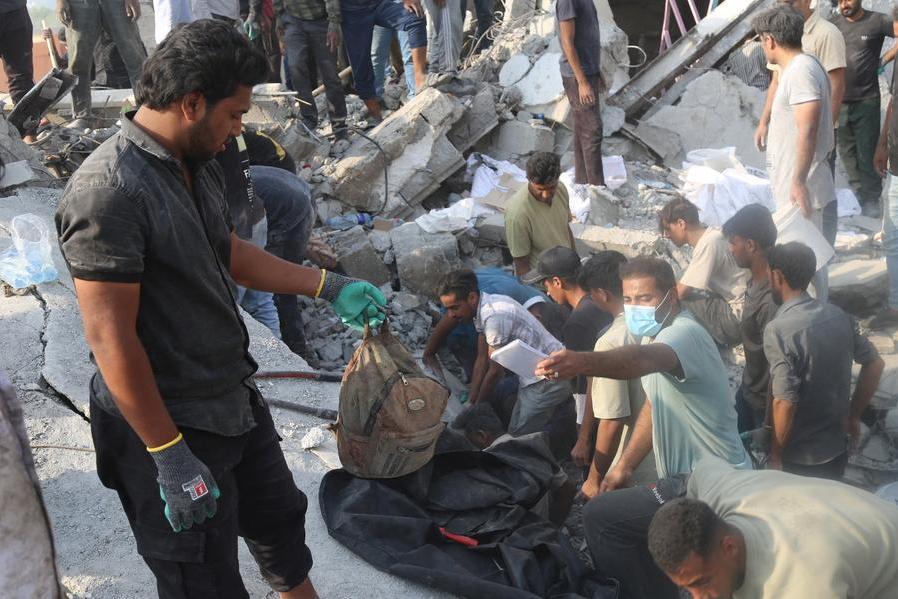




And what will happen now? The world holds its breath after the massive military attack launched on Iran by the United States and Israel on Saturday, February 28, with hundreds of targets hit across the country. Not only military and strategic infrastructures: the bombs also rained on areas with a high density of civilianslike a girls’ school in the south of the country: dozens and dozens of girls died under the rubble of their girls’ school.
According to data from the Iranian Red Crescent, the attacks by the United States and Israel against Iran have caused at least 201 deaths and 747 injuries. In response, Iran launched missiles and drones against Israel and US installations in various Gulf countries (Bahrain, Qatar, Emirates, Kuwait, Saudi Arabia), and closed the Strait of Hormuz, a fundamental hub for global energy traffic.
There were explosions heard and sirens in various cities, and at least some injuries reported in Dubai. The former Italy coach Roberto Mancini, from Doha, the capital of Qatar where he now coaches Al-Sadd, told Tg1: «The alarm started ringing on the phone, with writings in Arabic. Since this morning, five or six have arrived and shortly after we heard the explosions. We were at mass, the alerts arrived while we were in church: they told us to go home immediately and stay there”. Defense Minister Guido Crosetto was stranded in Dubai following the attacks.
Meanwhile, theconfirming the death, following yesterday’s attacks, of Iran’s supreme leader since 1989, Ayatollah Ali Khameneiseveral members of his family, the secretary of the Defense Council, the commander of the Islamic Revolutionary Guard Corps, the chief of staff and the minister of defense. It will now be up to the Assembly of Experts, a body of 88 elected senior clerics, to choose the next new supreme leader. Meanwhile, power is exercised by a provisional council made up of the president in office, the head of the judiciary and a member of the Guardian Council, who promised “a devastating response” to the attacks
US President Donald Trump has said the operation can end within a few days if Iran stops pursuing nuclear and missile programs. He assured the armed forces that if they lay down their arms they will be able to receive immunity, otherwise they will face “certain death”. Trump also addressed the civilian population, stating that «this is a moment in which the people could regain control of their own destiny. Condemnation for what is happening has instead come from Russia and China (which depends heavily on Iranian oil), while the European Union has underlined the need to protect civilians, respect international law and keep diplomatic channels open to stop the use of weapons as soon as possible. If this happened, it would obviously be the most favorable scenario, but at the moment it does not seem the most likely. The worst is a long conflict that has also spread to the Gulf countries allied with the United States on the one hand and to terrorist groups flanked by Iran, the so-called “proxies” on the other, such as the Lebanese Hezbollah and what remains of the Palestinians of Hamas. Above all, the specter of nuclear power hovers over everything, as threatened by Russian Foreign Ministry spokeswoman Maria Zakharova. These attacks are certainly part of the economic war that the United States has waged with China for the control of energy: yesterday Venezuela, today Iran and tomorrow Cuba.