
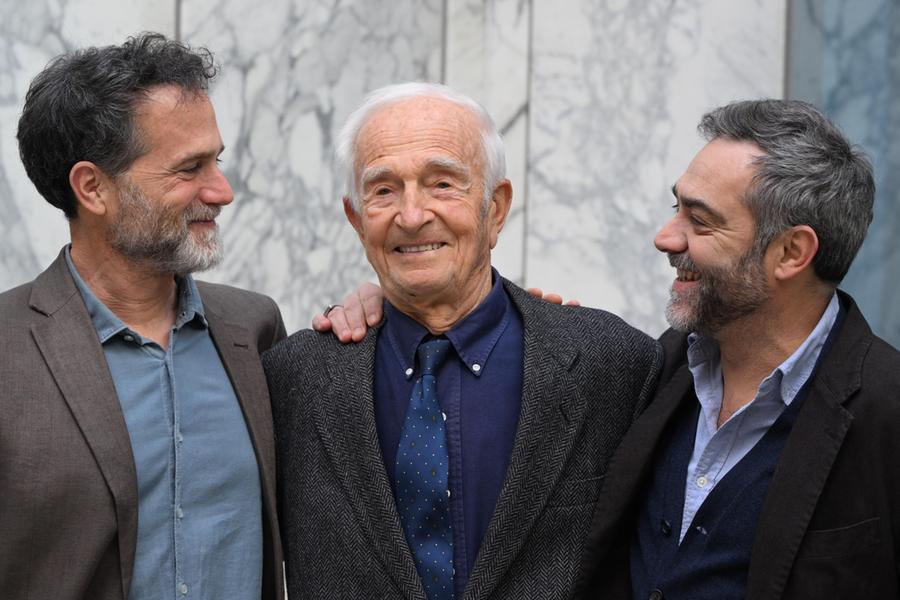


A few days ago, during the relay that carried the Olympic flame towards the Opening Ceremony of the Milan Cortina 2026 Games, a complaint came out on Facebook according to which Abdon Pamich, who had arrived from Rome to be the torchbearer in Vicenza, had been abandoned in the street by the minibus accompanying the torchbearers. When he found out, Pamich, who at 92 years old is in great shape and very aware of himself, denied it in amazement: simply, once he had finished his journey, he left in the car with some friends with whom he had an appointment. A detail, which however makes the person who he is. Today, he was in Montecitorio for the Day of Remembrance, dedicated to the historical tragedy of the Foibe and the Istrian exiles, where he also met the President of the Republic Sergio Mattarella: an occasion which never fails to bear witness.


THE ORIGINS AND THE FAMILY
Born in Rijeka, first in Italy, then in Yugoslavia, now in Croatia with the name of Rijeka, a city which he recalls as a lively and sociable place, a crossroads of cultures, a Babel where Italian, Croatian, German and Hungarian are spoken, intertwined in a perhaps inextricable bond, and from a common language, the Fiume dialect, which Pamich, even today who has lived in Rome for a long time, still retains as a link with the land from which he fled at the age of 13 with his brother, one year older, Giovanni, later a surgeon.
A fate common to many Istrians, when Tito in 1947 made that place hostile to many Italians. Born to Giovanni, an accountant and business manager, and Irene Susanj, Abdon Pamich never knew which of his parents chose the baptismal name Abdon for himwere not questions that a son asked at that time. A name of Persian origin which means “Servant of the Lord”, which Pamich admitted he had struggled with at first, so much so that as a child he called himself Aldo, without knowing that he would become famous and esteemed. At 92 years old, Pamich is a straight and elegant man, with a trait of ancient courtesy, which often distinguishes Istrian exiles.
THE ESCAPE
When Abdon and Giovanni run away they are two pre-adolescents, as Pamich says at the commemorations organized for the day of remembrance, “hardened by the war, they have already seen a lot, the bombs, the dead in the streets”they take a wide berth to dodge the shots, the intent is to cross the border on board a train. A few years ago, a La Voce del Popolo, Italian newspaper from Istria and Kvarner, Pamich described that journey like this, which we tend to describe as his first march towards freedom, not without a touch of rhetoric: «It had been the first or second day of school. It was a beautiful sunny day and in the afternoon my brother and I went to the beach. At 2 am we took the train to San Pietro del Carso (Pivka, Slovenia, ed.) where we were waiting for the one that would then take us to Trieste. The latter was divided into two sections: one was directed to Trieste and the other to Fiume. By mistake we took the train to Rijeka and then got off at the next stop, running five kilometers along the platform in the vain hope of reaching the train to Trieste. We then had to wait another 5/6 hours to get the next one. Finally, at 10pm, after 20 hours of travel, we arrived in Trieste. So we continued to Udine where there was a transfer camp and from here they sent us to the Novara refugee camp.”
THE REFUGEE CAMP AND THE RETURN TO THE FAMILY
In that disused, disadvantaged barracks, in the cold they will eat rice and lentils for a year, a legume that Pamich still cordially detests. But at 14 you have your life ahead of you and somehow the family reunites in Genoa. It wasn’t easy at the beginning: «In Italy», he recalls today, «they thought we were all fascists, then they met us and understood».
MARCHER BY CASE
Abdon Pamich would like to enroll in the nautical institute but there is no place, his father convinces him to turn to accountancy, he is tempted by boxing which an uncle would have introduced him to if he had remained in Fiume, but then a bit by chance he was introduced to walking, thanks to the meeting with the coach Giuseppe Malaspina, a discipline which almost no one liked, the least flashy of the athletics disciplines, the most fakirsque, a walk forced by the heel-toe technique: since it is forbidden to run, under penalty of disqualification, there must always be a moment in the step in which the heel of one foot and the toe of the other must touch the ground at the same time, otherwise one would fall into running and be penalized. But it is a fast pace that requires resistance and composure, maintaining the pace through fatigue is the most difficult thing: when the effort clouds you, you become distraught.
TALENT AND WORK
Abdon, a long and light skeleton, is a natural resistant, a characteristic that the up and down of Liguria is perfect for cultivating. The legend begins quickly, Pamich dominates the race at a national level, in such a way that in the Federation archives his name is linked to a sequence of «uninterruptedly», like this: «Italian titles: 10 km track: 1956, from 1958 continuously until 1969; 20 km road from 1958 continuously until 1969; 50 km road from 1955 continuously until 1968″. Comparisons are made with legends of resistance, who came before him in running: the Finnish Paavo Nurmi, the Czech Emil Zatopek, but his true point of comparison is Pino Dordoni, the hero of the 1952 Helsinki Olympics, who will become his coach. At the European Championships in the 50 km Pamich came second in 1958 and won twice in 1962 and 1966.
THE OLYMPICS
Rome at home is on paper its Olympics, but it’s up to training as the federation wants and too intense training the day before leads to Pamich exhausted in the race that counts, he finishes third but the bronze doesn’t satisfy him. On the other hand, in Rome he repeatedly won the Rome-Castengandolfo race and it even happened that his victory was announced by Pope Paul VI to the faithful in St. Peter’s Square. But walking will never become a job: to go to the Olympics for the Esso company he works for, he has to take holidays.
At Tokyo 1964 he wants revenge, but the stars seem askew again, too cold tea at the refueling risks ruining everything due to a stomach ache, which forces him to stop and free himself, but Pamich’s journey through life has seen a lot and he doesn’t let it affect him. What emerges is a masterpiece, immortalized in a memorable page by Gianni Brera: «The very last kilometers of Pamich, an agonizing journey towards the finish line. Dordoni to pace his pace, to turn every now and then to look. Thin, livid, ghostly, the Englishman trembled sharply and writhed helplessly. Pamich entered the Olympic stadium rectifying his style with touching respect for himself and the public. He was even beautiful to look at although his legs seemed to be made of wood. The ankle was deaf to any stress. Only the legs opened to the synchronous work of the arms. A hundred meters behind Nahill, who was also meticulous in respecting the style. Pamich looked back at him once, to make sure he didn’t overextend. At the last bend he greeted someone by extending his arm. Having reached the woolen thread, he grabbed it with sudden energy and made the gesture of tearing it.”
TO Monaco 1972 will still be there, it will carry the Italian flag as standard bearerthe race will not give him satisfaction, due to a disqualification for irregular walking, a fact that will go unnoticed in the Games marred by the Black September massacre.
AFTER THE RACES
Even when he retires Pamich doesn’t stop, he still walks to maintain his body and studies languages, Russian and German, to keep his mind flexible. When they call him he goes to schools to talk about his two lives. He took two applied psychology and sociology degrees for a period in the field of sport as a psychologist for the national handball team, walking coach and athletic manager of the Federal Tennis Center of Latina. He is a member of the Society of Fiumani Studies and was a testimonial of the house of remembrance, since 2024 he has been an honorary member of the Rijeka Olympians’ club. He never stopped testifying, trying to give students an open and tolerant vision that makes the soul of frontier people multiple.