
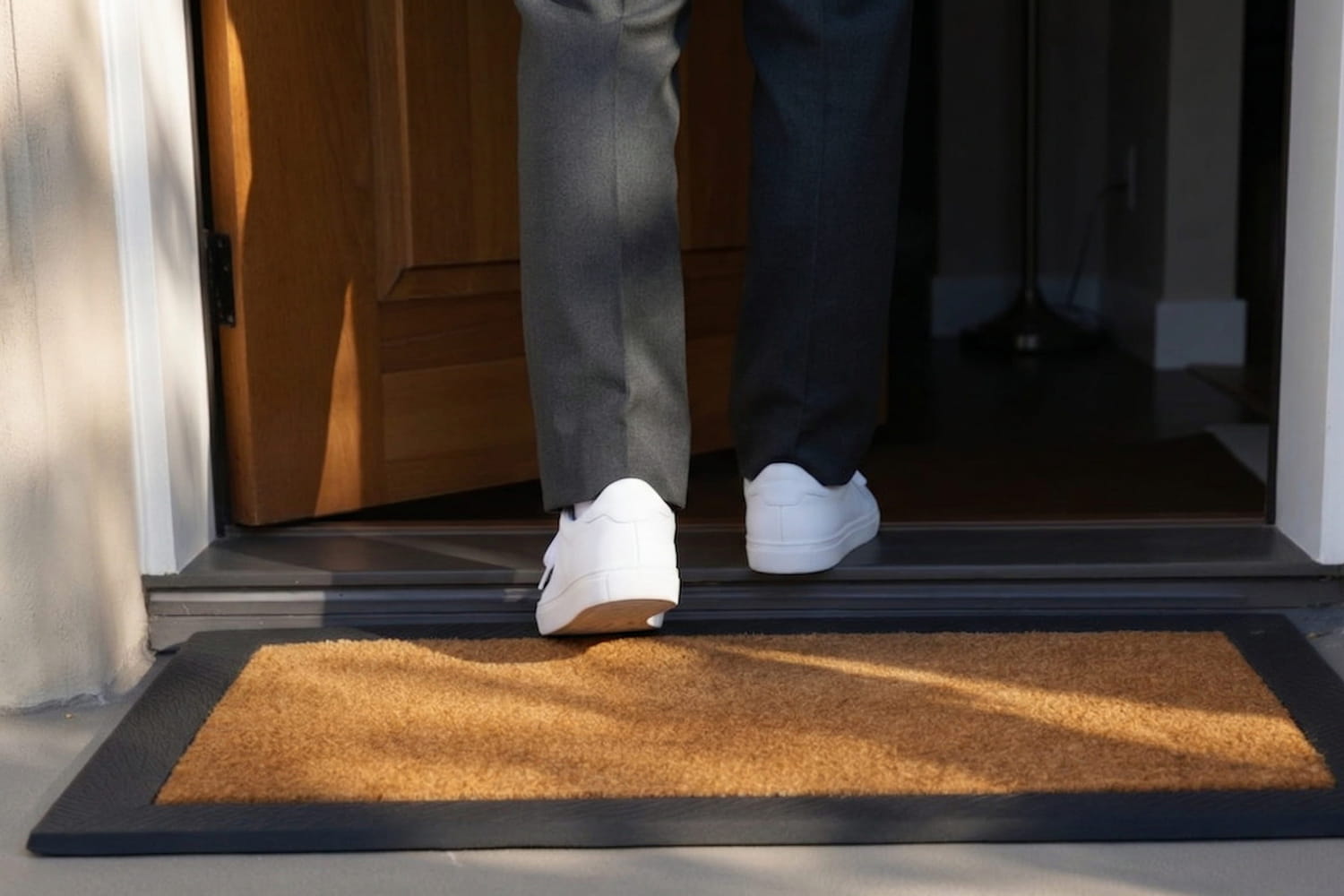




If the key does not turn quickly enough in the lock, the urge can lead to incontinence.
Hearing the sound of running water, getting up in the morning, feeling cold or simply thinking about the toilet can be enough to trigger an irrepressible urge to urinate. These triggers are numerous, but there is one that is particularly little known, although almost everyone experiences it on a daily basis. Its impact can even go so far as to cause involuntary urinary leakage. Explanations.
This phenomenon has a name: doormat syndrome. It refers to an urgent urge to urinate, sometimes accompanied by an involuntary leak, triggered by the simple fact of arriving at your front door, key in hand. This phenomenon is common and comparable to a Pavlovian reflex. In the 19th century, the physiologist Ivan Pavlov showed that a dog could begin to salivate at the simple sound of a bell, after associating it with the arrival of food. Through repetition, his brain would eventually anticipate and trigger the reaction before the food even arrived.
This is exactly what happens when you have to pee as soon as you get to your front door. By associating arriving home with going to the toilet, the brain registers certain signals – such as the key in the lock – as a trigger. Result: the urge appears automatically, even if the bladder is not yet full. It is therefore not only the bladder that triggers the urge, but an interaction between the filling of the bladder and the anticipation of the brain. In most people, this reaction remains mild and without consequences.
On the other hand, when these urges are very frequent, difficult to remember or associated with leaks, they can suggest an overactive bladder and justify speaking to a health professional. This disorder is defined by urinary urgency with or without incontinence. A study published in the journal Biomedical Research, carried out on 76 patients suffering from this overactive bladder syndrome, looked at their triggers. The two most common are: being on the way to the toilet (89.5% of participants), but also arriving home and opening the front door, cited by 71% of respondents. More worrying: this situation leads to episodes of incontinence in 68% of people affected.
The good news is that this conditioning is reversible. Concretely, it involves learning to gradually postpone urination, no longer going to the toilet in anticipation, and mentally distracting yourself from identified triggers: deliberately occupying yourself with something else when you get home, taking a different route to get to the toilet, or practicing breathing exercises to calm the urgency you feel. Bladder rehabilitation accompanied by a physiotherapist specializing in perineology can also be considered to take the process further.