





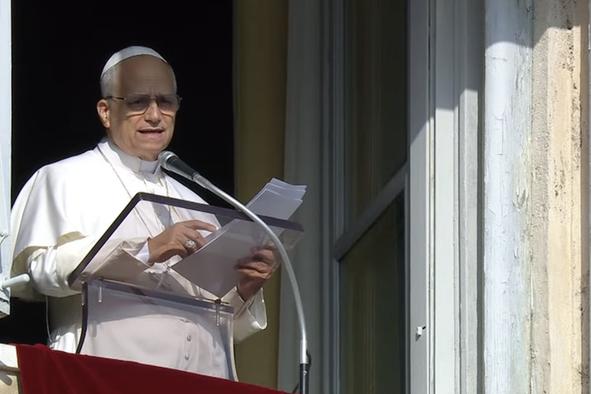
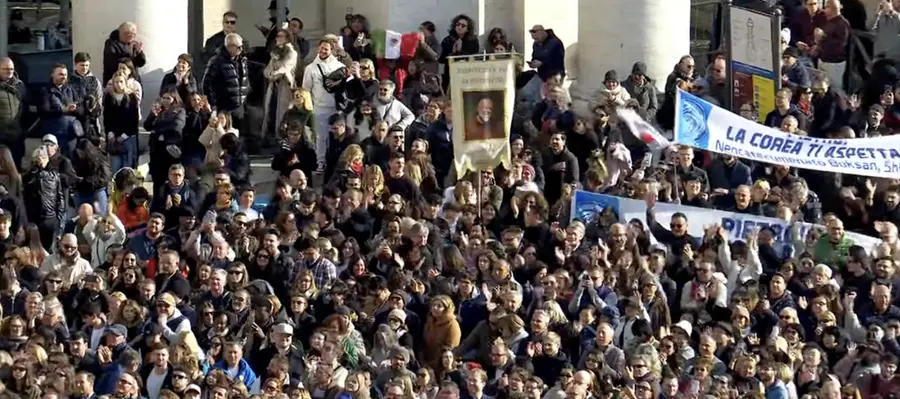
From the prison of John the Baptist to the joy of Advent, from the suffering of the last to the hope that does not disappoint. Pope Leo’s Angelus, pronounced in St. Peter’s Square in third Sunday of Advent, called Gaudete Sundayis a clear invitation not to lose faith precisely when faith is put to the test and reality seems to belie expectations.
The Pontiff starts from the Gospel of the day, which symbolically leads John the Baptist “to prison”, imprisoned because of his preaching. Yet, the Pope underlines, imprisonment does not extinguish prophecy: “even if in chains, a free voice remains in search of truth and justice”. From the darkness of the cell arises a question that runs through history and concerns every believer: “Are you the one who must come or should we wait for another?”
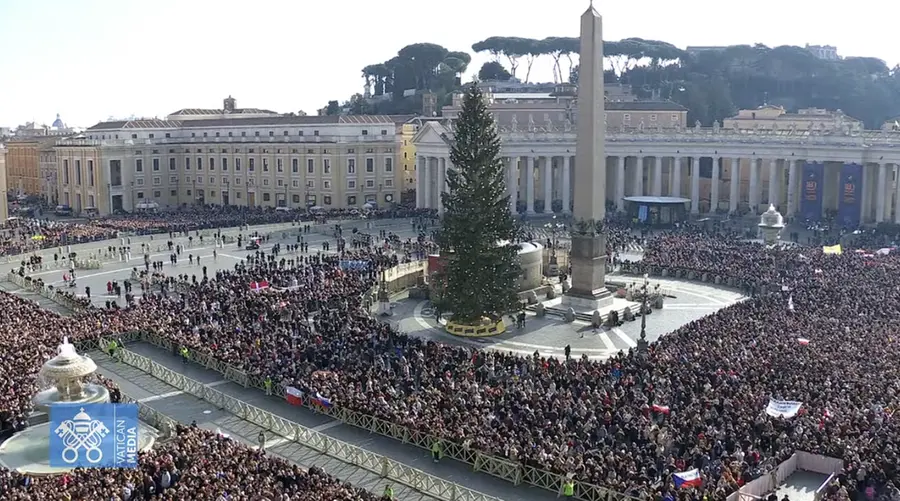
It is the question of those who seek freedom and peace, of those who await concrete and non-ideological salvation. Jesus’ response, Pope Leo reminds us, is neither theoretical nor abstract: he speaks through facts. The poor, the sick, the last, those in whom the work of God is made visible, bear witness to who the Messiah really is.. “Christ announces who he is through what he does”, states the Pontiff. And what it does brings back life where it seemed to have gone out.
In the heart of the Angelus the evangelical list of messianic signs thus resonates: the blind see, the mute speak, the deaf hear, lepers find dignity, even the dead return to life. It is not a symbolic language as an end in itself, but the description of an action of salvation that affects man in his entirety. «When God comes into the world, it shows» says Pope Leo, recalling that the word of Jesus frees us from the “prison of despondency and suffering”.
The Pontiff also warns against what makes man deaf to the truth: ideologies, appearances, violence and hatred that take away the voice of the oppressed. Christ, on the other hand, restores speech and listening, heals the gaze and redeems the heart from an evil that leads to internal death. It is here that every prophecy finds fulfillment.
The invitation addressed to the disciples in the season of Advent is placed in this horizon: to combine the wait for the Savior with attention to what God is already doing in the world. Only in this way, explains the Pope, can one experience the “joy of freedom that encounters its Savior”. Not a naive or evasive joy, but that evoked by the Pauline antiphon: «Always enjoy Domino». It is the joy that sustains above all “in the hour of trial, when life seems to lose meaning”.
The Pontiff’s gaze then broadens to the testimony of the martyrs. Pope Leo recalls with gratitude the beatifications celebrated in recent days in Spain and Paris: priests, religious and lay people killed “in hatred of the faith” during the persecutions of the twentieth century. Men and women who have chosen to remain close to their people and faithful to the Church, paying with their lives. “Courageous witnesses of the Gospel”, he defines them, praising the Lord for their example.
Finally, there is a heartfelt appeal for peace. The Pope expresses “deep concern” over the resumption of clashes in the eastern part of the Democratic Republic of Congourging the parties to the conflict to cease violence and engage in authentic dialogue while respecting peace processes. It is a reminder that links the liturgy to current events, faith to historical responsibility.
Entrusting the journey of Advent to the Virgin Mary – a model of waiting, attention and joy – Pope Leo concludes by inviting us to share “bread and the Gospel with the poor”. An inseparable combination, which translates Christian joy into concrete gestures and gives the world a visible sign of hope.

HOMILY OF THE HOLY FATHER LEO XIV in St. Peter’s Basilica for the Third Sunday of Advent, 14 December 2025
Dear brothers and sisters, today we celebrate the Jubilee of hope for the prison world, for prisoners and for all those who take care of the penitentiary reality. With a choice full of meaning, we do so on the Third Sunday of Advent, which the liturgy defines as “Cheers!”, from the words with which the Entrance Antiphon of the Holy Mass begins (see Phil 4:4). This, in the liturgical year, is the Sunday “of joy”, which reminds us of the luminous dimension of waiting: the trust that something beautiful, joyful will happen.
In this regard, on 26 December last year, Pope Francis, opening the Holy Door in the Church of Our Father, in the prison of Rebibbia, launched an invitation to everyone: «I tell you two things – he stated -. First: the rope in your hand, with the anchor of hope. Second: open wide the doors of the heart.” Referring to the image of an anchor launched towards eternity, beyond every barrier of space and time (see Heb 6:17-20), he invited us to keep faith alive in the life that awaits us, and to always believe in the possibility of a better future. At the same time, however, he urged us to be, with generous hearts, operators of justice and charity in the environments in which we live.
As the closing of the Jubilee Year approaches, we must recognize that, despite the commitment of many, even in the prison world there is still much to be done in this direction, and the words of the prophet Isaiah that we heard – “the redeemed of the Lord will return and come to Zion with rejoicing” (Is 35:10) – remind us that God is the One who redeems, who liberates, and they sound like an important and demanding mission for all of us. Of course, prison is a difficult environment and even the best intentions can encounter many obstacles. Precisely for this reason, however, we must not get tired, discouraged or back down, but move forward with tenacity, courage and a spirit of collaboration. In fact, there are many who still do not understand that from every fall one must be able to get back up, that no human being coincides with what he has done and that justice is always a process of reparation and reconciliation.
However, when the beauty of feelings, sensitivity, attention to the needs of others, respect, the capacity for mercy and forgiveness are preserved, even in difficult conditions, then wonderful flowers bloom from the hard soil of suffering and sin and even within the walls of prisons, gestures, projects and encounters unique in their humanity mature. It is a work on one’s feelings and thoughts, necessary for people deprived of freedom, but even more so for those who have the great burden of representing justice to them and for them. The Jubilee is a call to conversion and precisely in this way it is a reason for hope and joy.
For this reason it is important to look first of all at Jesus, at his humanity, at his Kingdom, in which “the blind regain their sight, the lame walk (…), the Gospel is proclaimed to the poor” (Mt 11.5), remembering that, if sometimes such miracles occur with extraordinary interventions of God, more often they are entrusted to us, to our compassion, to the attention, wisdom and responsibility of our communities and our institutions.
And this brings us to another dimension of the prophecy we have heard: the commitment to promote in every environment – and today we particularly emphasize in prisons – a civilization founded on new criteria, and ultimately on charity, as Saint Paul VI said at the conclusion of the Jubilee Year of 1975: «This – charity – would like to be, especially on the level of public life, (…) the principle of the new hour of grace and good will, which the calendar of history opens up before us: civilization of love!” (General Audience, 31 December 1975).
To this end, Pope Francis hoped, in particular, that for the Holy Year, “forms of amnesty or remission of punishment aimed at helping people regain confidence in themselves and in society” could also be granted (Bolla Spes non confundit, 10), and to offer everyone real opportunities for reintegration (see ibid.). I trust that his wish will be followed up in many countries. The Jubilee, as we know, in its biblical origin was precisely a year of grace in which everyone, in many ways, was offered the opportunity to start again (see Lev 25.8-10).
The Gospel we heard also speaks to us about this. John the Baptist, while preaching and baptising, invited the people to convert and symbolically cross the river again, as in the time of Joshua (see Jos 3:17), to come into possession of the new “promised land”, that is, of a heart reconciled with God and with our brothers. And in this sense, his figure as a prophet is eloquent: he was upright, austere, frank to the point of being imprisoned for the courage of his words – he was not “a reed shaken by the wind” (Mt 11.7) -; yet at the same time he was full of mercy and understanding towards those who, sincerely repentant, struggled to change (see Luke 3:10-14).
In this regard, Saint Augustine, in one of his famous comments on the Gospel episode of the forgiven adulteress (see John 8:1-11), concludes by saying: «With the accusers gone, misery and mercy were left (…). And the Lord said to her: (…) go and sin no more (Jn 8,10-11)” (Sermo 302, 14).
Dear ones, the task that the Lord entrusts to you – to everyone, prisoners and those responsible for the prison world – is not easy. There are many problems to face. Let’s think about overcrowding, the still insufficient commitment to guarantee stable educational recovery programs and job opportunities. And let’s not forget, on a more personal level, the weight of the past, the wounds to be healed in the body and heart, the disappointments, the infinite patience that is needed, with oneself and with others, when one undertakes paths of conversion, and the temptation to give up or no longer forgive. The Lord, however, beyond everything, continues to repeat to us that only one thing is important: that no one should be lost (see John 6:39) and that all “be saved” (1 Tim 2:4).
Let no one be lost! May all be saved! This is what our God wants, this is his Kingdom, this is what his actions in the world aim at. As Christmas approaches, we too want to embrace his dream with even greater strength, constant in our commitment (see James 5:8) and confident. Because we know that even in the face of the greatest challenges we are not alone: the Lord is near (see Phil 4:5), walks with us and, with Him at our side, something beautiful and joyful will always happen.
Images © Vatican Media