

MumyMumy
  • News
  • Female Empowerment
  • Business
  • Politics
  • Career
  • Culture
  • Parenting
  • More
    • Web Stories
    • Popular
    • Pregnancy

Subscribe to Updates

Get the latest women's news and updates directly to your inbox.

Trending Now
What is Askatasuna, why is it called that. The stages of a two-sided story

What is Askatasuna, why is it called that. The stages of a two-sided story

21 December 2025
A celebrity makeup artist reveals the secret to beauty that beautifies everyone, “from 18 to 80 years old”

A celebrity makeup artist reveals the secret to beauty that beautifies everyone, “from 18 to 80 years old”

21 December 2025
AI: when the algorithm decides what we can see

AI: when the algorithm decides what we can see

21 December 2025
When François-Xavier Demaison invites himself to a fan’s house…

When François-Xavier Demaison invites himself to a fan’s house…

21 December 2025
Hating parties hides this specific childhood injury, psychologists reveal

Hating parties hides this specific childhood injury, psychologists reveal

21 December 2025
Facebook X (Twitter) Instagram
  • Privacy
  • Terms
  • Advertise
  • Contact
Facebook X (Twitter) Instagram Pinterest Vimeo
MumyMumy
  • News
  • Female Empowerment
  • Business
  • Politics
  • Career
  • Culture
  • Parenting
  • More
    • Web Stories
    • Popular
    • Pregnancy
Subscribe
MumyMumy
Home » AI: when the algorithm decides what we can see
Parenting

AI: when the algorithm decides what we can see

By News Room21 December 20255 Mins Read
Share Facebook Twitter Pinterest LinkedIn Tumblr Reddit Telegram Email
AI: when the algorithm decides what we can see
Share
Facebook Twitter LinkedIn Pinterest Email

There is a new form of censorship that doesn’t build walls or burn books. It doesn’t have a face, it doesn’t pronounce explicit prohibitions, it doesn’t sign decrees. Yet, every day he decides what we can see, share, tell. It is the silent and pervasive algorithmic censorship that operates within the artificial intelligence technologies omnipresent on social media and everywhere.

It is around this topic, profoundly ethical even before technical, that was discussed during the Roman conference of Ministry of Culture – Cinecittàpromoted by the Undersecretary of Culture Lucia Bergonzoni: “AI: the algorithm, censorship of the 21st century”, which took place on 17 December in Rome, at the National Galleries of Ancient Art of Palazzo Barberini. A title that sounds like a warning: we are not just talking about tools, but about a power that new technologies can exercise on thought, on the imagination, on the body, on creative freedom: «Where once morality, religion and modesty dominated, today new forms of control are raging which often turn into real actions of censorship to the detriment of our artistic and cultural heritage and the artists who have made it and make it so extraordinarily unique. Dynamics animated” explained the Undersecretary for Culture Lucia Borgonzoni, at the opening of the conference “by that invisible engine that powers the most modern technologies and which could have repercussions in terms of influence on society and on the wealth generated by the diversity of the cultural debate”.

Taking part in the event were artists (the photographer Donatella Nicolini, the sculptor Jago, the writer Donato Carrisi), experts from the university world (including Martino Diez, Renata Salvarani and Randa Khalil), law (Prof. Avv. Valeria Falce) and technology (Father Paolo Benanti, Gianluca Mauro, founder and CEO of AI Academy and Epiphany) together with MiC executives (Luca Mercuri, Alfonsina Russo, Alessandra Necci, Moira Mascotti) and illustrious personalities of the cultural panorama (Claudio Pagliara, Giordano Bruno Guerri, Rav. Roberto Della Rocca, Fiamma Nirenstein)

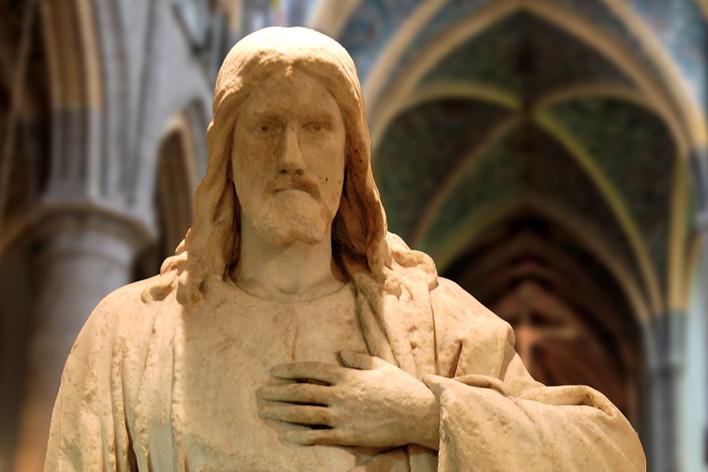
The focus, above all, was the world of art. Museums, photographs, sculptures, images of the human body which for centuries have told of the beauty, fragility and dignity of people, today risk being obscured by automatic filters incapable of distinguishing between pornography and visual art, between offense and symbolic language. An algorithm does not “see”: it classifies. And in this classification it loses context, history, meaning.

The paradox is evident: what was once judged by different cultural sensitivities is today subjected to even more rigid control because it is opaque, global and often decided elsewhere. No longer a recognizable censor, but trained mathematical models that reflect visions of the world that are not always compatible with reality, especially when it comes to art, but distorted by chatbots.

Many interventions have insisted on this point: artificial intelligence is not neutral. It brings with it the values, conscious or not, of those who design it, of those who train it, of those who establish its criteria and boundaries. When these criteria are applied automatically to the circulation of images and words, the risk is homologation.

However, this is not about demonizing technology. AI can be an extraordinary resource for cataloguing, studying and enhancing cultural heritage. It can help tell new stories, make archives accessible, build bridges between past and present. But only if it remains a tool in the hands of man, and not the other way around.

The theme of the body, naked, vulnerable, real, has emerged as one of the most delicate terrains. On the internet and in social media, the body is often reduced to an object to be censored or consumed, without the possibility of being a language, a story, a relationship. Artistic photography, motherhood, physical diversity thus end up penalized by automatic systems that are unable to read the complexity of human experience.

In this scenario, ethical reflection becomes decisive. A technical or legal regulation is not enough: a culture of shared responsibility is needed. We need to educate our gaze, our discernment, our awareness that what we delegate to machines has a profound impact on who we are and what we become. Father Paolo Benanti, who has been involved in the ethics of technologies for years, also forcefully recalled this: the advent of AI has redefined the boundaries of creativity, offering tools of unprecedented power for the generation of content, code and artistic solutions. However, this algorithmic “freedom” brings with it urgent ethical questions: from copyright protection to data transparency, up to the risk of hallucinations and cognitive biases.”

For a society that defines itself as democratic, this is a crucial challenge. Defending creative freedom means defending the dignity of the person, the plurality of visions, the possibility of expressing human talent, without reducing it to a binary code. In a time that increasingly entrusts decisions to algorithms, the real urgency is perhaps this: not to stop being human, even if we build ever more intelligent machines.
Share. Facebook Twitter Pinterest LinkedIn Tumblr Email

Related Articles

What is Askatasuna, why is it called that. The stages of a two-sided story
Parenting

What is Askatasuna, why is it called that. The stages of a two-sided story

21 December 2025
Goodbye to Matilde Amorosi, reporter with a soul
Parenting

Goodbye to Matilde Amorosi, reporter with a soul

21 December 2025
Giovanni Franzoni, the first podium in the Cup, his dedication with his fingers to the sky moves skiing
Parenting

Giovanni Franzoni, the first podium in the Cup, his dedication with his fingers to the sky moves skiing

21 December 2025
“Doors of hope”, art enters San Vittore
Parenting

“Doors of hope”, art enters San Vittore

20 December 2025
Tonight on TV Conti and Macii on Raidue On the shoulders of giants towards Milan Cortina
Parenting

Tonight on TV Conti and Macii on Raidue On the shoulders of giants towards Milan Cortina

20 December 2025
“Separation of careers” among Google searches for 2025, a good sign of attention to the common home
Parenting

“Separation of careers” among Google searches for 2025, a good sign of attention to the common home

20 December 2025
Latest News
A celebrity makeup artist reveals the secret to beauty that beautifies everyone, “from 18 to 80 years old”

A celebrity makeup artist reveals the secret to beauty that beautifies everyone, “from 18 to 80 years old”

21 December 20250 Views
AI: when the algorithm decides what we can see

AI: when the algorithm decides what we can see

21 December 20250 Views
When François-Xavier Demaison invites himself to a fan’s house…

When François-Xavier Demaison invites himself to a fan’s house…

21 December 20250 Views

Subscribe to Updates

Get the latest women's news and updates directly to your inbox.

Popular Now
this is how they override the system Culture

this is how they override the system

News Room21 December 2025
Goodbye to Matilde Amorosi, reporter with a soul Parenting

Goodbye to Matilde Amorosi, reporter with a soul

News Room21 December 2025
Giovanni Franzoni, the first podium in the Cup, his dedication with his fingers to the sky moves skiing Parenting

Giovanni Franzoni, the first podium in the Cup, his dedication with his fingers to the sky moves skiing

News Room21 December 2025
Most Popular
What is Askatasuna, why is it called that. The stages of a two-sided story

What is Askatasuna, why is it called that. The stages of a two-sided story

21 December 20250 Views
A celebrity makeup artist reveals the secret to beauty that beautifies everyone, “from 18 to 80 years old”

A celebrity makeup artist reveals the secret to beauty that beautifies everyone, “from 18 to 80 years old”

21 December 20250 Views
AI: when the algorithm decides what we can see

AI: when the algorithm decides what we can see

21 December 20250 Views
Our Picks
When François-Xavier Demaison invites himself to a fan’s house…

When François-Xavier Demaison invites himself to a fan’s house…

21 December 2025
Hating parties hides this specific childhood injury, psychologists reveal

Hating parties hides this specific childhood injury, psychologists reveal

21 December 2025
this is how they override the system

this is how they override the system

21 December 2025

Subscribe to Updates

Get the latest women's news and updates directly to your inbox.

Mumy
Facebook X (Twitter) Instagram Pinterest
  • Privacy Policy
  • Terms of use
  • Advertise
  • Contact
© 2025 Mumy. All Rights Reserved.

Type above and press Enter to search. Press Esc to cancel.