


Two weeks ago Syria celebrated the first anniversary of the fall of Bashar al-Assad’s regime – forced to flee by a very rapid military operation – and the beginning of the political transition under the leadership of the new president Ahmed Hussein al-Sharaa. Former jihadist and leader of Hayat Tahrir al-Sham (Hts, Organization for the Liberation of the Levant) – an armed group born from the split with Al Qaeda and previously called Jabhat al-Nusra – the Syrian president, better known as Abu Mohammad al-Jolani, he was wanted for years by the United States who had placed a terrorism bounty on him. Years ago Al-Sharaa distanced itself from jihadism and transformed HTS into a Syrian armed group (which was then disbanded in January 2025 and integrated into the Syrian army). As the new leader of Syria, at the head of an interim government, has undertaken a new political course aimed at breaking the country’s international isolation, starting reconstruction and carrying out reforms in a deeply fragmented nation, as well as devastated by thirteen years of bloody civil war and also by the terrible earthquake of 2023.
In these twelve months many things have changed and there have been numerous signs of hope, in particular the historic meeting which took place last November at the White House between President al-Sharaa and Donald Trump, a visit that marked the culmination of a process of rehabilitation of the country, the rapprochement with Washington with the removal of economic sanctions. After the meeting at the White House, the Syrian government officially joined the global coalition to defeat ISIS led by the United States (it is the 90th country to join the international coalition against terrorism).
The Islamic State has not been eradicated and continues to represent a source of destabilization for the country with terrorist actions. Syria still remains far from real, effective internal pacification and continues to be affected by insecurity and instability, balanced between attempts at rebirth and reconstruction and internal tensions. Ten days ago three Americans – two soldiers and a civilian interpreter – died in the region of the archaeological site of Palmyra, hit by an ISIS-affiliated sniper who opened fire on a joint Syrian-American patrol. Two days ago Donald Trump has ordered a major offensive – also supported by Jordan – against the terrorist organization in Syria.
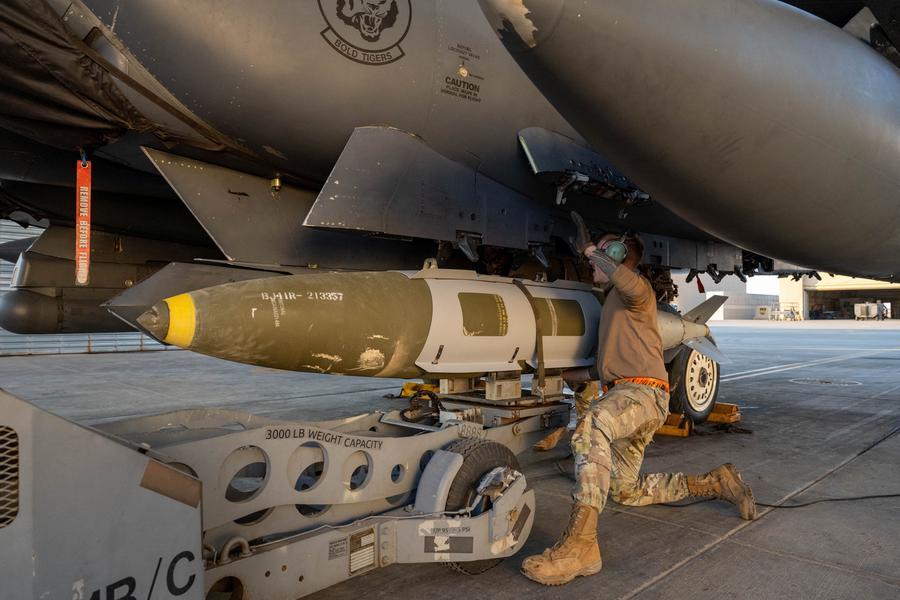
Over 70 ISIS targets in different areas were targeted in a wave of raids as part of Operation “Hawkeye”. After the attack on the patrol, the US president promised a strong response, which he actually delivered with the toughest and most massive military operation against ISIS in recent times, confirming the centrality of the American presence and action on Syrian territory. According to the Syrian Observatory for Human Rights, at least five militiamen were killed.
The Government of Damascus, for its part, has confirmed its commitment to fighting the Islamic State on Syrian territory. «We are striking hard at ISIS strongholds in Syria, a blood-soaked place that has many problems, but which has a bright future if ISIS is eradicated.”Trump declared on his Truth social media profile. And he added: «The Syrian Government, led by a man who is working very hard to bring Greatness back to Syria, is completely in support». And a warning: “All terrorists who are evil enough to attack Americans are hereby warned.”