





They have become the undisputed stars under the tree, but this success attracts an invisible threat that could well ruin your parties. More and more buyers are having the unpleasant surprise of discovering a zero balance when paying with their gift cards, victims of a well-established technique.
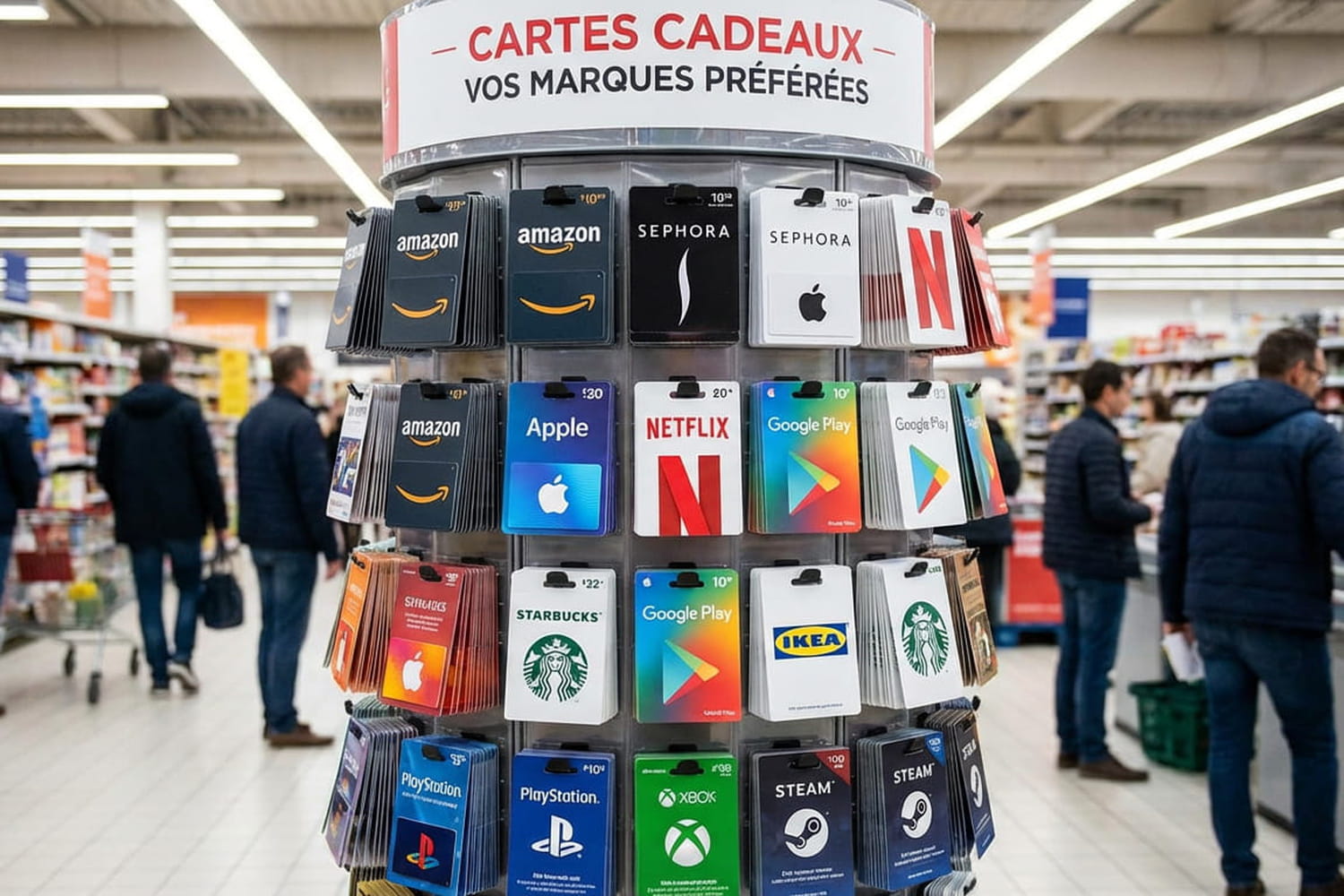
Fnac, Sephora, Amazon, Ikea, Decathlon, King Cadeau, Auchan, or even Airbnb… An overwhelming majority of brands today offer gift cards. Physical or dematerialized, practical when you don’t know what to give and want to be sure to please despite everything, they have become an essential part of Christmas gifts. Moreover, it is even the third most given gift in France according to the Uggy company. Even companies sometimes offer them to their employees for the holidays, notably thanks to cards that can be spent in several different stores. In France alone, the gift card market represents no less than 8 billion euros!
Not only are the sales of gift cards increasing, and their amount too: the French spend on average 44.40 euros on a card purchased in store, and 56.22 euros on an e-card, according to a study by Global POS in 2024. But the problem when a market is booming is that it attracts both consumers… and fraudsters. Scams are becoming more and more widespread, and take different forms, each more devious than the last. In-store and online, your gift cards can be emptied before you can even spend their balance.
Imagine: you give a 100 euro gift card for Christmas, but when they use it, the person discovers that their balance is zero. It’s entirely possible, whether you bought it online or directly in store. On physical cards, usually found at checkouts in supermarkets or stores, there is a unique code that only the owner is supposed to know. It is protected by a sticker, but the criminals manage to steal the codes and reattach the protective film (almost) without alteration. Some erase them in the meantime, rendering the card completely unusable for the consumer, who only realizes it once they get home.
The problem is that the strongest also manage to empty dematerialized gift cards, purchased directly on the brand’s website for example, by hacking the balance and the card number. Here again, they can use it as if it belonged to them, leaving its real owner with a zero balance. And that’s without counting the numerous phishing attempts, by email or even by SMS, such as that of the fake boss who asks you to discreetly buy gift cards for all employees, or even these false promotions posing as well-known brands which in reality sell fake gift cards…
It is a relatively new fraud, and figures on victim losses are rare. However, we know that in the United Kingdom, 9,386 cases of gift card scams were recorded between 2023 and 2024, according to Report Fraud, for a total loss of around £18.5 million. With of course a peak in January, after the end-of-year holidays. We still do not know the extent of the phenomenon in France, but one thing is certain, it does indeed exist: in 2024, five men were judged for having stolen more than 1.3 million euros in gift cards from the King Cadeau, Auchan and Darty brands. For their part, companies are looking for solutions to make the sale and use of gift cards more secure.