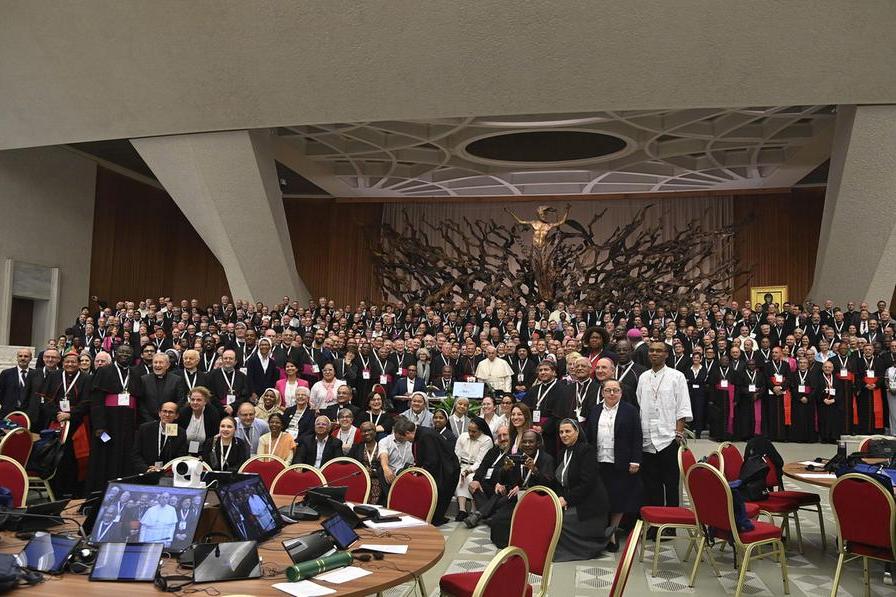



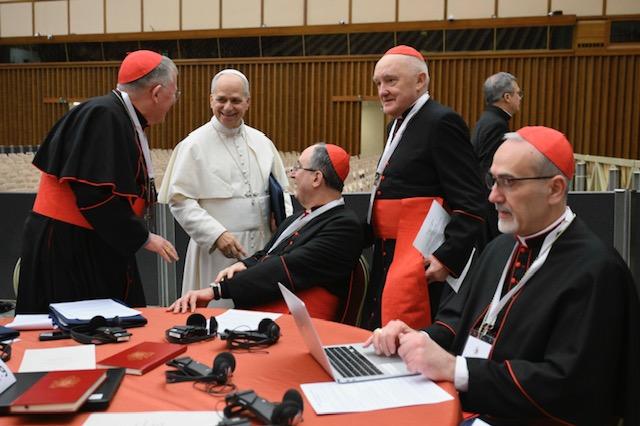
Next meeting June 27th and 28th. Pope Leo convenes the cardinals again during this year and then, from 2027 the appointment will become annual, but longer. Pope Leo thanks, especially the older cardinals who made the effort to be present, for their “truly precious testimony” and said he is close to those who, due to the situations in their countries, were unable to come: “we are with you and we feel close to you”, he declared. At the end of the work, the Pontiff reiterated that “the meeting of these days is in continuity with what was asked during the meetings of the cardinals before the Conclave and also after the Conclave” and that “the chosen methodology was chosen to help people meet and get to know each other better”. He then underlined, explained in the briefing Matteo Bruni, director of the Vatican Press Office, «deep communion and harmony between the many interventions, a non-technical organizational synodality, but a tool for growing in relationships». Pope Leo highlighted, in particular, the continuity with the path of the Second Vatican Council, an event to which the Wednesday catecheses will be dedicated, “which is the basis of the journey, of the conversion, of the renewal of the whole Church” and in continuity with Evangeli Gaudium, Pope Francis’ apostolic exhortation on the proclamation of the Gospel in today’s world. The other two topics, the one on the liturgy and on the Apostolic Constitution Praedicate Evangelium, “are not forgotten” even if they were not discussed in this day and a half of work.
On the chosen themes, however, synodality and mission, were highlighted as key points missionary nature of synodality, the primacy of the Bishop of Rome, the role of the laity, the authority exercised in a synodal key, the need for guidelines and references in canon law, and a verification of the reception of Evangelii Gaudium.
The morning session, on synodality, was introduced by Cardinal Mario Grech who underlined, reports Matteo Bruno, «that synodality is missionary and the mission is synodal, as an ecclesial act integrated into the life of the Church». Furthermore, it was «reaffirmed that synodality aims at communion and collegiality as a principle of unity of the whole Church, with a strong emphasis on the primacy of the Bishop of Rome”. The cardinal highlighted «the prophetic function of the people of God and the role of the discernment of the pastors in a circular relationship between the people and the pastors. This circularity implies mutual listening, participation and co-responsibility in the ecclesial and missionary journey.”
Synodality, it has been said, is exercised at different levels: throughout the Church, consultations between bishops and Episcopal Conferences, meetings of the college of cardinals, even informal ones.
The cardinals worked in 20 groups, 11 composed of non-elector cardinals (i.e. over 80 years of age) and members of the Roman Curia and 9 of elector cardinals of local Churches and nuncios still in service. At the end of the session, the reports of the 9 groups were presented. It emerged that we are still in an initial phase of synodality and that the spirituality of listening needs to be developed. Furthermore, it was reiterated that walking together implies walking with Christ; That synodality does not change the hierarchical structure, but adds a level of missionary participation of all the people of God and the value of the baptism as the source of ecclesial life which makes all the faithful co-responsible; the Church is first and foremost a “mystery of salvation” before being a structure.
Furthermore, it is necessary that synodality “influences the way of exercising authority, the ratio sacerdotalis and the formation towards a more relational ecclesiology”. This is why we need a more international curia and a closer relationship with the episcopal conferences. Overlaps of competences between departments and dioceses with the Secretariat of the Synod must be avoided and the role of ecclesial participation bodies must be valorised. «Synodality», therefore, «is a process aimed at the mission, not at the conservation of structures». For this reason there is also a need for guidelines and new references in canon law. The need has emerged to better understand, even canonically, the synodal mechanisms of the Eastern Churches and of putting “charity at the heart of synodality”.
On the other topic, however, addressed in the afternoon session and introduced by Cardinal Fernández, it was reiterated that the‘Evangelii Gaudium «is not a text that “expired” with the previous pontificate» as also confirmed by the assembly on the first working day. At the center of the mission are “the proclamation of the kerygma, the nucleus of the Gospel and the beauty of God’s saving love manifested in Jesus Christ dead and risen”. And, quoting Benedict XVI, it has been said that theevangelization is first and foremost “the experience of an encounter”, beauty, attraction; this perspective is valid today, when the transmission of faith is wounded or broken.” And then we must ask ourselves whether «a God who loves infinitely and a Christ who saves from sin and emptiness is transmitted”. The invitation is to a “synodal missionary conversion: putting into the background what is not directly needed and reaching everyone with the first announcement”. We must also review the way of preaching «so that the announcement is not “buried”; the teachings of the Church are all true, but they must be connected differently to the heart of the kerygma with an “intimate union between the proclamation of the kerygma and social commitment”.
The interventions of the afternoon, they underlined the importance «not of a simple “relaunch” but of capturing the freshness and heart of the document; the Gospel is the treasure for the mission» and all Christians are “outgoing subjects” who must grasp the need to «get to know the men and women of our time who seek belonging more than faith; we need to approach broken lives with humility”. The expression of the Church as a “field hospital” and the need to “love those in pain and those who are marginalized” was recalled. There is a need for the Church “and to feel loved”
Evangelization responds «to the spiritual thirst of people with understandable language, it does not aim at numerical growth», but at «building ecclesial communities where “desertification” finds an answer in Jesus».
And therefore the “joy of the Gospel” is “an answer to lives in storm”. The risk is then that “the language of faith is dragged into political battles”.
At the end of the work, the Pontiff then also placed emphasis on world situation «which makes a response from the whole Church all the more urgent» and he expressed, reported Matteo Bruni, «his concern, shared during the Consistory, for the situations of suffering, war, violence, which afflict many local churches. Finally he prayed with the prayer that is recited at the moment of the creation of the cardinals which begins: “Grant with your grace what human weakness cannot reach”.