


In Gerace, every morning, you are enchanted by the sun emerging from the Ionian Sea, between Punta Stilo and Capo Bruzzano, where the Locrians landed 2,700 years ago, giving life to one of the most flourishing Magna Graecia colonies. The imposing Romanesque cathedral was built in the year 1000 with the columns of the temples of Locri Epizefiri, symbol of death and resurrection: for every civilization that disappears, there is one that comes to life.
This was the last cornerstone of the Byzantine rite in Italy, before, in 1480, a Greek bishop, Attanasio Calceopulo, led the transition to the Latin one. And here we have returned to breathing with both lungs in a Christian way, keeping together the traditions of the West and the East. An example of this is the hermitage of Monserrato, where Sister Mirella Muià lives. The 10th century “catholic”, with its characteristic tile dome, was transformed over six hundred years later by the Aragonese into a sanctuary of the Moreneta, the Virgen de Montserrat of Barcelona.
Since 2002, Sister Mirella, in this strip of land facing east, has cultivated the fragile plant of unity, between peoples and between faiths. Once a month an Orthodox priest, Father Sergei Tikhonov, celebrates the lectio divina on the Psalms. Even reformed and Jewish brothers, people searching, as well as naturally many Catholic faithful, knock on Sister Mirella’s door for moments of prayer and discussion. On the altar of the church there is the iconostasis, painted by herself with refinement. On a table adorned with the tallit, next to a seven-branched candelabrum, the Bible in Hebrew is placed.
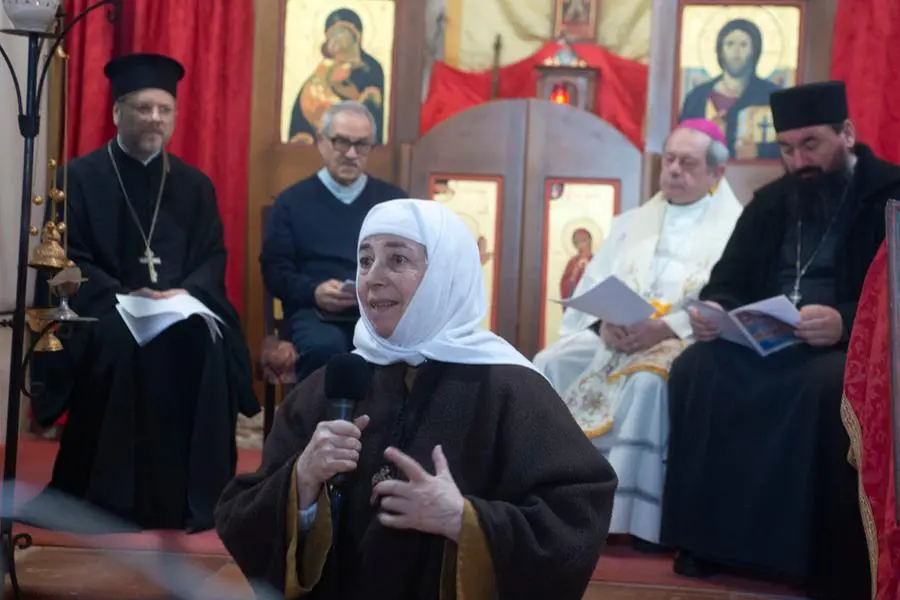
photo by Giulio Archinà
The spiritual journey
Calabria, especially this side, has always been a place of landings and meetings, departures and returns. Just like the life of Mirella, born in 1947 in Siderno and emigrated at the age of five to Genoa, where her father was a maritime worker. “Every life is a journey,” he wrote in his latest book which has just been released. As a young girl she grew up as a little “foreigner”, then studied languages and took part in the protests of 1968. She met Claude, a young Frenchman with whom, in 1970, she moved to Paris, where she taught in high schools and held conferences on Italian literature at the Sorbonne. The couple gives birth to a daughter, who is now a volunteer in the Amazon. Mirella is not embarrassed to talk about her double motherhood, biological and ecclesial: «As a religious woman I discovered the gift of being a mother, also in welcoming women who have difficulties in the family and in the parental role». In the nineties a profound crisis resulted in separation from her partner and reconversion to Christianity, which she abandoned in adolescence. In the Basilica of the Sacred Heart, in Montmartre, she met a great iconographer, the Jesuit Egon Sendler, who introduced her to Russian sacred art and spirituality. «It was a fundamental experience for me», says Mirella. «We met in what was Jacques Maritain’s house. I was starving for everything. The Absolute was in my emptiness and I didn’t know it yet.”
Being reborn with the Church
Thus the rediscovery of one’s roots also occurs. Mirella feels the irresistible call of her homeland. In Rende she was welcomed by another Jesuit, Father Pino Stancari. For ten years she prayed and worked there, until, in 2001, the then bishop of Locri, Giancarlo Bregantini, proposed that she move to Gerace. «Think, in Paris», he reveals with a smile, «in memory of my childhood places, I kept an old photograph of Santa Maria di Monserrato in my study». It was almost a challenge: «Bregantini told me: “If you come, I will give you a church to be reborn”. Those words corresponded to the call that I had felt for some time: a Church that is reborn in unity, through the monastic legacy of the desert fathers.”
In the same year, the patriarch of Constantinople, Bartholomew I, visited Calabria. «I spoke with him about my plan for a hermit life, which he fully approved because it was part of the history of Italian-Greek monasticism. So the following year I came to Gerace.”
Monserrato slowly comes back to life. “I understood that mine is an ecumenical call: the Church is the body of the Risen One, but it is wounded and I want to be a small ointment on the wounds of divisions.”
In 2012 he made his perpetual profession as a diocesan hermit. Remembering this makes her heart beat: «I knelt in the dim light of the cathedral and the bishop laid his hands on me for a long time, invoking the Spirit. For me it was the definitive entry into the Mystery of the Church, with a density never tasted before.”
Hermitism as sharing
Mirella was supported by the various bishops who succeeded one another at the helm of the diocese, including the current one, Monsignor Francesco Oliva.
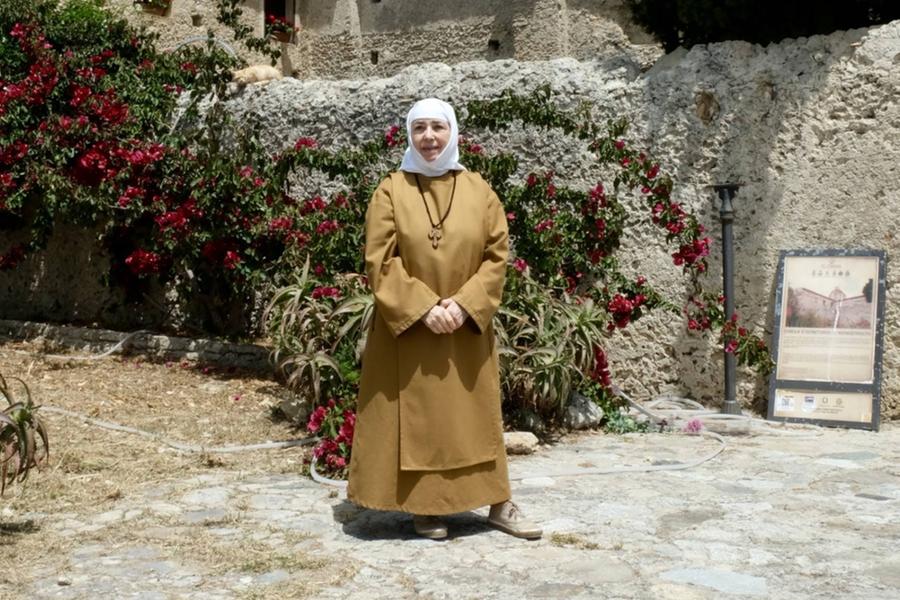
This petite woman, whose face is still fresh despite her age, is now a different person compared to the professor of the Parisian avant-garde. The head is wrapped in the veil of Orthodox nuns, over a sand-colored dress borrowed from Dossetti’s Piccola Famiglia dell’Annunziata. His days are marked by meditation and aghiagraphy, the sacred writing of icons. And then, last but not least, there is welcoming and listening. «This hermitage is now a sanctuary of ecumenism. Among others, friends of the Byzantine community of Reggio and those of the eparchy of Lungro come, with whom we celebrate the divine liturgy and meditate on the Holy Scripture.”
In the small wooden guesthouse, Sister Mirella hosts a nun in discernment for a possible transition to a hermit’s life. His experience attracts and teaches. «Hermitism is not closure in isolation, nor escape from human relationships, but it is a form of spiritual sharing. For this reason, silence is essential, especially internal silence, a necessary condition for listening to God and our brothers.” And he adds: «The desert is our world. There is no need to look for it outside, it is in our cities and monasticism brings a breath of baptismal life. This is what people need. Not of ideas, but of the fullness of the Lord in life.”