






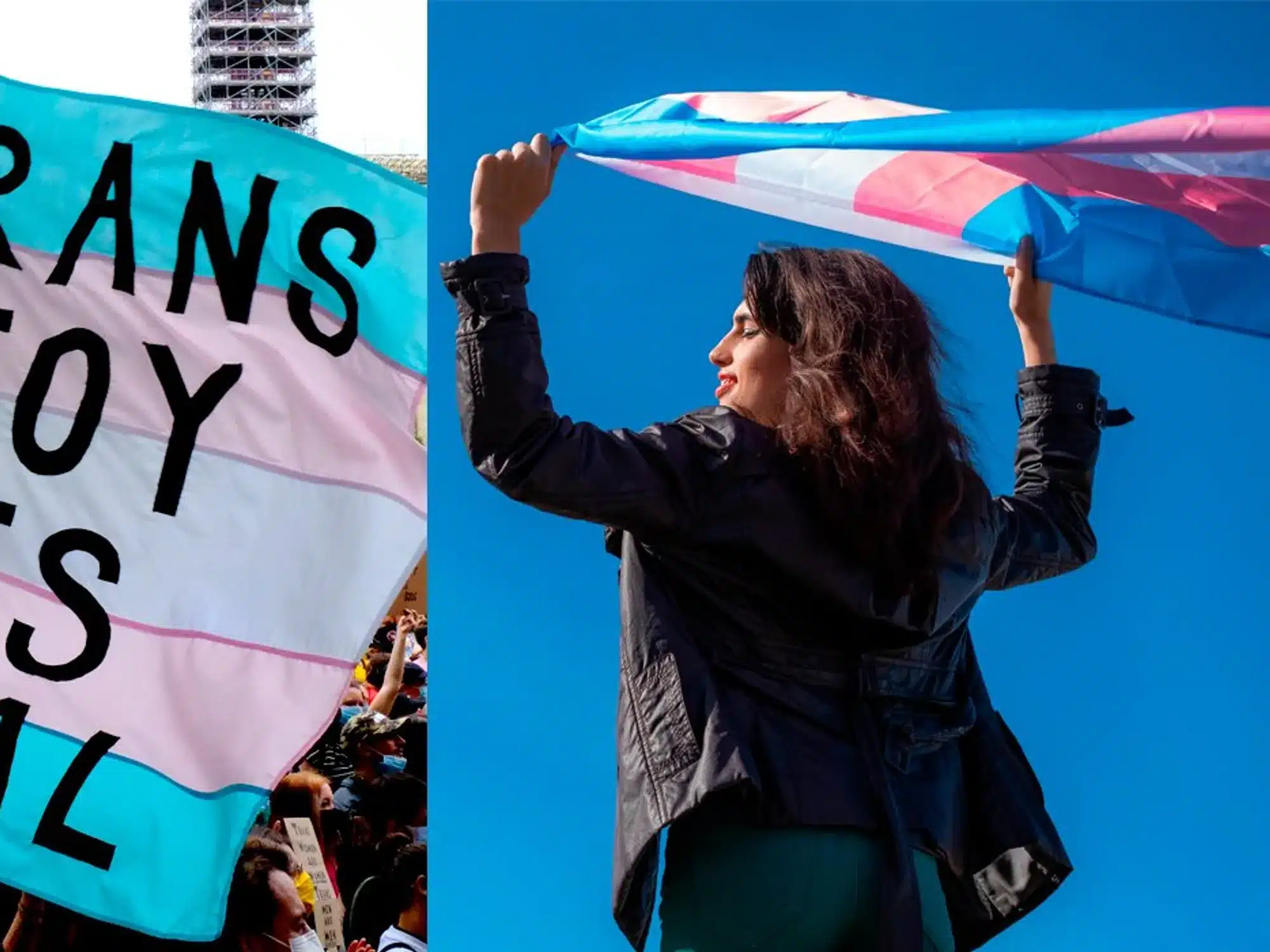
The United States government is viciously targeting children and adults in a precious and often misunderstood group. What did these people do? They were born with a medical condition in which their brains didn’t match the sexual organs of their reproductive systems: They are transgender.
What exactly does being transgender mean? Our gender identities are our innermost concepts of our genders – what we feel ourselves to be in our hearts and brains. Those who are transgender identify themselves as having a gender orientation different from the genitally-based gender identification they were given at birth–usually the opposite gender. Nonbinary transgender individuals do not identify as exclusively male or female. Nonbinary identification includes those who are gender-fluid–with a gender identity that shifts over time along the male-female continuum, those who are static – maintaining an unchanging identity along or outside of the male-female spectrum, and those who are agender – not identifying with any gender at all.
Some transgender people alter their physical characteristics via social, hormonal, and/or surgical changes to embody the gender that matches their internal senses of themselves. Such adjustments are often the only substantial relief for those who suffer from gender dysphoriaa discomfort with their outward appearances and bodily processes.
Being transgender has nothing to do with sexual orientation. Just like cisgender people, trans people can be straight, gay, bi, pan, or asexual. Sexual orientation indicates who one tends to fall in love with and wants to go to bed with; gender identity indicates who one goes to bed ace. To illustrate, a cisgender lesbian does not want to remove her breasts, grow a penis, and be a man. She is sexually and romantically attracted to women, and she knows and feels that she is a woman.
Being transgender is not a mental or physical illness; it is a variation that often requires medical attention. As puberty approaches, most transgender people feel mounting panic as development into adult bodies that conspicuously don’t match the identities their brains developed during fetushood becomes more imminent. In ways, this is similar to how we might feel if we were born with a condition that would cause a few complications during childhood, but that would produce horrific problems with the onset of puberty. We would be desperate to access the medical treatment that would prevent the next phase of development.
Knowing what we now do about the huge risks of going through a mismatched puberty – self-harm, being the victim of discrimination and hate crimes, suicide, and more–we realize how important it is for a transgender child to have the option to receive hormone blockers. Hormone blockers press the pause button on puberty, giving the child time to decide whether to go through hormone therapy, which is only partially reversible. If the child decides not to take hormones, and discontinues taking blockers, puberty proceeds as it would have.
If teenagers choose to take hormones of the gender they identify as, which most doctors allow beginning between the ages of fourteen and sixteen, they will go through the puberty that matches their brains instead of the puberty that matches their reproductive organs. The last step, if they wish to take it, is gender-confirming/affirming surgery. If a trans man has gone through some or all of female puberty and has breasts, they are removed. This is called “top surgery.” Changing the genitals surgically to or toward those of a different gender is “bottom surgery.”
Are people really born transgender? Many experts say yes. According to an article in The Journal of Neuroscience(November, 2014), experts believe a transgender identity is caused when the fetus’s brain develops like that of a gender different from that of the reproductive system, during the second half of pregnancy. The reproductive system develops in the first trimester. In the second and third trimesters, the presence or absence of testosterone makes the brain structure male or female. This continues through a bit after birth. These hormones create the brain organization underlying a person’s gender identity. Because sexual brain differentiation happens at a different time than sexual differentiation of the genitals, both processes can be influenced independently, which may result in the baby being transgender. Scientists believe that transgender identity results from a “mismatch” between gender-specific development of the brain and the body, the brain developing in a way resembling that of the gender identity instead of the sex assigned at birth. DNA may also contribute by instructing the hormones to act in these ways, despite the fetus’s genitalia. Thus, being transgender isn’t a result of parenting styles, family structure, or environmental conditions. It is a medical condition.
As reported in the Journal of Psychiatric Research (February, 2011), New Scientist (January, 2011), and The Journal of Neuroscience (November, 2014), among others, brain scans reveal significant structural differences between transgender and cisgender (non-transgender) people’s brains. For example, the white matter is different. Though there is no difference between the hypothalamus of a gay and straight male’s or a lesbian and straight female’s brains, there is a difference between a cisgender male’s and a transgender female’s (born with the same reproductive systems) hypothalamus, and between a cisgender female’s and a transgender male’s (born with the same reproductive systems) hypothalamus. These differences in the brain, more than genitals at birth, are the central indicators of gender identity.
All around the world right now, many politicians are lying about and viciously scapegoating trans people – an innocent and vulnerable population. Few people understand what transgender means, so they believe these disappointments. In United States’ 2024 elections, Trump spent 22 million dollars, and Republicans spent 215 million dollars, on anti-transgender campaign ads, instead of advertisements discussing important issues.
In 2024, Republican politicians introduced seven hundred and one anti-transgender bills. 2025 was worse, with one thousand and twelve anti-trans bills having been introduced. Every time there is an anti-LGBTQ bill in the media, young people’s calls to suicide hotlines spike by 400 percent. Hate policies also have caused hate crimes to increase drastically. When Trump won the presidency in November, 2024, crisis calls from LGBTQ youth after election day skyrocketed 700 percent. Every forty-five seconds a young transgender person attempts suicide. A landmark study in the prestigious journal Nature Human Behavior demonstrated that anti-trans laws causally increase suicide attempts among transgender youth by as much as 73 percent in certain states. This is not because of their gender identities, but because of how society stigmatizes and mistreats them.
Meanwhile, certain politicians and celebrities continue to spread malicious lies. For example, no child goes to school and comes home that day another gender. Gender confirmation surgery is not performed on children, and is rarely performed on teens under the age of eighteen. Wait lists are lengthy, and one must have a verified history of being treated by hormone blockers and hormones first, as well as having letters from doctors and therapists who are specialists in the field. Recovery is long and hard; depending on the procedure, weeks to months of severe incapacitation. Yet, people believe these politicians’ intentional lies and vote for them. And the majority of politicians in our government are actively targeting trans people’s civil, medical, and human rights. These politicians are demonizing trans people to distract the country from the governing they are neglecting – issues like dealing with our huge healthcare and housing crises – not caring how many lives they ruin, nor how many deaths, due to suicides and hate crimes, they trigger.