


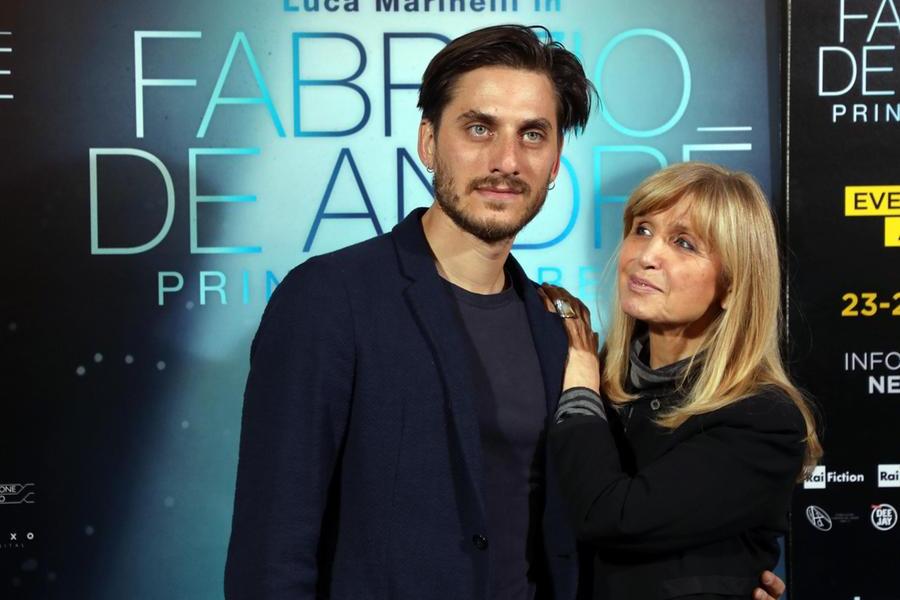
Today Fabrizio De André would have turned 86. Unfortunately, he passed away just before turning 59. To remember him, Rai 1 rebroadcasts in just one evening Fabrizio De André-Free Princea fiction that recalls his life with great love and respect. A result to which his wife Dori Ghezzi contributed significantlywho participated in every phase of the creation. Valentina Bellè, who plays her, confessed her embarrassment at finding herself in front of the camera checking that everything was fine. An embarrassment which, however, soon turned into an incentive to do better and better.
In an interview a few years ago, Dori confided to us: «Fabrizio was not, let’s say, very tidy. He didn’t throw anything away: he left it, often even at other people’s homes. But he was very demanding of himself, he was capable of working for days on a single word.”
From a narrative point of view, the TV film is divided into two parts. The first is a coming-of-age novel that sees the young Fabrizio (Luca Marinelli) fighting against a destiny that seems established by his father (Enzo Fantastichini), a powerful entrepreneur from Genoa. He would like him to follow in his footsteps but, at the same time, gives him a guitar. And so he wanders around the alleys of the “old city” together with his inseparable friends Paolo Villaggio (Gianluca Gobbi) and Luigi Tenco (Matteo Martari), in the “neighbourhoods where the sun of the good God does not give its rays”, which become an inexhaustible source of encounters with those latter (thieves, prostitutes, sufferers of loneliness) who will provide him with the inspiration for his first masterpieces.
The second part instead focuses on the tormented path that will lead De André to become the most famous Italian singer-songwritera path that will pass from his idiosyncrasy towards live performances surpassed only in the 70s and from the terrible days of kidnapping lived in Sardinia with Dori, which will also provide him with the inspiration to write one of his most poignant songs, Hotel Supramonte.
When telling the life of a much-loved character, the first risk is to laps into hagiography, which however is avoided here because De André is portrayed as a brilliant man, but also full of fragilities which for many years found refuge in alcohol. One of the most exciting moments of the TV film is when Fabrizio, dead drunk, composes Fragile Friend. Ten years later, his father Giuseppe, on his deathbed, made him promise that he would stop drinking. “I was there that day,” Dori recalled. «Thanks to his father, Fabrizio managed to definitively free himself from alcoholismcompleting a journey that began after writing Amico fragili, his most autobiographical song.” Which is no coincidence, together with Il testamento di Tito, a song included on the album The good newsFabrizio considered it “my best song”.
The other risk of biopics is to focus only on the protagonist. Here, however, all the characters are well focused, with a special mention for Elena Radonicich, very good at portraying a woman who knows how to process the pain of betrayal by transforming love into affection: Puny, Fabrizio’s first wife and mother of their son Cristiano.
And then there’s Marinelli, amazing in making the protagonist credible without falling into sterile mimicry, even when he takes on the burden of singing, while elsewhere we really listen to Faber’s voice. The best moment? When De André plays in the recording studio Waltz for a love to Dori Ghezzi to conquer it. He remembered it like this: «Humorous, ironic, full of doubts and contradictions. He had his five minute storm. And immediately afterwards it was as if nothing had happened. This was his beauty: he never held grudges against anyone.” Not even for their kidnappers: “He always considered them as victims of their social conditions.”