





On the feast of the Holy Family the liturgy proposed to us the passage from Ephesians 5.22: “You, wives, submit to your husbands, as is fitting in the Lord”. Many of us consider it a legacy of an outdated culture. We can’t even proclaim it without a strong internal reaction. Expressions that represent women in a state of subjection to men always disturb us. Not so for male workers who in the Church, in general, continue to feel and be in a situation of superiority towards women.
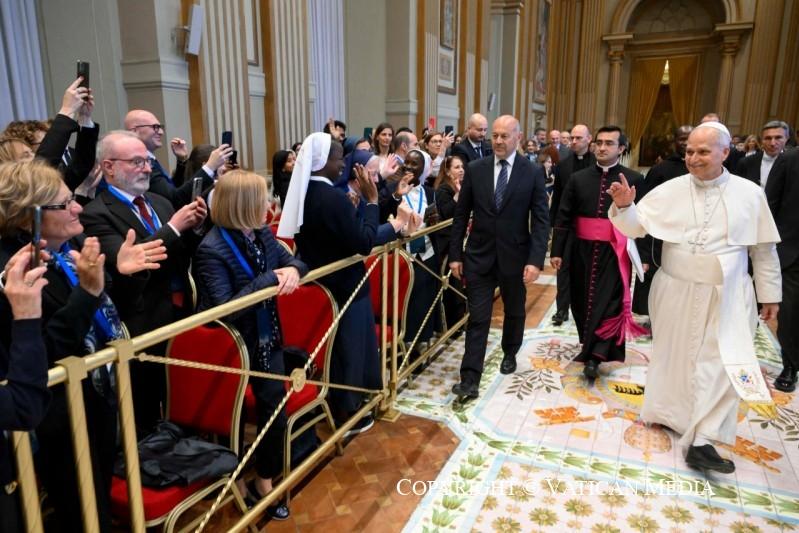
A group of catechists
Dear friends, you do well to ensure that sometimes a certain chauvinist culture – which in the Church disguises itself behind forms of clericalism – does not kill relationships of fraternity and sorority. You are right to protest when necessary. Your Baptism and the teaching ministry that the Church itself has entrusted to you enable you to do this.
Now let’s get to your confusion. First of all, it must be considered that the Bible has a cultural background linked to the time in which it was written and which we cannot ignore. In this case I am referring to the patriarchal conception, typical of the era in which Saint Paul lived. At the same time, however, we must be aware that that same Bible, if we make the effort to interpret its passages to grasp its message for us today, always manages to tell us new things.
In the specific case you are referring to, the concept of “submission” is relevant. Paul also uses this same verb (ὑποτάσσω) in 1 Corinthians 15.28 in reference to the submission of everything to Christ and, as the final act of history, of Christ himself to the Father. Therefore, the use made of it in Ephesians 5.22 (which in the original Greek text is implied and taken from the previous verse) does not mean submission in the (negative) sense current today, but rather as the re-establishment of an order of creation, which is realized in service and love. It is the new rule which, in reciprocity, must govern the relationships between husband and wife. That reciprocity, on the male side, is attested to in verses 25ff, in which the husband is invited to love his wife as Christ did with his Bride, the Church. Giving, that is, his life for her. Loving her like his own flesh. In other words, submitting everything to her.
I would like to underline precisely this. Paul places a new emphasis – indeed revolutionary for those times! – on the male man, who in ancient times was the pater familias with the power of life and death over the entire family unit. It is above all these, the “strong” part, called to convert and to love his wife to the point of giving himself for her, rather than exercising arrogance and superiority. For the social relations current in antiquity this is no small matter!
In conclusion, Paul introduces the rule of reciprocity into the discussion on marital relationships, which were decidedly asymmetrical at the time. If I understand, therefore, your difficulty in accepting that verse and if I hope that, perhaps, one day the translation will be revised according to our sensitivity, I invite you, however, to reflect on the profound meaning of Paul’s speech. Which is revolutionary in its appeal to the need for conversion and which, if taken seriously, seems to me to be the best antidote against the chauvinism which, at least in part, still survives today in our beloved Church.