





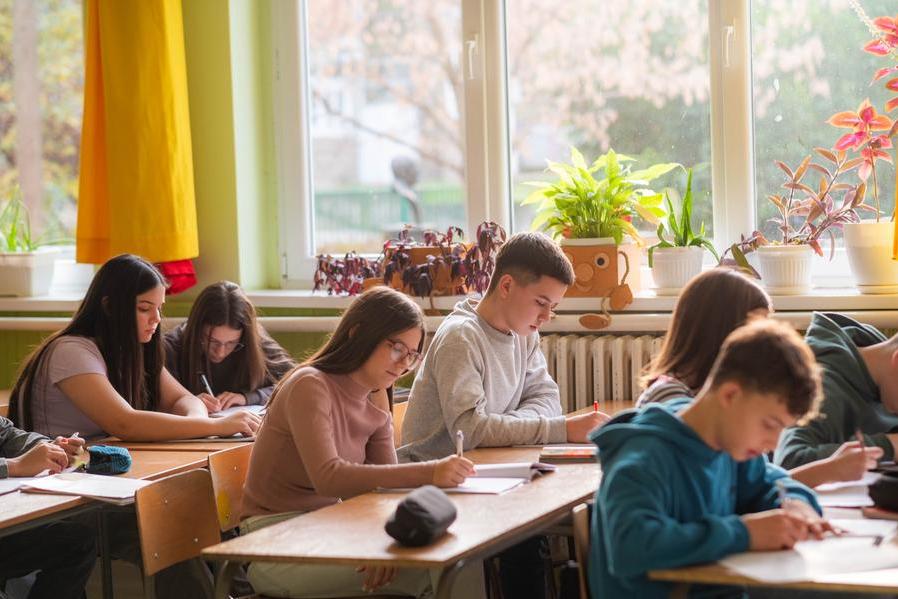
High schools continue to dominate the choices of Italian students, but the classical high school is still falling behind. The data on high school enrollments for 2026 confirm a now stable trend: 55.88% of children choose a high school pathwhile technical and professional remain respectively at 30.84% et al 13.28%.
Within this framework, however, clear signs of change emerge. Classical high school drops to 5.20% of preferences and, especially in northern Italy, shows a constant decline. In Lombardy, for example, it stands at around 3.2%. “The classic is losing thousands of members nationwide every year,” he observes Alessandro Giuliani, director of School Technique. “This is not a sudden collapse, but a continuous reduction that has continued for several years.” The phenomenon is particularly visible in large urban centers: «Only in Milan», he underlines, «in five years approximately 1,500 students enrolled in classical high school were lost».
Families are more prudent in their choices
According to Giuliani, it is above all that orients decisions a cultural change in familiesincreasingly attentive to future usability of the course of study. «If you decide for a high school, today we tend to favor the scientific one, which guarantees broader skills in view of university», he explains. A choice that appears more prudent especially because, at 13, many kids still don’t have clear ideas about their future. The scientific field is thus perceived as a more “open” field, capable of maintaining more viable paths, in particular in the area of STEM disciplines (science, technology, engineering and mathematics) and in university courses with a strong scientific component.
The Latin knot
The relationship with ancient languages also weighs on the decline of the classical. «There is less sensitivity towards traditional cultural preparation linked to Latin and Greek», observes Giuliani. It is no coincidence, in fact, that the trends that lighten or eliminate Latin are growing.
The high school of human sciences, especially in the economic-social option, attracts many families precisely because it maintains a high school system but without classical languages. A trend that reflects an increasingly pragmatic approach to school choice. In this scenario, the scientific institution consolidates its role as a balanced high school: «It offers greater guarantees to families», reiterates the director of School Technique.
The consequences for institutions
The decline in enrollments is not without effects on the school system. If the trend continues, some classical high schools could undergo the so-called downsizing. «When the number of students falls below certain thresholds», explains Giuliani, «the institute risks losing autonomy». In concrete terms, the school is merged with other realities, with the loss of the school director and a part of its identity in the area. A process which, in the long term, could further reduce the presence of the classics in some areas.
To reverse the trend, according to Giuliani, the classical high school should partially update its educational offering. «The traditional structure must be maintained», he specifies, «but disciplines closer to the interests of children could be introduced», such as sociology, anthropology or psychology. A rebalancing that could also happen through a review of timetableswithout distorting the identity of the address.
Orientation and risk of dispersion
However, the issue of orientation remains decisive. The transition between middle and high school, Giuliani recalls, it is one of the most delicate moments of the school career. “The highest number of dropouts and changes of address are recorded in the two-year period of high school,” he underlines. For this reason it becomes fundamental help students really learn about the different options before choosing. In recent years, also thanks to Pnrr funds, schools are investing more in orientation but, he warns, “often not all the useful information to fully understand the routes is available yet”.
There remains only one starting point: listen to the kids. «The nature of the student must prevail», concludes Giuliani. “The family should accompany the choice, not replace it.” Because, beyond the statistics and fashions of the moment, the challenge always remains the same: to help every child to find the most suitable path to truly grow your talents.