




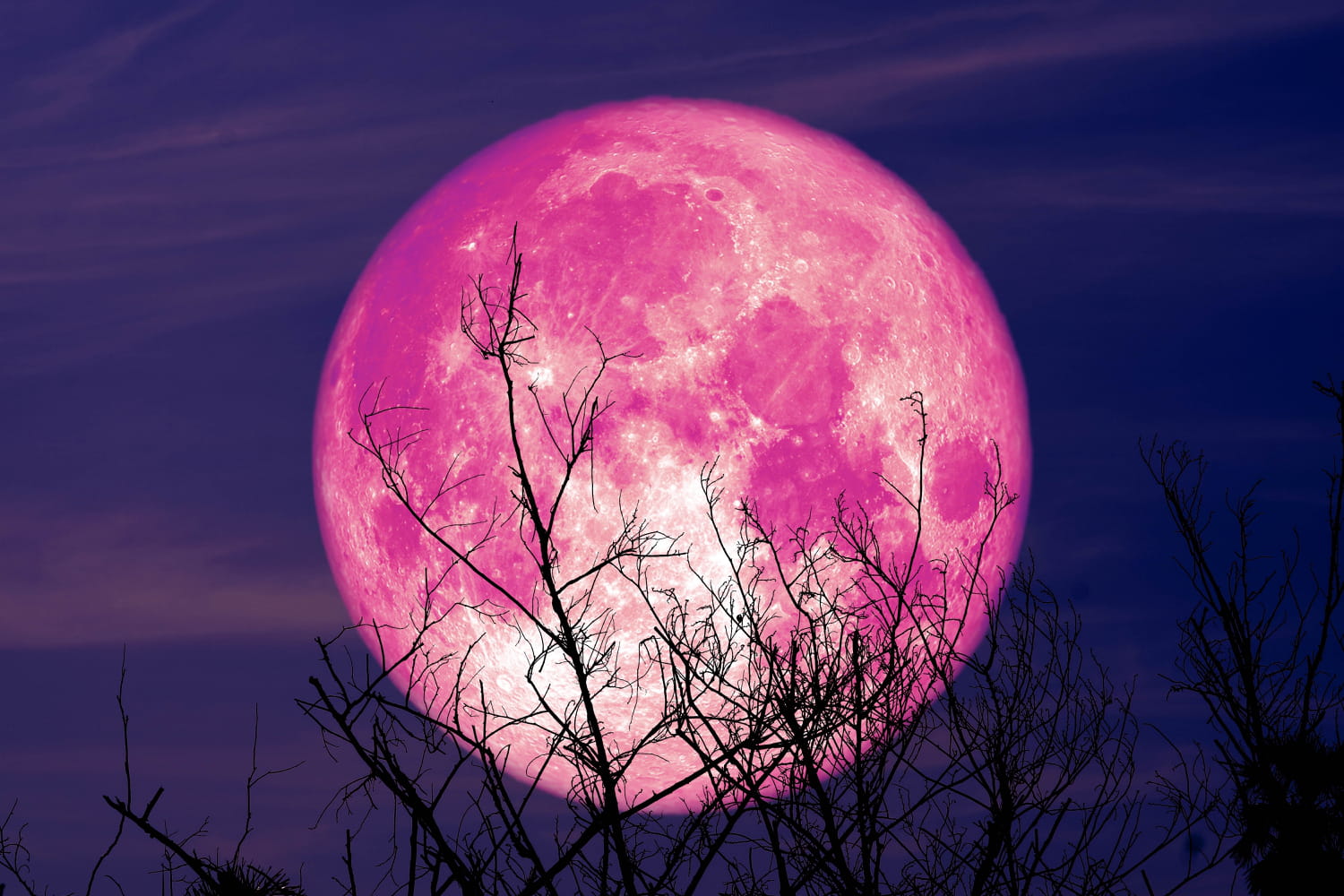
It can appear up to 14% larger and 30% brighter than a typical full moon. It will give us the impression of “falling” on us.
Spring begins to set in and with it comes one of the most anticipated celestial events of the year: the Pink Full Moon. Whether you are an astronomy enthusiast or simply a fan of beautiful night shows, get ready, because this 2026 edition promises to be extraordinary. Let’s bust the myth right away: the Moon won’t change color and suddenly look like floating cotton candy. Its poetic name comes from Native American tribes, who named it in homage to “Phlox subulata”, a small pink flower that covers the landscapes of North America from the beginning of spring. In the sky, she will retain her magnificent silvery-white or slightly golden dress, but she will have a “little something” extra.
The Pink Full Moon is what we call a Super Moon: it will therefore be larger and brighter than other full moons. The Moon’s orbit is not a perfect circle but an ellipse. When it is at its closest point to Earth (perigee), it can appear up to 14% larger and 30% brighter than a typical full moon. We will have the impression that it “falls” on us. A spectacle that does not go unnoticed, even to the naked eye.
The next Pink Full Moon will take place on Thursday, April 2. It will reach maximum illumination at 4:13 a.m. (Paris time). To take full advantage of it, you have to look at the Moon just after rising (in the East) when it touches the horizon (this is also the photographers’ little secret). Thanks to a famous optical illusion, the brain perceives it as gigantic when it is close to terrestrial elements such as buildings, mountains or trees. It is advisable to choose a place with a clear horizon towards the East. Parks, seasides or the roofs of buildings are ideal observation posts. No equipment is required, but a pair of binoculars allows you to admire the details of its craters with incredible clarity.
Science confirms what many feel: the Super Pink Moon can disrupt sleep, mainly because of its 30% more intense brightness, which slows down melatonin and delays falling asleep. Regarding the effects on mood, opinions are more divided. If we sleep less well because of the light, we will naturally be more irritable, anxious and tired the next day. This is the “snowball” effect. Also, unconsciously, we are more attentive to our strong emotions on these days, which reinforces the idea that it is the Moon’s fault. We often hear: “If the Moon acts on the tides, it acts on us because we are made of 80% water”. This is physically wrong. The tidal effect depends on the mass of the object. The gravitational force of the Moon on a human being is weaker than that of a mosquito landing on our arm. The impact is therefore purely psychological.
However, to limit the possible effects of the Full Moon on April 2, it is recommended to close the shutters or use blackout curtains to block as much light as possible. If you miss this event, know that the Pink Full Moon is an annual event. The next one will happen in a year, on April 20, 2027. Until then, keep your eyes up to the stars…