






Urinary leaks, loose perineum, intimate discomfort… After 40 years, these signals are not inevitable. What if the solution was at your fingertips, from home?
We rarely talk about it, among friends or even at the doctor’s office. The perineum, this muscle that we don’t see, that we barely feel… Until the day it manifests itself by a small leak when sneezing, laughing or going for a run. A detail, we think. An inevitability, we sometimes resign ourselves to. However, no.
After the age of 40, with the hormonal changes linked to premenopause and menopause, the pelvic floor can lose tone. This is neither a surprise nor a punishment: it is physiology. And above all, it is something that it is entirely possible to act on, at any age, including from home.
So where to start? What are the warning signs? And how to re-educate your perineum? We take stock.
Why can the perineum weaken?
Imagine a hammock stretched between the pubis and the lower spine. That’s pretty much what the perineum is: a set of muscles and ligaments that supports the bladder, uterus and rectum, and which works silently in every moment of your life. When you cough, when you carry your groceries, when you play sports — he’s the one who takes it.
The problem is that we only think of him when he remembers us. And after 40, he tends to do it more often.
The first reason is hormonal. With premenopause and then menopause, estrogen levels gradually decrease. However, these hormones play a direct role on the elasticity and tone of tissues. Result: the pelvic floor muscles lose flexibility and resistance, sometimes without us realizing it right away.
Then come the delayed effects of pregnancies and childbirth. We often believe that if everything went well after birth, it’s sorted. But the consequences on the perineum can appear much later, sometimes ten or fifteen years later, under the combined effect of time and hormonal changes.
Finally, lifestyle also plays its role. Repeated efforts (such as with impact sports, carrying heavy loads, chronic cough or constipation) gradually weaken the pelvic floor. Conversely, a sedentary lifestyle does not stimulate it sufficiently. In both cases, your perineum loses.
What you need to remember: these changes are common, but they are not inevitable. The perineum remains a muscle, and muscles respond to training at any age. We still need to know how to recognize the signals that indicate that it is time to act.
When should perineal rehabilitation be considered?
Many women wait until the symptoms become really bothersome before worrying about them. However, perineal rehabilitation is much more effective when it is undertaken early, including in the absence of declared disorders.
After 40, and even more so as menopause approaches, it’s a good time to take stock. No need to wait for disabling urinary leakage or the feeling of permanent heaviness to act. A perineum that is maintained regularly is a perineum that is more resistant to future hormonal changes.
That said, if you already feel signs, leaks during exercise, urges, intimate discomfort, feeling of relaxation, the first step is to consult a health professional. A doctor, gynecologist, midwife or specialized physiotherapist will be able to assess the situation and direct you towards the appropriate course. Perineal rehabilitation, whether done in the office or at home, always benefits from being based on an initial assessment.
Find out how to prevent perineum problems after 40 at Fizimed.
Can you do perineal rehabilitation at home?
This is a question that many women ask themselves, and the answer is yes, provided you know how to go about it. Perineal rehabilitation at home is not a cheap solution: it is a complementary approach, recognized by health professionals, which makes it possible to maintain and consolidate the benefits of rehabilitation over time.
Because this is often where the problem lies. We do a few sessions with the physiotherapist or midwife, we leave with good intentions… And then everyday life takes over. Lack of time, forgetfulness, loss of motivation: these are the real enemies of the perineum. Health professionals are also the first to say it: home exercises are very useful for anchoring progress over time.
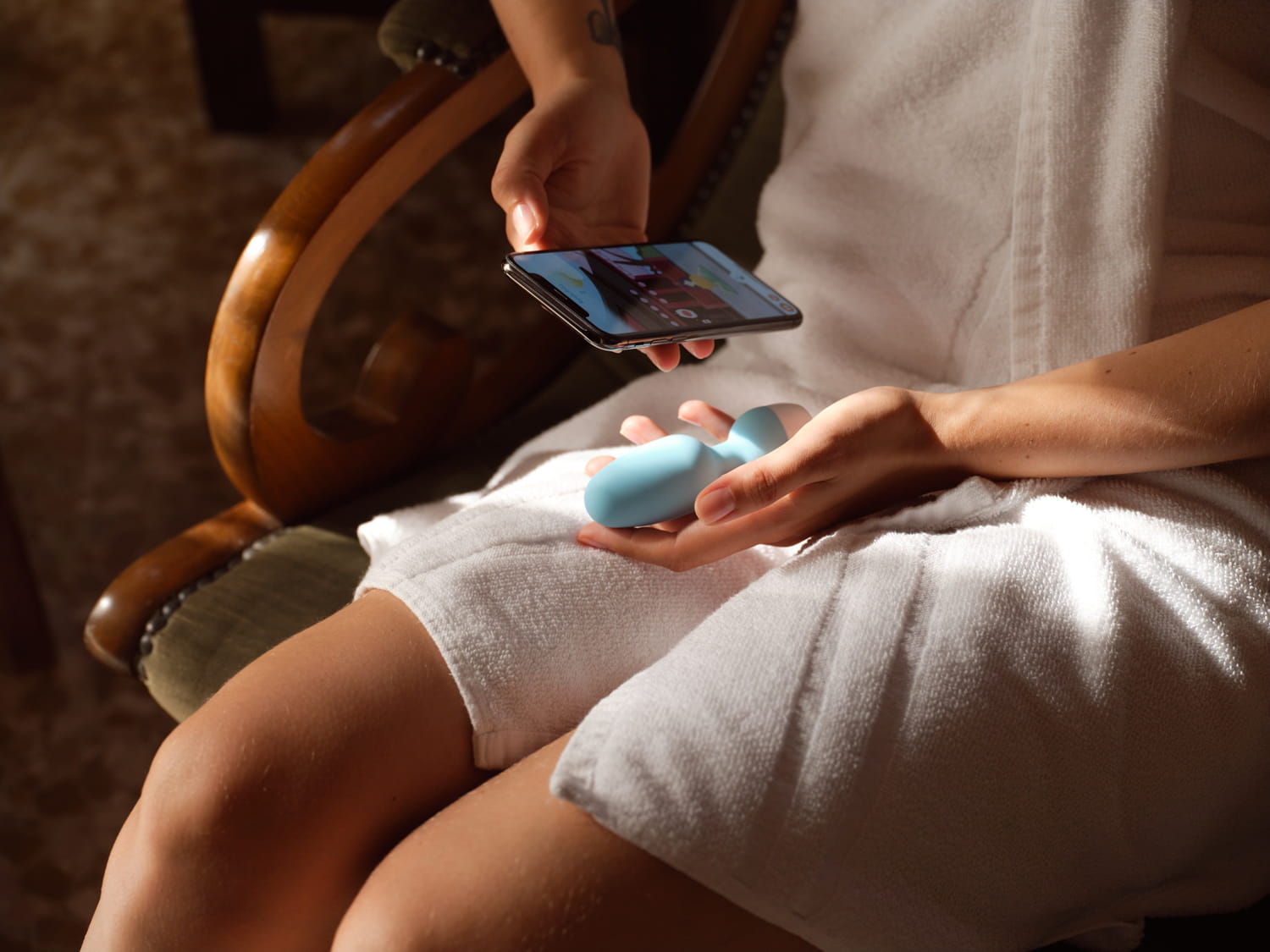
It is now possible to carry out perineal rehabilitation at home using different methods: pelvic floor contraction exercises, biofeedback or guided programs. It is with this in mind that the Strasbourg start-up Fizimed has developed Emy Trainer, a connected perineal probe designed specifically to allow women to re-educate their perineum at home, without appointment constraints and at their own pace.
Learn more about Emy Trainer at Fizimed.
Emy Trainer: exercises and solutions to strengthen the perineum
What exactly is Emy Trainer? A connected perineal probe, equipped with biofeedback sensors, which measures the muscular activity of your perineum in real time and sends the data directly to your smartphone. Already adopted by more than 5,000 healthcare professionals, the device allows you to visualize your contractions, correct yourself if necessary, and help you progress with each session. No more doubt about the quality of your exercises: you see what you are doing.
The device is associated with a free application which offers 32 interactive games and 8 medical programs based on the globally recognized PERFECT Scheme protocol. From the first use, a test evaluates your ability to contract and relax your perineum, and the application builds a personalized program based on your results. Over the course of the sessions, the exercises evolve with you.
Five to fifteen minutes a day, two to three times a week: that’s all it takes. And the first results are felt after three weeks of use. After three months, 98% of participants in the clinical study conducted in partnership with the Strasbourg University Hospital noted a significant improvement in their quality of life, and 91% a reduction in their urinary symptoms.
Designed in France with medical grade materials and manufactured in Europe, rechargeable and guaranteed for five years, Emy Trainer is a CE marked medical device, without electrical stimulation or vibration. Discreet, silent, usable standing, sitting or lying down, it fits naturally into everyday life, without disrupting your schedule. And if you are already following a treatment course, know that it is completely compatible with in-office follow-up: your physiotherapist can even program your exercises directly via the application.
While perineal rehabilitation has long suffered from an austere, medical, restrictive image, solutions like Emy Trainer are changing everything by making these exercises accessible, fun and integrated into the daily life of any woman, whatever her age or situation. Because a toned perineum is not an abstract medical objective: it is running after your children without thinking about it, laughing out loud without restraint, returning to sport without apprehension.