


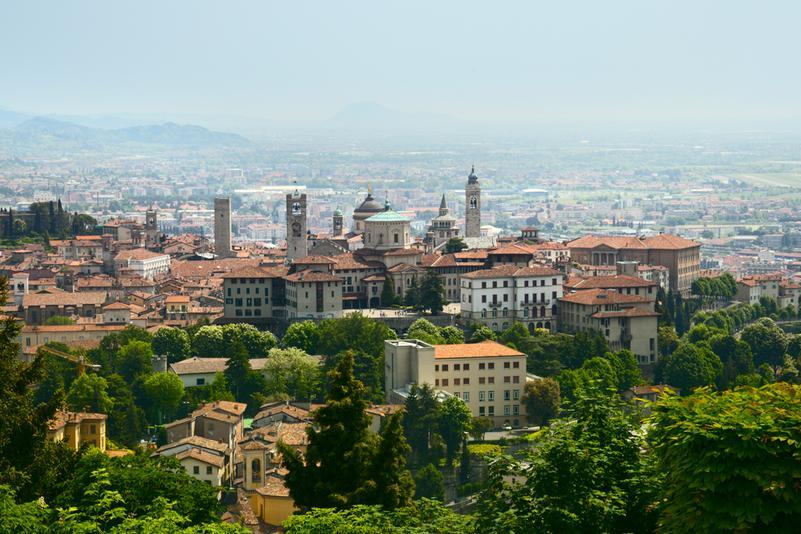
It’s not just an event, but a change of direction. From 19 to 21 March, the Giovanni XXIII Congress Center in Bergamo will host the fifth national conference of the CEI Service for the pastoral care of people with disabilities. The title chosen, “WE, community and life project”, is not a simple slogan, but a declaration of intent: to overcome the dichotomy between “us” and “them” to rediscover a single community in which each individual, with their own potential and needs, can be the protagonist of their own destiny.
Created in collaboration with the Dioceses of Bergamo and Bresciathe event will transform the city into a laboratory of the future. Over 60 speakers — between theologians, operators, families and representatives of institutions — will discuss crucial issues such as self-determination, work, sport and accessibility, trying to give concrete answers to everyday challenges.
Among the central moments of the three days, the morning of Friday 20 March will see the speech of Massimo Maggio, director of CBM Italia. Within the dedicated round table, Maggio will address the topic “Communicating disability”. «Social communication» declared the director «has the extraordinary power to generate listening and participation, as long as it is authentic, accessible and capable of involving large audiences, breaking old stereotypes».
But what does it mean, in practice, to move from “doing something for” people with disabilities to “building together”? And how can the Church truly become a home where everyone feels they belong? We asked Sister Veronica Donatello, head of the National Service for the Pastoral Care of People with Disabilities of the CEI, who in this interview tells us not only the vision behind the conference, but also the passion that arises from her personal life experience.
Sister Veronica, the title of this conference strongly insists on the concept of “WE”. Despite years of cultural battles, why do we still struggle so much to undermine the dichotomy between “us” and “them” in society and, sometimes, even in our communities?
«“WE, not them” or “with us” is the common thread that we have always carried forward in our conferences. The challenge is to accompany communities to overcome that effort which, despite the documents and years of work, still leads to implementing postures in which one works for them and not with them. Traveling around the territories and listening to people, we realize that prejudice is still the greatest limit: when faced with a disability, whether congenital or acquired, we often stop at the support tools – the slide, compensatory or adaptive subsidies.
But the tools, while necessary, are not enough. The transition we are working on is that from inclusion to belonging: this is what generates the “us”. The other feels he belongs when he perceives that he himself can be a builder of good and of society, both civil and ecclesial. This is why the title continues with “community” and “life project”: the “we” comes to life if we create a network. We chose Bergamo precisely because it is an area that has chosen to implement concrete responses, where the Church, the civil world, schools, sport and the healthcare sector collaborate to accompany and, above all, to allow themselves to be accompanied. It’s a two-way path: it’s not you who accompanies them, but together we become a community.”
What does it concretely mean to move from an approach based on simple “taking care” to accompanying a person with disabilities in building a real life project made up of desires, work and sport?
«It means moving away from the logic of doing something for them. The care approach is a good start, because the needs are real and should not be denied, but they do not exhaust the person, who also has talents and desires. I think of the people with very serious disabilities that I met in Grumello: it is clear that they will never be able to have a traditional job, but they live a working dimension by contributing to small daily tasks in their structure. This allows them to not only feel assisted, but subjects capable of offering a good and building the environment in which they live.
We must dismantle stereotypes and “one-color” responses. It’s tiring, but the challenge is won by building networks. It often happens that once compulsory school is finished, everything ends: if you’re lucky you find structures that follow you in the transition to adulthood, otherwise you’re left alone. Families ask to be accompanied at these junctions. Nobody has the answer ready on their own: neither the Church, nor the State, nor the associations. Only by staying within the complexity and networking can we give real answers to young people, adults and elderly people with disabilities.”
She experiences the issue of disability not only as a service manager, but also in her personal life as the daughter of deaf parents and sister of a person with a disability. How has your experience shaped your vision of pastoral care?
«Jokingly, I always say that I have “all the union acronyms”: I am CODA (daughter of the deaf), sibling of a sister with disabilities and caregiver. At home I saw that “it can be done”. I learned a lot from my parents who, faced with a Church that was sometimes absent, rolled up their sleeves and worked for the local community. From them I learned faith.
Even today I experience on a daily basis what every family member experiences: to come to this conference, I had to organize the management of my sister Chiara in the structure she attends. I experience the same anxieties and the same practical difficulties linked to “during us” and “after us”. All this is a great driving force, a passion that comes from my history but also from the many stories that I have encountered every day for ten years in this service. As a poem says, “we are the others”: encounters change us, and I have been profoundly changed by the people with whom I build responses every day.”
Is there a true “disability pastoral care” in Italy today or is the spiritual life of these people still delegated to the good will of the families?
«Unfortunately, this is still often the case. Precisely for this reason the conference will open in Sotto il Monte with a moment of ecumenical spirituality: we will be together with families of other confessions because spirituality helps us not to feel alone. Too often we stop at basic needs – eating, sleeping, rehabilitation – forgetting that we are body, soul and spirit.
Where is the spiritual accompaniment for a person with disabilities in various stages of life? Or for those who become disabled due to an accident or war? Scientific evidence tells us that working on the spiritual dimension reduces behavioral disorders and improves acceptance of one’s condition. Spirituality is the humus of “us”: it helps us to recognize ourselves as people, because, ultimately, we all have limits and it is what makes us human. It is the key to stop talking only about rights or needs and finally start talking about belonging.”