








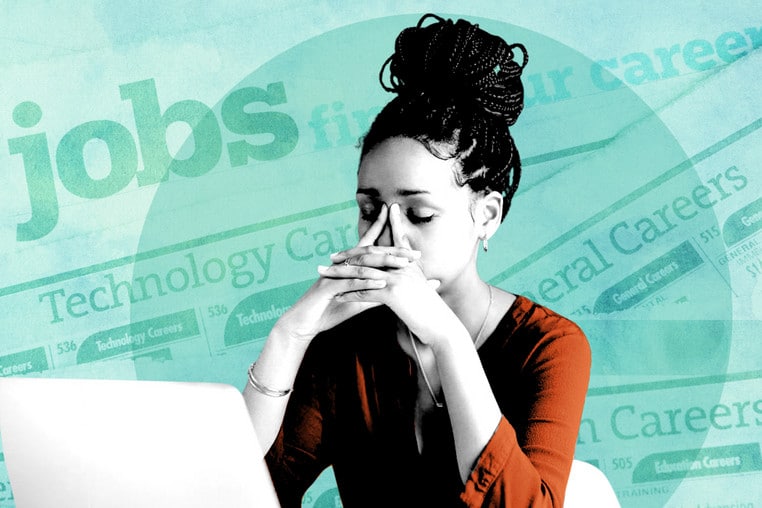
The Economic Policy Institute released data this week that shows black women suffered large employment losses in 2025. As Black women are being pushed out of workplaces in record numbers, it’s not hard to see why we feel like imposters. Black women continue to live at the intersection of racial and gender bias in a society where their labor is undervalued, their safety is inconsistently protected, and their voices are routinely dismissed or ignored across workplaces, healthcare systems, media coverage, and public policy.
Unfortunately, long before workplaces questioned our competence, generations of silencing from well-meaning parents, church members, and society at large had already taught Black women to second-guess their own voice. Imposter syndrome is often described as the belief that you are not as capable or accomplished as others perceive you to be, even when evidence says otherwise. For me, it was a constant questioning of whether I belonged in spaces I had come to idealize. I assumed that my success in any area came from luck or timing, thereby minimizing my achievements and bracing for the moment when someone might realize I was not as good as they thought. I lived with it quietly, shaping my behavior long before I ever spoke it aloud.
That internal tension did not appear out of nowhere. I grew up in Mississippi, in a time when young Black girls were taught early to be seen and not heard. To speak when spoken to. To stay in a child’s place. This was not about cruelty. It was about survival. In a society where compliance and respectability for Black Americans could mean safety, silence was framed as discipline and care. After all, many of our cultural leaders were killed for speaking out or being too visible. Those lessons followed me, carrying into adulthood, professional spaces, and rooms where my voice was needed most.
As I grew older, the messaging shifted but never disappeared. The expectation was to accomplish more, but not do too much. For black women, it seems there is an unwritten rule that it’s okay to be successful, but only “successful enough,” never so much that you trigger insecurity or resentment in those around you. Even among peers in the Black community, there is the underlying judgment of “she thinks she’s all that,” or, for others, the thin line between “she’s capable” and the question, “who does she think she is?”
Over time, these assumptions teach you to regulate yourself, to stay alert to how your ambition is perceived, and to shrink before anyone asks you to.
For many of us, being raised in the Black church adds another layer. Humility is held as the highest Christian virtue. Yet humility is often misunderstood. True humility is dependence on God as the source of all things, not the erasure of self, or self-depreciation. Still, the message can become tangled. The message becomes “we are not worthy.” Do not exalt yourself. Don’t take too much credit. Do not stand too tall. Over time, faith, culture, and survival blur together, reinforcing the idea that visibility requires caution.
Then comes the familiar refrain: you have to work twice as hard for half as much. Even when offered as preparation, it conveys a subtle message that effort must compensate for something lacking. That, without extra proof, extra credentials, extra labor, you are not enough. That belief is ingrained early, shaping how black women show up.
If cultural silencing isn’t enough, we eventually enter a society that reinforces this self-doubt. We are portrayed as too loud or too silent, too ambitious or not ambitious enough, strong but not soft, capable yet somehow still suspect. Media narratives, workplace stereotypes, public discourse, and everyday interactions send constant signals that our confidence must be measured and our presence carefully managed. Over time, these messages accumulate, shaping not only how we move through the world but how we are received once we arrive in professional spaces. The result is not simply internal doubt. It is a broader social conditioning that follows Black women into every room.
It’s true that not all black women experience imposter syndrome or cultural and professional silencing, but it’s more common than not.
As Black women continue to be pushed out of workplaces in record numbers, it becomes clear that our stories are not isolated. The self-doubt may have started long before, but it meets environments that continue to question our voice, our leadership, and our presence. Until we fully acknowledge how lifelong conditioning and present-day workplace dynamics collide, the pattern of Black women being pushed out will continue to be misunderstood as individual struggle instead of what it truly reflects: systemic bias, structural inequities, and the cultural suppression of Black women’s voices.
About the Author: Eboni Delaney is the Director of Policy and Movement Building at the National Association for Family Child Care (NAFCC), and a Public Voices Fellow of the OpEd Project in Partnership with the National Black Child Development Institute.


