



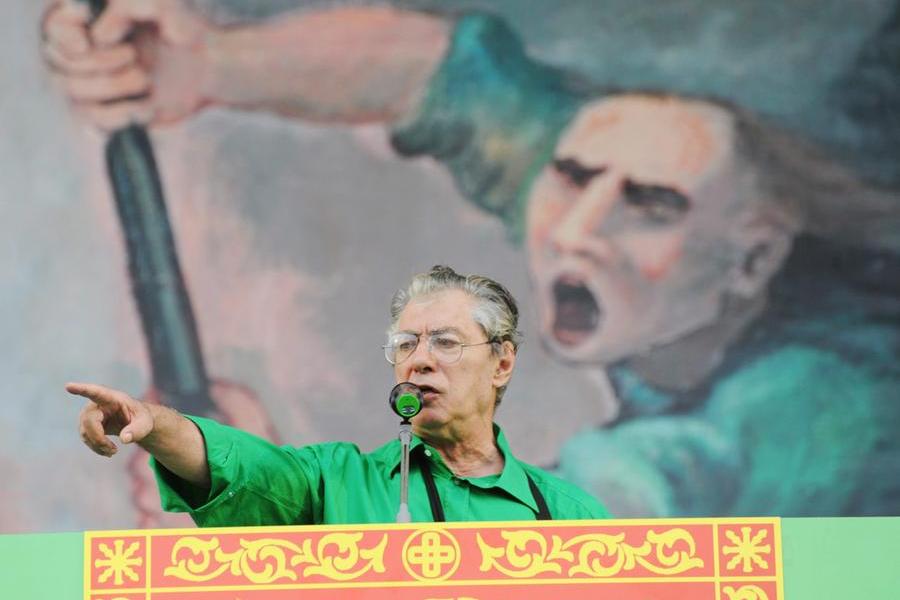
Now that the stunning and colorful set of crocodiles, testimonies and memories dedicated to Umberto Bossi of Cassano Magnago, who died in Varese at the age of 84 after a long illness, has passed away like a hurricane of pages, I too will try to write mine about a political experience that lasted 40 years, which I followed as a reporter almost step by step, which officially ended with his death, even if historically it had ended a long time ago.
I was born and raised in Busto Arsizio, in the province of Varese, a few kilometers from his hometown, Cassano Magnago, and from Gemonio where he lived and which has always been his retreat and therefore I know what I’m talking about. I got to know the League, the oldest party present in Parliament, long before it was born, in the year of grace 1984 by the will of seven founding members. Umberto Bossi’s Lombard League was already hovering in the widespread anti-Southernism that prevailed in my area. In middle school I remember that there was a schoolmate (his name was Armiraglio) who in every discussion with the literature teacher always blamed the southerners (obviously echoing the discussions at the parents’ table). Outside the classroom, southerners became “southerners” and people – lots of people – took on a much harsher tone (“you don’t rent to southerners”) complete with slander, courtyard brawls, arguments in the oratory, ambushes on leaving school, even condominium disputes. Bossi had the intuition to transform anti-Southernism into consensus, into political propellant, and his party was born, which then obviously became something more complex, with the language of the squares and the instinct of those who sense before others where a crack is opening. And he widened that rift between the North and the central state, between taxpayers and the public machine, making it a much broader political project, also because the new migrants had come to the rescue: non-EU citizens.
A leader born outside the system
Umberto Bossi, whose political past as a ’68er and singer-songwriter of the ’70s (stage name Donato) survived in his teardrop glasses (the only famous case, that I know of, apart from Antonello Venditti), was not born in the corridors of power, and this marks everything. When he set up the Lombard League in the 1980s, it had neither a complete structure nor a complete theory. However, he has a clear target: the anti-meridionalist retrothink and Rome. And a language that breaks with the polite politics of the First Republic. No pompous rhetoric: slogans, phrases in dialect, provocation, sloppy clothing, in short: a postmodern commoner. It is a politics that is more like an organized protest than a party. Perhaps it would have ended there, like many other independence groups of the time, but Bossi is a barbarian of genius, a formidable political tactician who history chose to undermine the First Republic.
The favorable historical context
The first triggering factor, the great booster, is the fall of the Berlin Wall and the end of communism which transforms the vote from ideological to identitarian. From left-right dualism we move to North-South. A formidable propellant for autonomy. In the East after the fall of the Wall there was slaughter, as in Bosnia and Sarajevo. It went well for us, there are even those who say thanks to Bossi who was able to incorporate and contain the most violent pressures. He chooses as his symbol that Alberto da Giussano who never existed, symbol of the struggle of the Municipalities against Barbarossa. He is inspired by the Legnano bicycle brand and the monument of the Lombard city by Enrico Butti, the same sculptor of the statue of Giuseppe Verdi in Piazza Buonarroti, in Milan. He becomes a senator, earning the title of senatur together with Giuseppe Leoni who is elected honorable. Then Tangentopoli arrives, and there Bossi, despite having been touched by the Mani Pulite investigation, understands that the moment has come. The parties that have governed for decades collapse under the weight of the investigations and the end of communism which had kept them standing for fear of the “leap in the dark”, and he presents himself as the clean man. Not refined, not reassuring, but credible to those who are fed up. The Northern League was born in 1991, a federation of territorial leagues held together more by the charisma of the leader than by a true ideology, his true strength.
The rise: from Parliament to Milan
1992 is the first leap: the League enters Parliament with numbers that shake the old balance. But it was 1993 that marked the decisive transition: Milan, the economic capital of the country, elected Marco Formentini as mayor. It’s not a local episode, it’s a national signal. The productive bourgeoisie of the North recognizes itself in Bossi, or at least in his denunciation.
The meeting-clash with Berlusconi
In 1994 came the clash with Silvio Berlusconi. Two different men, but both children of the collapse of the First Republic. Together they win the elections and go into government together with Gianfranco Fini’s MSI cleared by the Cavaliere and becoming the National Alliance. But the alliance lasts a few months. Bossi breaks, accuses Berlusconi of wanting to build personal power (and in fact the entrepreneur who “took to the field” has always tried to remove Bossi’s colonels to enlist them in Forza Italia) and withdraws his support. It is the first tear in a relationship that will always be ambivalent: necessity and distrust, convenience and rivalry.
The break with Miglio and the primacy of the boss
In those same years the break with Gianfranco Miglio also took place, the professor who had given the League a theoretical structure. I remember the day when, from a stage set up inside a warehouse in front of a crowd of cheering Northern League members, some of whom were wearing Northern hats from the American Civil War, he declared the division of Italy into three and proclaimed secession. But Bossi prefers concrete, even brutal, politics. He chooses the former Alitalia steward Speroni as reform minister and Miglio leaves, mocked by Bossi. The divorce between the two marks the end of any “scientific” ambition of the Northern League project. Miglio is none other than one of the hundreds of Northern League leaders burned by the senatur, with an almost Leninist methodology, a privilege of charismatic leaders who receive power directly from the people. I gave Miglio the last interview of his life, visiting him in his Tyrolean-style villa in Domaso, on Lake Como. He spoke to me about Bossi as if he were a bar thug and had a melancholic look in his eyes, very different from his well-known Luciferian look.
Symbols, rites and political theatre
Also in 1994 Bossi brought Irene Pivetti to the presidency of the Chamber. It is a breaking gesture: a young Northern League member, outside the traditional circuits, at the top of an institution. But here too history repeats itself: the relationship deteriorates, and Pivetti will end up outside the party.
In the mid-1990s the League took the most radical path: secession. Padania is born, symbolic referendums are organised, a powerful identity narrative is built, which will even end up creating a sort of pagan religion with the ritual of the cruets of the sacred Po river and other such antics. The Bergamo meadow of Pontida becomes the sacred place, the collective rite. It’s politics, but it’s also theater. In Pontida there was a market made up of stalls where political gadgets of all kinds were sold, almost as if to grotesquely recreate a Po Valley Republic: from banknotes with Bossi in effigy to books on federalism, from AC i Padano membership cards to typical products and underwear knitwear with the words “Viva la Padania”. And it works, at least for his voters and at least for a certain time. In the meantime, Bossi implements the “turnaround” by allying himself with D’Alema and Buttiglione, forming a new government.
The return to government and Maroni’s role
But then reality knocks. Without alliances you cannot govern. And Bossi returns with Berlusconi in 2001. He becomes minister for Reforms and tries to translate his warhorse into law: federalism. Roberto Maroni grows next to him, the number two, the most institutional, most capable of keeping the party together in difficult moments. The relationship between the two is one of unstable balance: Bossi is the boss, Maroni the manager. It works as long as it works.
Illness and the beginning of decline
The stroke came in 2004. A hard blow, which marked him physically and politically. Bossi returns, but he is no longer the same as before. His voice breaks, his charisma weakens, even if the symbol remains intact. The League continues to weigh in on Berlusconi’s governments, especially in 2008, but it is clear that something is changing.
A controversial legacy
So, summing up, we need to be honest: Bossi divided the country, but the country was already divided. He gave political form to that division, made it visible, strengthened it, brought it into the institutions. He imposed direct, often unpleasant, but effective language to gain consensus.
The scandals and the end
The final blow came in 2012, with internal scandals over the management of party funds. Far from thieving Rome, it turns out that the League is the more “Italian” party than the others, with its mercenaries and its thefts. Millions and millions stolen thanks to the law on public financing of parties. At the beginning they try to stem the scandal with a few strokes of paint. Among the hundreds of demonstrations that I followed, traveling for thousands of kilometers with my car from one end of the North to the other, from Venice to Mantua (where they had established the Padano Parliament, while the government was in Bossi’s house in Gemonio), from Varese to Lecco, with snow, fog, rain or much more rarely the dazzling sun, in addition to the dozens of rallies in Pontida in which I was numb for hours, with my notebook, mixed among the cheering crowd, perhaps next to some energetic Northern League member in camouflage or disguised as a Viking, with his feet in the mud (the Pontida lawn is actually a patch of watered-down earth), I also put up with the antics of the brooms, inside a rented shed of the Bergamo Fair, as if waving around twenty green-painted brooms was enough to demonstrate that a clean sweep had been made in a party corrupt.
The long goodbye
Bossi is forced to leave the secretariat. It’s not a sudden fall, it’s the end of a long attrition, of a long goodbye. The movement passed into other hands, changed its skin, gradually abandoned secessionism to become a national party. I remember the first demonstration in Milan of the Northern League members led by the heir Matteo Salvini, who raised it from 3 percent to 20 percent. The Casa Pound clubs were also at the demonstration. Bossi has always made anti-fascism and the Resistance one of his fetishes, even if he was not immune to warlike metaphors and warlike impulses, such as the birth of the green shirts. What the hell did Casa Pound’s clubs have to do with the League? Then over time I understood it. Salvini, however, understood it. But that’s another story.