




On Golgotha, the tree of life
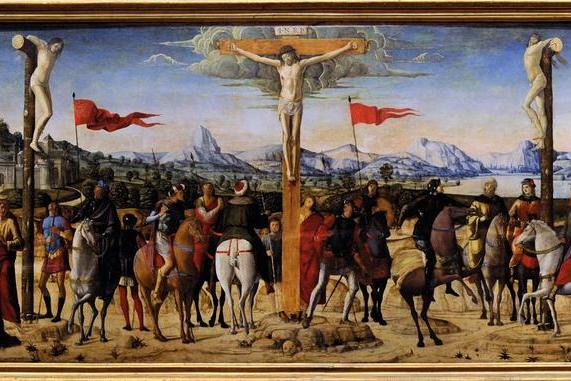
The story of the Passion according to John, especially in the section that goes from Golgotha to the burial (John 19,17-42), is not just the chronicle of a violent death. It is a great theological meditation, built with images, references, silences. Everything is full of meaning, nothing is left to chance. Jesus is led to the place called the Skull, Golgotha, and there he is crucified together with two others: one on one side and one on the other, “and Jesus in the middle”. John insists on this “in the middle of”as if it wasn’t obvious. But he doesn’t do it out of distraction: he wants to suggest an ancient and very powerful image. In the middle of the garden of origins, Genesis tells us, he was the tree of life. Now that tree is the cross. From it hangs the fruit that gives life to the world.
In his Gospel John has prepared this moment from the beginning. When Jesus promises close to the call of the first disciples that the sky will open and the angels will ascend and descend on the Son of man, he is evoking the ladder Jacob dreamed of. But that ladder, for the believer, has a precise name: it is the cross. It is from there that heaven and earth communicate again. There is no profound look at God that does not pass through this wood. Under the cross moves a humanity divided and recomposed at the same time. The Roman soldiers, pagans, divide the clothes of Jesus; the tunic, however, remains intact, drawn by lot. Not far away are four women, all Jewish, including Mary and Mary Magdalene. Men and women, pagans and Jews: the evangelist seems to mean that salvation knows no boundaries. The cross planted in the middle of the world opens the four cardinal points of history. The seamless tunic, which is not torn, has long fascinated the Church Fathers. It is the robe of the high priest, but also the sign of the unity of the Churchwhich cannot be torn. Like the net of a miraculous catch, which although full does not break, so the community of believers is called to remain one.
Under the cross Jesus pronounces essential words. He entrusts his mother to the beloved disciple and the disciple to his mother. A new family is born here, founded not on blood but on faith. Mary, called “woman” as at Cana, appears as the new Eve, mother of a reconciled humanity. The wedding announced at the beginning of the Gospel now finds its fulfillment: the groom gives his life for his bride, the Church. Then Jesus says: «I am thirsty». It is man’s thirst, of the profound desire that runs through every life. It is the same thirst evoked before the well of Sychar. And finally: “It is finished.” It’s not a cry of defeat, but of fullness. Love has reached the extreme. Bowing his head, Jesus delivers the Spirit.
Blood and water flow from his pierced side. John sees in that gesture the fulfillment of the Scriptures: Jesus is the new temple, from which the spring flows heals the world. It is the water of Baptism and the blood of the Eucharist, the river of life that makes even the “dead sea” of human existence fruitful. The story ends in a garden. Joseph of Arimathea and Nicodemus, who had once sought Jesus at night, now act in the light of day. They bring aromas in abundance, as if for the burial of a king. The tomb is new, and no one has ever been placed there. It is a new death, which already smells of life. The garden returns to being what it was at the beginning: the place of encounter between God and man. On Golgotha, where everything seemed to end, paradise is silently reopened.