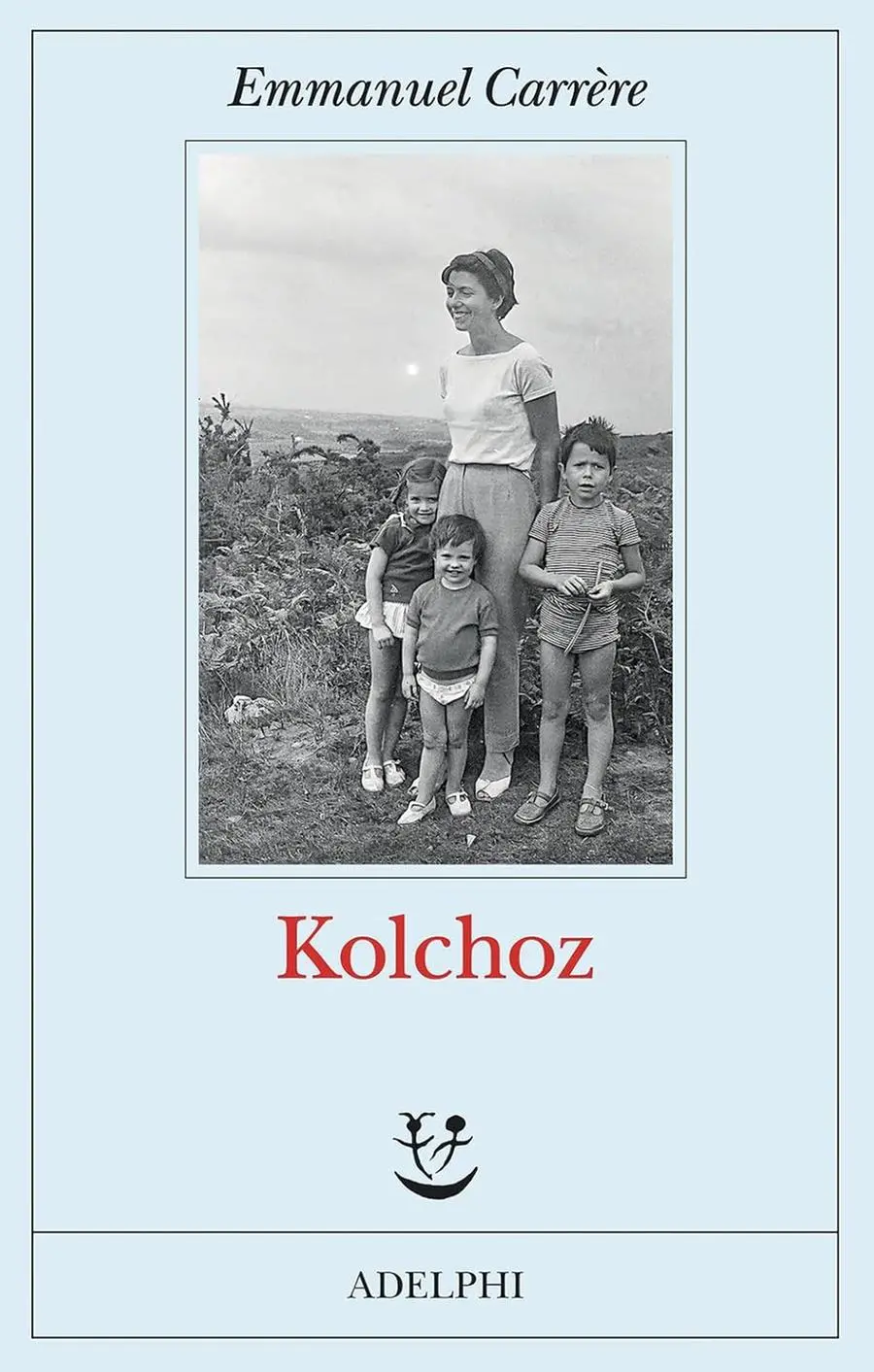






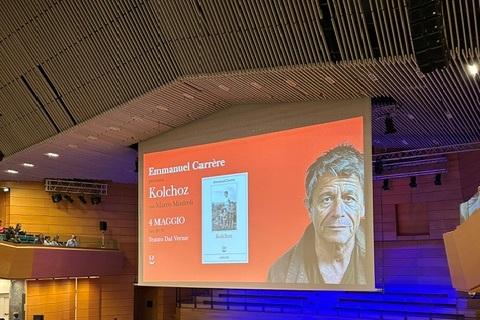
The long queue, where there is a sense of anticipation, is similar to that of an imminent meeting with a rock star. However, it is about the writer Emmanuel Carrèrecertainly a famous author, read and sold far beyond the French borders, and – apparently – also much loved in Italy. Last night, at the Teatro Dal Verme, he was literally sold out to talk about his latest book, interviewed by Marco Missiroli, Kolkhoz (Adelphi). The queue began at the end of the Forum Bonaparte, the theater was packed, many young and very young people, and on a giant screen inside, the iconic face of the French writer stood out.
There are those who booked online – entry was free – and those who hope, in vain, to find a place at the last minute. Many clutch books already read, ready for signing copieswithout knowing that it will only be possible to have one signed. Strict rules, necessary in the face of an enthusiasm which, as Missiroli observes, makes Italy “the country where Carrère arouses the most interest”. He smiles and replies: «If I had to choose the country in which to be most successful, it would definitely have been Italy».
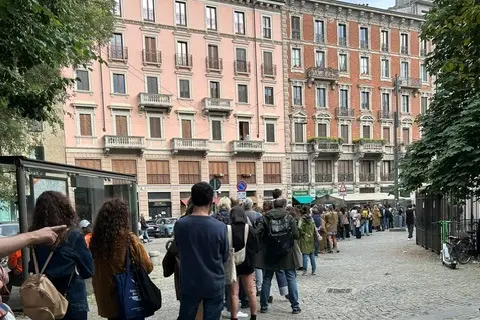
The long queue to attend the presentation of Emmanuel Carrère’s latest novel Kolchoz (Adelphi) begins in Foro Bonaparte in Milan
The atmosphere is that of a concert, but the words immediately bring you back to the substance of his writingsuspended between history and intimacy. “The war in Ukraine changed my relationship with Russia”, he confesses, explaining how geopolitical events were intertwined with personal ones, until the death of his mother. “Russia is a family business,” he adds, recalling his roots.
At the center of the story of his latest novel there is in fact the maternal figure, Hélène Carrère d’Encausse, born Zourabichvili, daughter of aristocratic parents, a family flourishing under the tsars and reduced to poverty by the Bolshevik revolution, she grew up in a studio flat in the banlieue of Paris, later becoming a great historian. First woman to lead theFrench Academyhis perpetual secretary for over twenty years, passed away in 2023 at the age of 94. A powerful woman, “very intimidating”, capable of transmitting to him “a passion for literature”. A difficult mother, she admits, but decisive. «When we are children we love our parents, as we grow up we judge them, and then – with a bit of luck – we forgive them» he explains, quoting Oscar Wilde.
And it is precisely within this sentimental and cultural education that one of the liveliest pages of the evening takes place: the domestic dispute between Leo Tolstoy and Fyodor Dostoevsky. «In my family», says Carrère, «there was an absolute cult of Dostoevsky». Indeed, the mother introduces it to her son early: «She bought me The Idiot when I was thirteen, and took two copies to read it with me».
Tolstoy, on the other hand, was looked at with suspicion, almost with contempt: “It was said that he was an overrated writer, who only impressed imbeciles.” A clear judgement, which the young Carrère meekly accepts, without questioning it. Until, years later, something happens that turns everything upside down. «Years later, my uncle who shared these same opinions, called me in the middle of the night, I was about thirty, he was about fifty, saying: “Do you know what I’m doing? I’m reading War and Peace and you go tomorrow morning and buy yourself War and Peace and you’ll see what will happen to you.” “And I saw,” says Carrère, “and War and peace it became for me the greatest novel ever.”

Queuing at the entrance to the Dal Verme theater in Milan
From that moment on, the family hierarchy breaks down. «The decline of Dostoevsky’s star began, while Tolstoy’s sun slowly rose». But the discussion does not remain literary: it becomes historicalalmost political. Dostoevsky, observes Carrère, “represents the best and the worst of Russia”: the depth of the human soul, but also “a form of hysteria”, a tension that today seems to echo in contemporary Russia. «In a certain sense», he adds, «lToday’s Russia is the triumph of Dostoevsky, and that is not something that can console us.”
Literature, therefore, as a key to reading the present. And also as a family legacy, a ground for comparison and growth. It is no coincidence that Carrère recognizes that the transition from reader to writer was natural, almost inevitable: «I’ve never wanted to do anything else.”
The very title of the book is rooted in this shared memory. «We ran collective farms as children», he says: a term taken from his mother’s Soviet lexicon to indicate finding everyone together in her bed, a gesture of domestic intimacy. An image that returns, many years later, in the last days of his life, when the family rallies around her in hospice.
And so, between history and affections, between great novels and small daily gestures, Carrère’s story finds its unity. Even with a sentence, simple and definitive, which remains as a luminous legacy to a child who did not excel at school: “My mother said that as long as you read everything is fine.”