





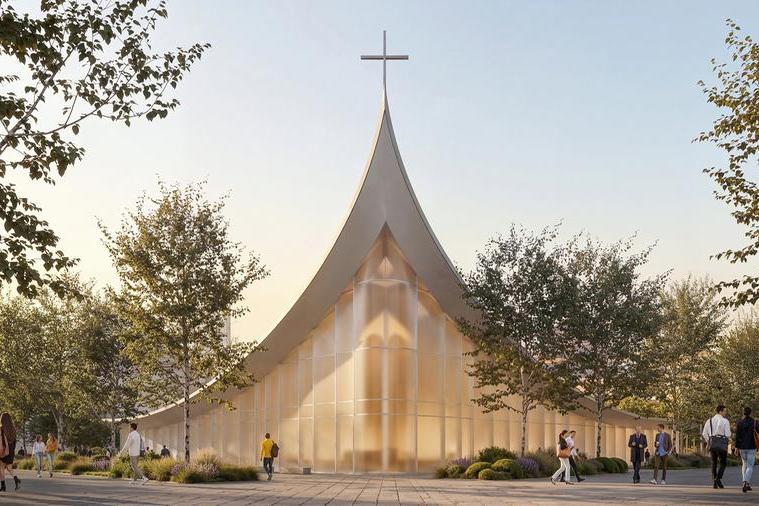
A monastery in the heart of the innovation district, next to scientific research laboratories, start-ups and universities. It is the project of “Ambrosian Monastery”presented Monday morning atChiaravalle Abbeyfrom the Diocese of Milan together with Principiathe company that develops MIND (Milan Innovation District), the area created in the spaces of Expo 2015 and destined to become one of the main European centers of life sciences-
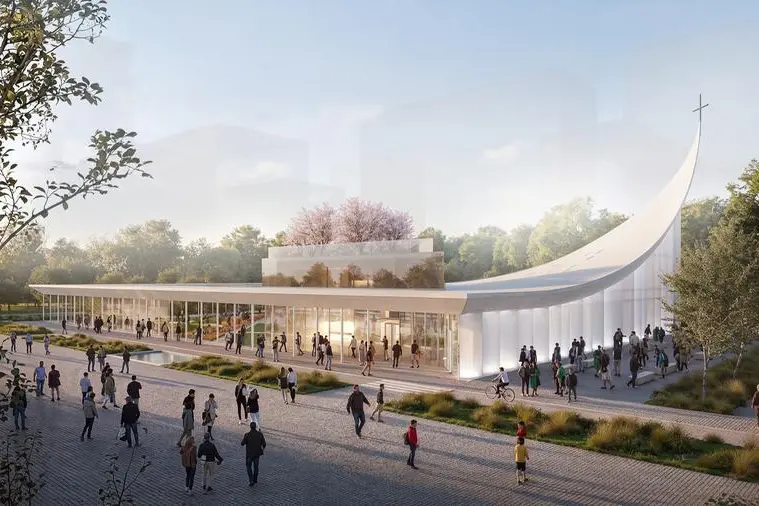
The new complex, which will see the light in about four years, will be built at the crossroads between the Cardo and the Decumanus of MIND, the large urban axis of the district which should host around 70 thousand people by 2030 among students, researchers, workers and residents. The project, entrusted to the studio Stefano Boeri Architectsprovides a structure of 2,700 square meters with over a thousand square meters of open spaces and began in 2023 when a new one was launched Call for ideas which involved ecclesial realities, institutions, research centers and architectural firms. From the process emerged the idea, illustrated in the press conference, of a presence of the Church in MIND divided into three dimensions: a stable presence linked to liturgical and community life; the promotion of spaces for dialogue between religions; the creation of environments for comparison between humanistic knowledge and life sciences.
This is why the model chosen by the Ambrosian Church to be present in this “citadel” of science and research is that of the monastery, capable of bringing together prayer, hospitality, dialogue between religions and comparison between humanistic knowledge and scientific research. The complex will include a large ecclesiastical hall, a Cloister of religions, a Garden and a Library of religions designed as a space for meeting and reflection.
The archbishop Mario Delpini he explained that the presence of the Church at MIND does not arise from the nostalgia of a world separated from the city, but from the desire to inhabit the places where man seeks, experiments and builds the future: «The Church wants to be a presence among men and not withdraw into a reassuring world and chooses to stay within the city, within men’s questions, even when they are difficult. The Ambrosian monastery has the responsibility of being present where research ventures onto paths to explore. It is not the nostalgia of a bucolic life that escapes the complicated life of the city, but a presence. It is the experience of enchantment in the face of man’s work carried out with honesty and respect.” In his speech Delpini also recalled the value of the question and the search for meaning in a time dominated by technology: «In the heart of the city of innovation the question arises about the meaning of everything, about the reason for commitment and investment. Perhaps the Ambrosian monastery will be the voice of the child who, faced with the abyss, says to men: “Why don’t you learn to fly?”».
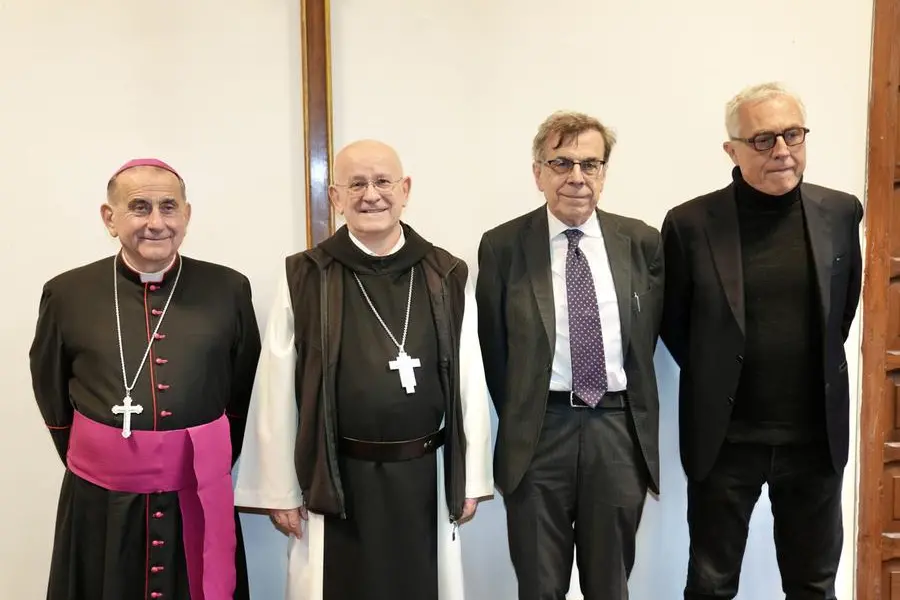
The choice of the Chiaravalle Abbey as the location for the presentation was intended to ideally recall the historical role of the monasteries in the construction of the territory and of European culture. The Cistercian monks who arrived in Chiaravalle in the 12th century were in fact not only protagonists of spiritual life, but also innovators capable of transforming the territory through hydraulic works, agricultural development and new forms of social organization. And when they returned in 1952 at the instigation of the then Archbishop of Milan, Blessed Ildefonso Schuster, they did so with a precise mandate entrusted to them by Schuster to safeguard the dimension of prayer in the city of Milan which “works a lot and prays little”.
He also explained the meaning of the monastic experience father Stefano Zanolini, abbot of Chiaravalle, who defined the monastery as a «fragile but precious sign», similar to a road sign indicating a direction: «The monastery is a world, a varied and complex reality. It is a sign that refers to something else, which orients towards a possibility of a beautiful life, not perfect, but true.” For Zanolini, the heart of monastic life is the search for God as a constant orientation of existence: «We monks seek God. It is a continuous orientation, not only when I want, I feel like it and I like it, but also when I don’t want to, I don’t feel like it and I don’t like it». The abbot also insisted on the value of welcome and prayer as a service to the city: «Guarding the spiritual dimension means praying at all hours, throughout the year and every year, reminding us that time belongs to God».
In presenting the cultural vision of the project, Monsignor Luca BressanEpiscopal Vicar for Culture, explained that the Ambrosian Church chose to go to MIND because it was called to deal with contemporary questions: «MIND is the desire to imagine a city of the future where those who arrive will be able to question themselves about the good, the beautiful and the true. The monastery was chosen to be able to bind us together and help the generation of a new culture.” Bressan also recalled the ideal link with the intuition of Giovanni Battista Montini, the future Paul VI, who as Archbishop of Milan wanted a church in every new neighborhood of the city “not only as a place to gather, but where to be amazed”.
The architect Stefano Boeri he illustrated the main elements of the project, explaining that the monastery was born as a «place of healing, dialogue and spiritual research» and that the entire architectural system revolves around the cloister: «The project reinterprets the archetype of the cloister as a spatial and symbolic device: an introverted but permeable place», he explained, underlining that the new complex wants to relate the fundamental dimensions of human experience: «Care, dialogue and spiritual research are the axes around which the entire project develops». The future church will have a trigonal layout and will be able to accommodate up to 350 faithful. Next to the Library of Religions, immersed in a small cherry forest, some statues from the deposits of the Veneranda Fabbrica del Duomo will also be placed. The “Ambrosian Monastery” is thus a candidate to become not only an ecclesial space, but a place of permanent discussion between faith, science and culture, in the heart of Milan that looks to the future.
Second Igor De BiasioCEO of Principia Spa, the publicly held company responsible for the development of MIND, with which the area within the site was identified (taking into account that the Territorial Government Plan provides for the presence of a place of Catholic worship), «the creation of the “Ambrosian Monastery” within MIND represents an important signal of the district’s ability to welcome and enhance profoundly different realities. Alongside the great centers of research, innovation and life sciences, there is also space for a project that focuses on the spiritual dimension, dialogue between cultures and reflection on human and social issues. It is a choice that confirms the inclusive vocation of MIND: a place where public, private, scientific, cultural and religious subjects can contribute together to the construction of a new model of city”.