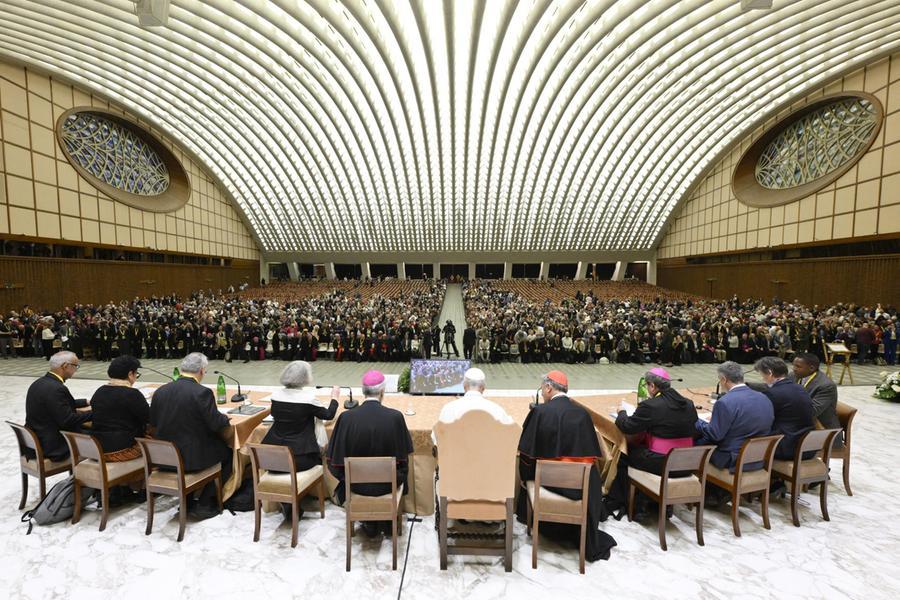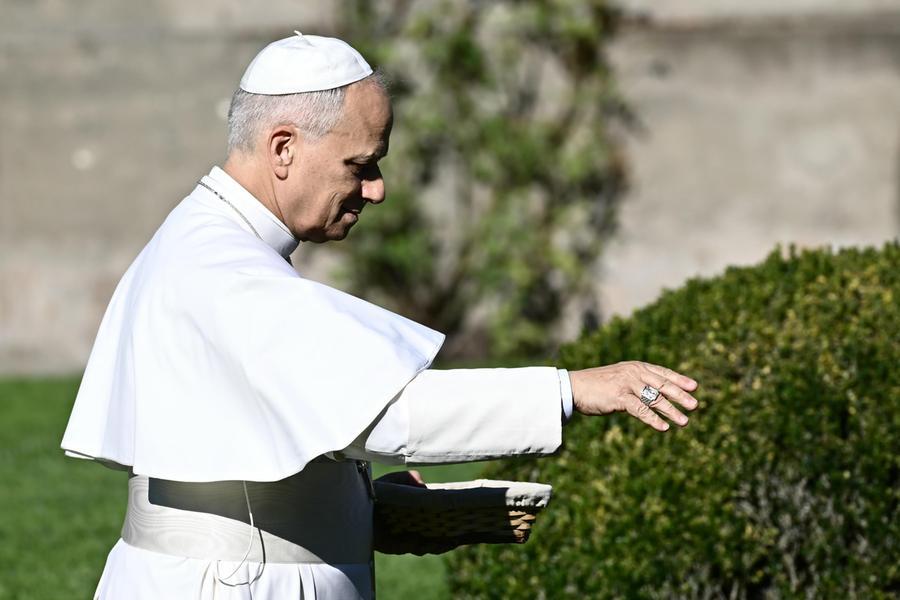






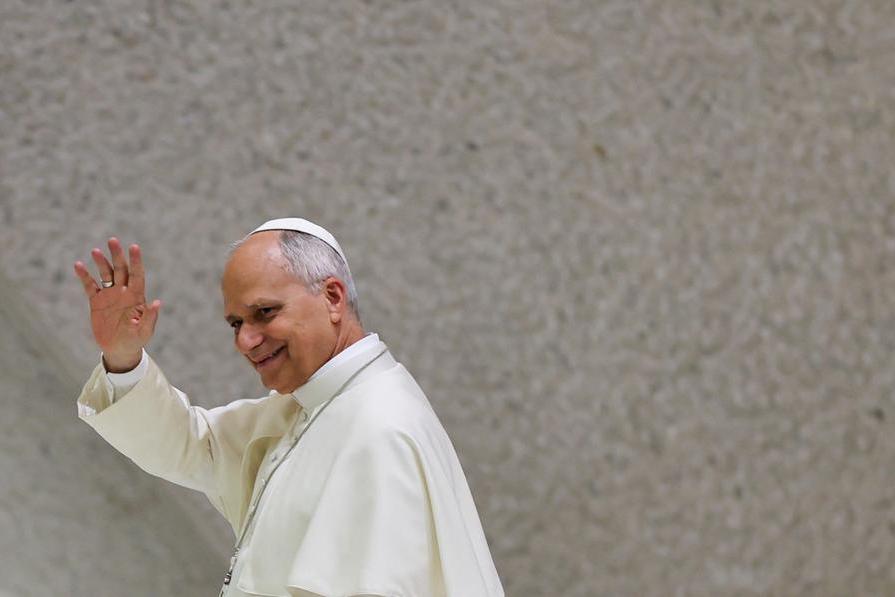
An appeal not to reduce the human being to “a profit, a consumption or a statistical data” and to rediscover the value of the “inner life» as an antidote to the mental health crisis among young people. Pope Leo addresses the participants in the Conference on «Education, mental health and digital technologies»promoted by the Organization of Ibero-American States, the Pontifical Commission for Latin America and the Dicastery for Culture and Education. The Pontiff compares education to the art of artisan weaving: «No thread alone is enough to create the design. Only patient interweaving generates beauty and resistance”. Today, he added, education cannot be the “construction of isolated individualisms” nor the “simple transmission of skills”, but must be rediscovered as the “art of weaving communion”.
Leone denounces the paradox of our time: many kids have increasingly sophisticated technological tools, but struggle to find meaning in living, hoping, loving and even suffering. “Behind so many difficulties, loneliness and psychological fragility there is often a silent question: ‘Does my life have meaning? Is there reliable hope for the future?'”.
Calling back his apostolic letter Drawing new maps of hope, written on the occasion of the 60th anniversary of the Conciliar declaration Gravissimum Educationisthe Pope reiterated that «We are a desire, not an algorithm». When the person is reduced to performance, consumption or statistical data, he explained, “a profound internal suffering inevitably arises”. Today’s young people live often «under the pressure of expectations and performance», immersed in a competitiveness that generates anxiety, fear of not being up to par and disorientation.
For this reason the Pontiff added, among the objectives of the Global Educational Pact, also that of cultivating the interior life. It is not enough to connect young people to digital networks if they then remain «disconnected from themselves, from others and from their inner self». Helping the new generations to rediscover silence, reflection, the ability to ask questions is the real challenge.
And, explaining that «we cannot address the issue of mental health exclusively from a clinical or technical point of view», but by helping people «to overcome many internal fragilities within a horizon of meaning», he underlined that «when this horizon darkens, internal emptiness, isolation and desperation increase. When, on the contrary, a person discovers that their life has value, that it is loved, awaited and called to a purpose in the world, then hope is born. And hope is not a naive illusion: it is a spiritual force that sustains life, even in the most difficult moments.”
Because of this young people must be accompanied «to discover not only how to live, but also why to live». An educational mission in which «public institutions, schools, universities, families, religious communities, the world of culture and the world of communication are all called to collaborate. No one can face such profound and complex challenges alone.” And he concluded with a biblical image: «To listen to the soul, it is necessary to sharpen the ear, because its voice is not a cry, but a whisper». Only in this way, he said, will it be possible to build a more just and fraternal world, inspired by Mary, “a model of educator”.