



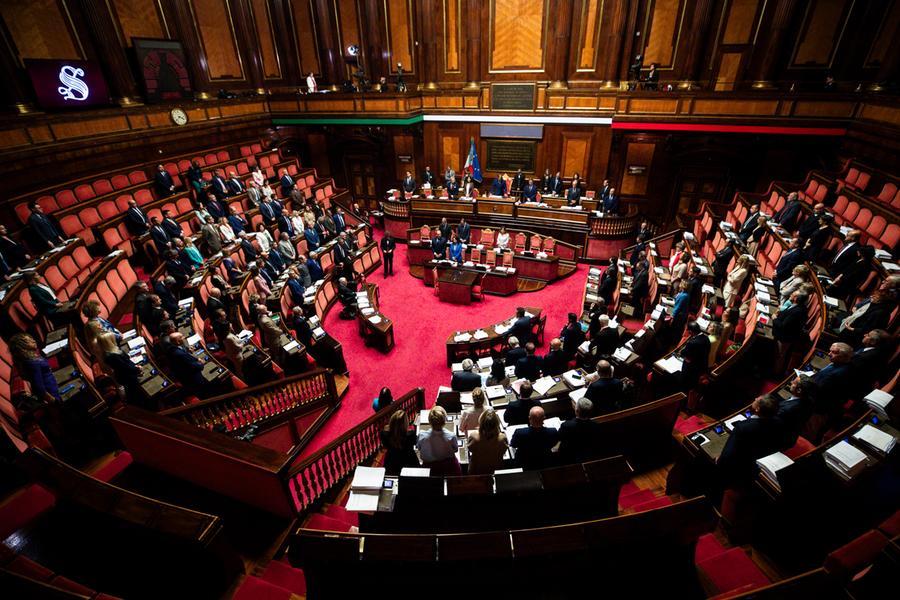
The Senate returns to dealing with end-of-life issues but the parliamentary path still appears bumpy with a tug of war between the majority and the opposition. On June 3, the Chamber of Palazzo Madama should begin the discussion on the bill intended to regulate medically assisted suicide. The conditional is a must because it remains to be understood which text will actually be examined and whether a decision will really be reached or, once again, a postponement.
The Conference of group leaders, with the mediation of the President of the Senate La Russa, set the date for June 3, reopening a dossier that has been stuck for almost a year. The positions, however, remain distant. On the one hand the unitary text of the opposition, presented by the senator of the Democratic Party Alfredo Bazoli and supported by the entire center-left. On the other hand, the text drawn up by the majority rapporteurs, Pierantonio Zanettin (Forza Italia) and Ignazio Zullo (Fratelli d’Italia), approved in the competent commissions last July but never reached the final vote in the Chamber.
The centre-right in the Chamber will ask for further discussion of their text, returning to the commission to await further amendments expected on 9 June. Announced by FI, in the arduous attempt to overcome the crossed vetoes and find agreement with the opposition, but also with other less conciliatory allies.
The opposition, however, will ask to examine the Bazoli text anyway, to officially certify who wants a law and who doesn’t. At that point, there could be a vote, by rule, by open ballot, that will decide which law goes forward and how.
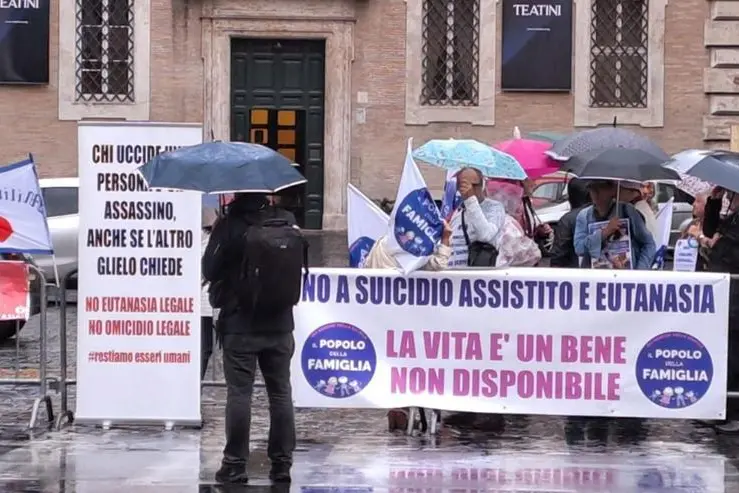
A sit-in by the People of the Family against assisted suicide and euthanasia in front of the Senate on September 17, 2024
(HANDLE)
It’s not just technical aspects that divide. In the background it emerges a different conception of the role of the State, of public health and of the very meaning of accompaniment of the person in the final stage of life. «The 2026 Eurispes Report finds that Italians in favor of euthanasia have grown compared to previous years and are now 70% of the population. These data also tell us that it is the task of politics, as also requested by the Consulta, and it is increasingly urgent, to legislate on end-of-life matters”, declared the president of the Democratic Party senators Francesco Boccia«next Wednesday in the Senate we will have the opportunity for an open discussion. Each political force will assume its responsibilities. The majority has, in the meantime, asked to reopen the deadline for amendments to the text which is being discussed in the Commission. We hope it isn’t yet another attempt to avoid a vote. A possible postponement of the discussion to the commission would be a very serious act. It would mean telling the country that, despite the rulings of the Council, despite the human tragedies experienced by many families, despite the stories that have crossed the consciences of Italians, despite the expectations of the majority of Italians, politics chooses once again to look the other way. We don’t fit in. We ask that Parliament has the courage to look the real country in the eyes and finally take on the responsibility of deciding.”
The crux of the role of the National Health Service
One of the most controversial points concerns the involvement of the National Health Service. The majority text excludes direct participation in assisted suicide procedures while the opposition text expressly provides for it.
The issue is not secondary. Entrusting or not entrusting an active role to the public health system means attributing to the community a precise responsibility in a choice that involves the value of life, personal freedom and the care relationship between doctor and patient.
The mediation attempt promoted by Forza Italia is focusing on this issue. The leader of the Senate Stefania Craxi is working to find a shared solution that can mitigate internal resistance within the majority and encourage discussion with the opposition.
Meanwhile, the next step of the Justice and Social Affairs commissions will be the hearings of Cnr and the Higher Institute of Health to evaluate the possibility of self-administering the drug for end-of-life treatment through a
machinery, as happened in Tuscany. It is no mystery that among government allies, it is Forza Italia that pushes hardest for «such an important law
and so sensitive to which we must give an answer to the Italians” as said by Stefania Craxi who is attempting to mediate with the progressives especially on the role of the National Health Service, a bone of contention between the two sides.
The indications of the Constitutional Court
The debate arises from the rulings of the Constitutional Court which, starting from the case of DJ Fabo and Marco Cappatohave identified some conditions in which aiding suicide is not punishable.
The interpretation of these requirements represents another battleground. The opposition contests the wording adopted by the majority text, deemed more restrictive than the guidelines of the Consulta. According to critics, access would be limited only to patients dependent on specific life support devices, reducing the pool of people who could apply. For the majority, however, rigorous discipline is necessary to avoid extensions that go beyond what has been established by the Court and end up legislating giving the green light to euthanasia
The voice of the associations and the cultural comparison
Even the associations involved in the topic express different assessments. The Association Luca Coscioni considers both proposals insufficient and continues to ask for the examination of its own popular initiative law on legal euthanasia signed, they explain, “by over 74,000 citizens”.
In the Catholic world, however, there remain strong concerns about the risk that attention will focus mainly on the procedures for accessing assisted death, while inequalities continue to be recorded in access to palliative care and pain therapy.
There law no. 38 of 2010, considered among the most advanced in Europe, it guarantees the right to palliative care, but its application still remains uneven across the national territory. Many experts underline how many families continue to encounter difficulties in accessing home services, hospices and adequate support programs.
The question that asks the country
For this reason, the discussion on the end of life is not just about rules and procedures. It touches on profound questions that question the entire society: how to support those who experience suffering deemed unbearable? What role should medicine, the family and the community have in accompanying a fragile person? How to reconcile individual autonomy with the protection of the most vulnerable?
These are questions that cross different political lines, cultures and religious sensitivities. And this is probably why, despite years of parliamentary discussions and judiciary rulings, a shared synthesis still appears difficult.
Even before deciding which bill to discuss, Parliament is called to deal with a broader question: what response to offer to people who are experiencing the most difficult stretch of their existence and ask not to be left alone.