






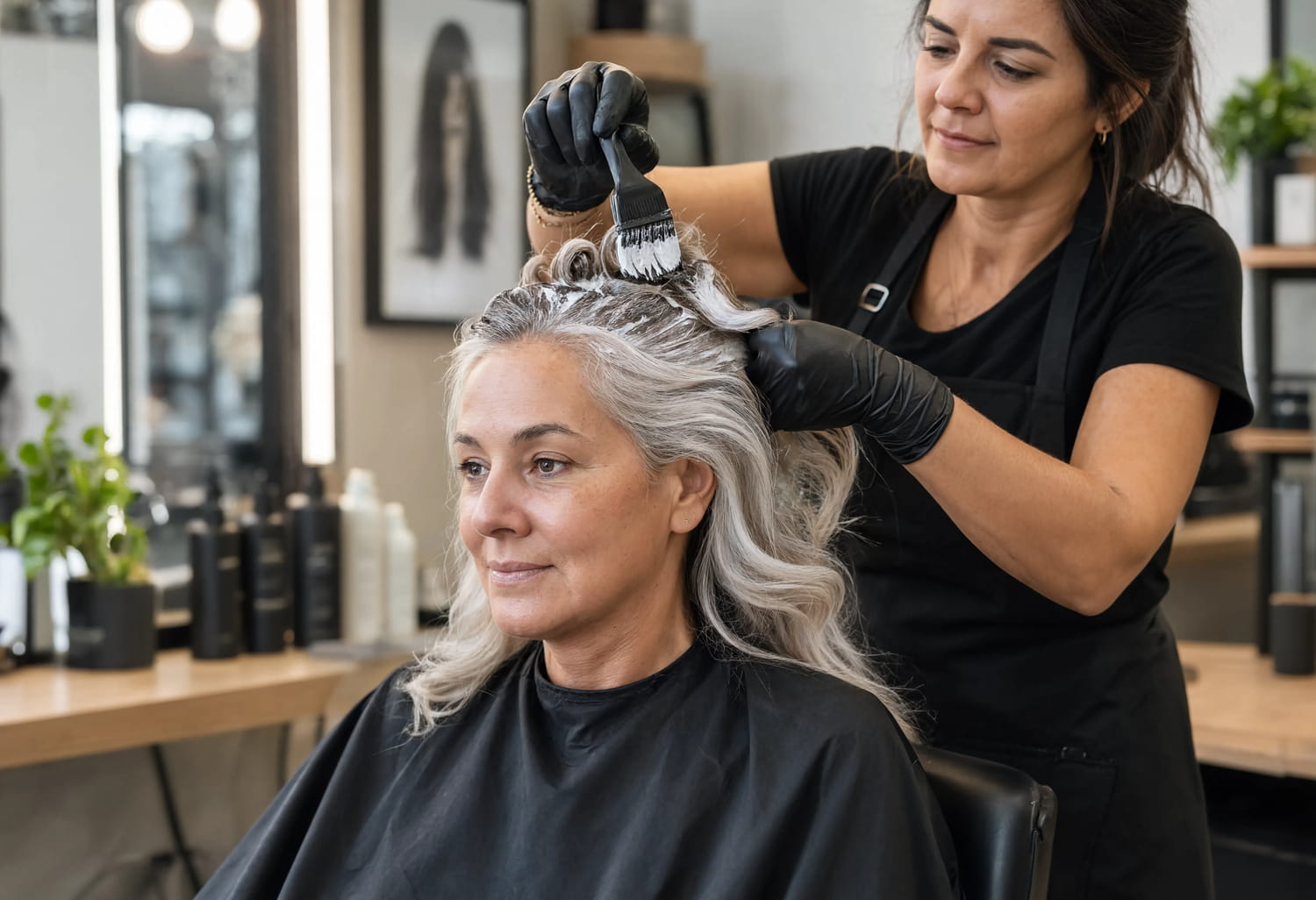
To transition to white hair smoothly, this type of coloring is ideal and does not damage the hair fiber. We explain everything to you.
Letting your hair turn white is a real step in life. In recent years, it has no longer been a question of camouflaging them but rather of embellishing them. We accept graying hair, and we sublimate it. It is no longer synonymous with “letting go”. She is chic and elegant. If many techniques exist to facilitate this transition from natural color to gray (hello gray blending and quiet silver), a certain type of coloring could create the salt-and-pepper hair of our dreams. Far from opaque colors which tend to harden the lines, this product focuses on transparency and softness. No more frequent visits to the hair salon, pronounced demarcations and colors that fade after three shampoos.
To understand the magic of this method, you have to look at its formulation. Unlike traditional colorings which saturate the fiber, this one adapts to the hair. According to Romain, founder of the Romain Colors salon, the secret lies in the flexibility of the product: “Plant coloring makes it easier to modulate colors. If I want great coverage, I can do that. If I want ultra-natural coverage, precisely to accompany white hair, I can do that too.“The specialist in vegetable coloring has even developed its own formula in a French laboratory. It does not contain indigo, which allows you to achieve “whatever you want”. In the case of a transition to white hair, vegetable coloring is then ideal.
There is no question here of creating new white hair or “making a big difference” with your base, but rather of enhancing what you already have thanks to the translucent side of plant-based coloring. “The goal is to accompany, to harmonize, and then little by little, we have these white hairs which take over, but which are embellished with a reflection or depth“, assures the expert. But it also makes it possible to compensate for the helmet effect of a chemical coloring. To succeed in this transition, the protocol is played out in two stages. On the one hand, we work the root to create a trompe-l’oeil: “We are only going to lightly recolor the base to blur the bar. I adjust the slider to adjust opacity and transparency depending on the lengths“, deciphers Romain. On the other hand, we provide relief: “On the lengths, we will work with a clay balayage, softer and compatible with vegetable dyes, to recreate light.“As the appointments progress, the hairdresser increases transparency so that the transition is incognito. On average, count on 2 to 3 sessions spaced a month and a half to two months apart. Thereafter, maintenance is limited to sweeping or treatment to counter unwanted reflections, once or twice a year.
Taking the plunge into white, yes, but not at any cost. According to the expert, it’s all a question of percentage and distribution. “Often, the first white hairs are very localized (temples, top of the cortex). It’s not harmonious or very aesthetic. In this case, I advise not to leave the blank as it is, but to readjust it.“
Conversely, if your hair has more than 40 to 50% white hair with a regular distribution, the green light is given. The colorist then plays with the nuances to blur the remains of chemistry and accompany your mane towards its most beautiful version.