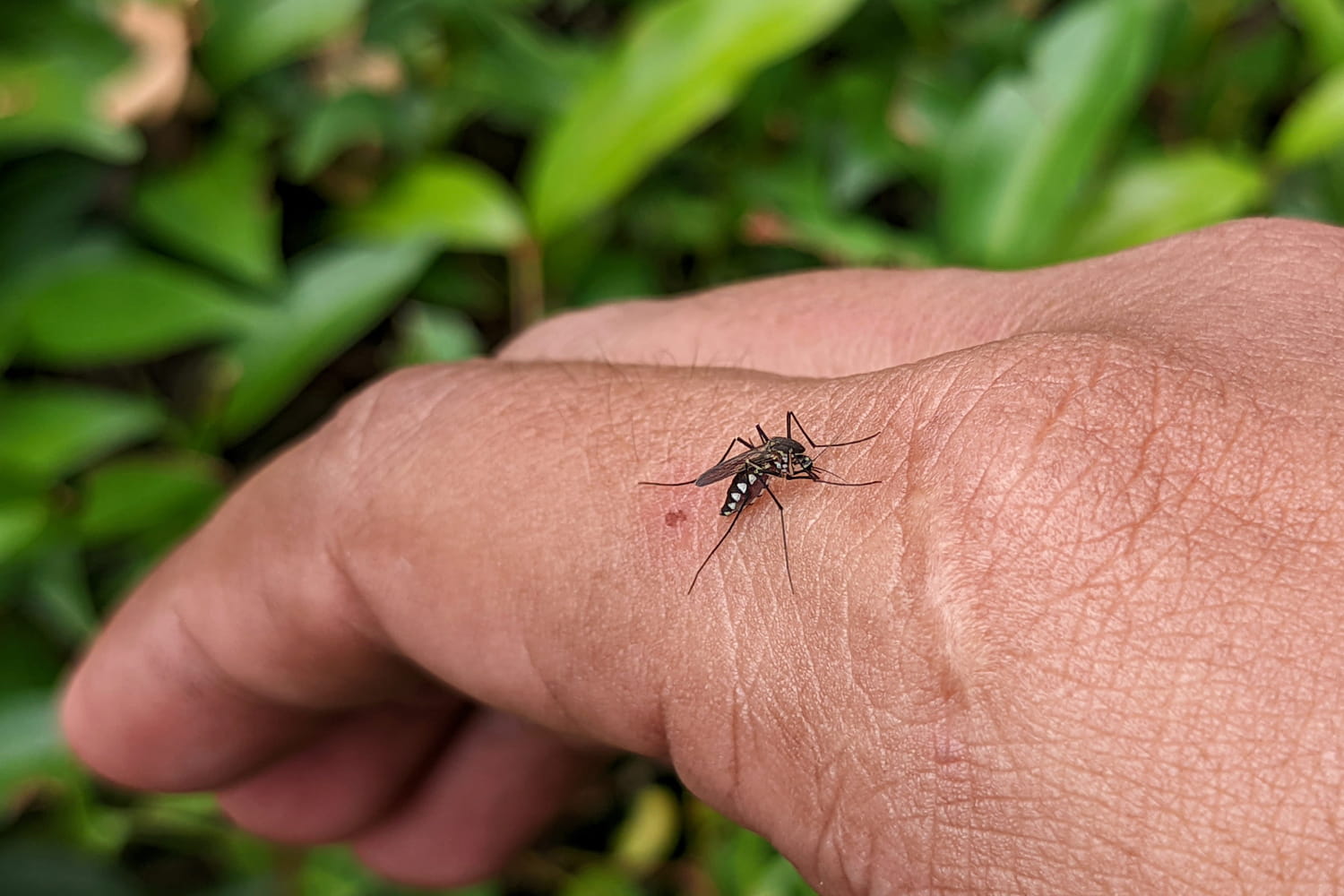
The tiger mosquito is especially prevalent in summer throughout France. Entomologist Yseult de Dreuille helps us decipher the true impact of heat waves and storms on this pest.
Summer sets in and, with it, the return of heat waves and stormy episodes. For many, the equation seems obvious: a big heatwave followed by a good rain = an explosion of tiger mosquitoes in our gardens. Faced with this growing concern, we interviewed Yseult de Dreuille, entomologist at The Invascience Company, to sort out fact from fiction and understand how this pest really reacts to the weather.
Contrary to popular belief, heatwaves are not insects’ paradise. Above 32°C, the mosquito suffers as much as we do. “Air that is too dry and too hot reduces its survival. In full sun, we cannot see it, it seeks shade and humidity.explains the expert. Additionally, extreme heat without limiting rain the development of populations by drying out part of the larval breeding grounds, in other words places where there is stagnant water and in which female mosquitoes come to lay their eggs.
But then, what happens when the storm breaks and the thermometer finally drops? This is where the answer becomes subtle. In reality, if the range between 18 and 32°C is generally favorable for the development of tiger mosquitoes, the real “boost” occurs after the heatwave, when the mercury drops to stabilize between 25 and 28°C. It is this ideal thermometer, combined with humidity, which accelerates the mosquito’s metabolism: the egg can then become a biting adult in just 6 to 7 days. So yes, an invasion of tiger mosquitoes is to be feared, but not during extreme heat: the real peak of vigilance is precisely a week later, as soon as the climate becomes both hot (but not scorching) and humid. Unsurprisingly, the risk concerns above all the departments already heavily colonized: the South-East, the Mediterranean rim, the Rhône valley, the West and the Center.
Violent storms can paradoxically “clean” the soil by leaching. What the tiger mosquito prefers is regular rain and our own negligence. “The combination of heat and water causes populations to explode, but only if there are breeding grounds available.”underlines the entomologist. This pest has a clear preference for artificial containers created by man: cups, buckets or swimming pool covers. If the neighborhood is densely populated, there will be “room and board“.
The good news is that the best protection remains in our hands. The key public health message is simple: we must systematically remove, return or regularly empty all containers that accumulate water. Rather than undergoing this chore, the expert advises “removing the shelter permanently” as soon as possible, for example by permanently returning unused objects or tightly covering rainwater collectors. To rediscover the pleasure of spending time on our terraces, the combination is within everyone’s reach: adopt these good collective gestures, install mosquito nets, use effective mosquito repellents and, if necessary, rely on external traps which imitate human breathing and odor to capture the insect before it bites you.
Thanks to Yseult de Dreuille, entomologist at The Invascience Company.