





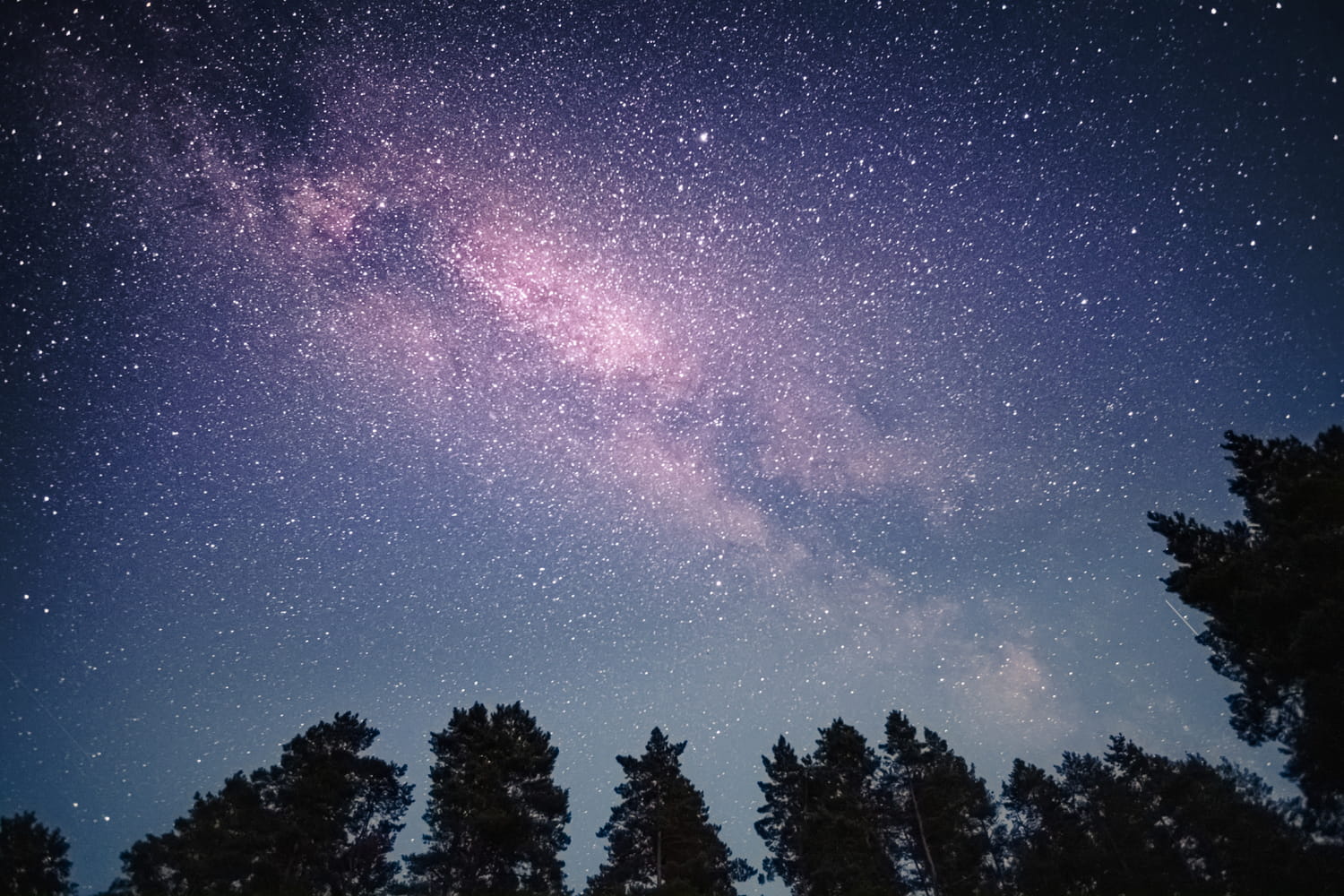
This is what astronomers and scientists call the “Beehive Cluster”.
Imagine a swarm of more than 1,000 young stars born from the same gas cloud, linked together by gravity and traveling together through Space. This is what astronomers and scientists call the “Hive cluster”, also called Messier 44 or the Crèche cluster. Behind this poetic name hides one of the most beautiful spectacles in our galaxy. Located about 600 light years from us, this group of stars is one of the closest to the solar system. Known since ancient times, it resembles a small, misty and mysterious spot floating in the heart of the Cancer constellation.
To our human eye, the Hive Cluster appears as a diffuse, almost ghostly cloud of light. The real show begins as soon as you use an instrument. With just a pair of binoculars, what appeared to be a mist suddenly transforms into an explosion of sparkling diamonds. It is then possible to distinguish hundreds of blue and orange stars scattered like precious stones on black velvet. The orange points correspond to stars at the end of their life which contrast with the majority of white and blue stars, which are much younger and massive. This star cloud is one of the rare celestial objects that is often more beautiful through binoculars than through a telescope, because its extent requires a wide field of view to be fully appreciated.
To not miss this celestial meeting from mainland France, mark the date of Saturday February 28, 2026 on the calendar. From 8:00 p.m., you will have to direct your gaze towards the South-Eastern horizon: the Beehive cluster will then be in a spectacular neighborhood with the Moon, which will be almost full that evening. Thanks to its intense lunar brightness, this satellite will serve as a natural beacon to locate the swarm of stars located very close to the Moon. To fully enjoy the spectacle, prefer the countryside and move away from the street lights to observe it because the Hive cluster completely disappears in the city due to light pollution.
Why is it called the Hive Cluster? Astronomers of the 18th and 19th centuries found that this swarm of stars resembled a swarm of bees bustling around a hive. In addition, the “compact” appearance in the center and more “diffuse” at the edges reinforces this image of celestial buzzing. In ancient tradition, this cluster was also called the Crib, flanked by two stars called the “Donkeys”, thus illustrating a completely different scene of life, but just as lively.
If the Hive Cluster is a celestial phenomenon not to be missed, prepare yourself for an event of rare intensity later in the year. On August 12, 2026, France will experience its first total solar eclipse (or almost total depending on the region) since 1999. At the end of the day, the Moon will “nibble” at the solar disk until it covers it almost entirely and plunges the country into total darkness for several minutes. In the north of Spain and on a fringe of southwest France (in Biarritz for example), the day will give way to sudden night, revealing the solar corona in a spectacle that will not be repeated here for decades. A celestial meeting that will make 2026 an unforgettable year for all lovers of the stars and celestial events.