
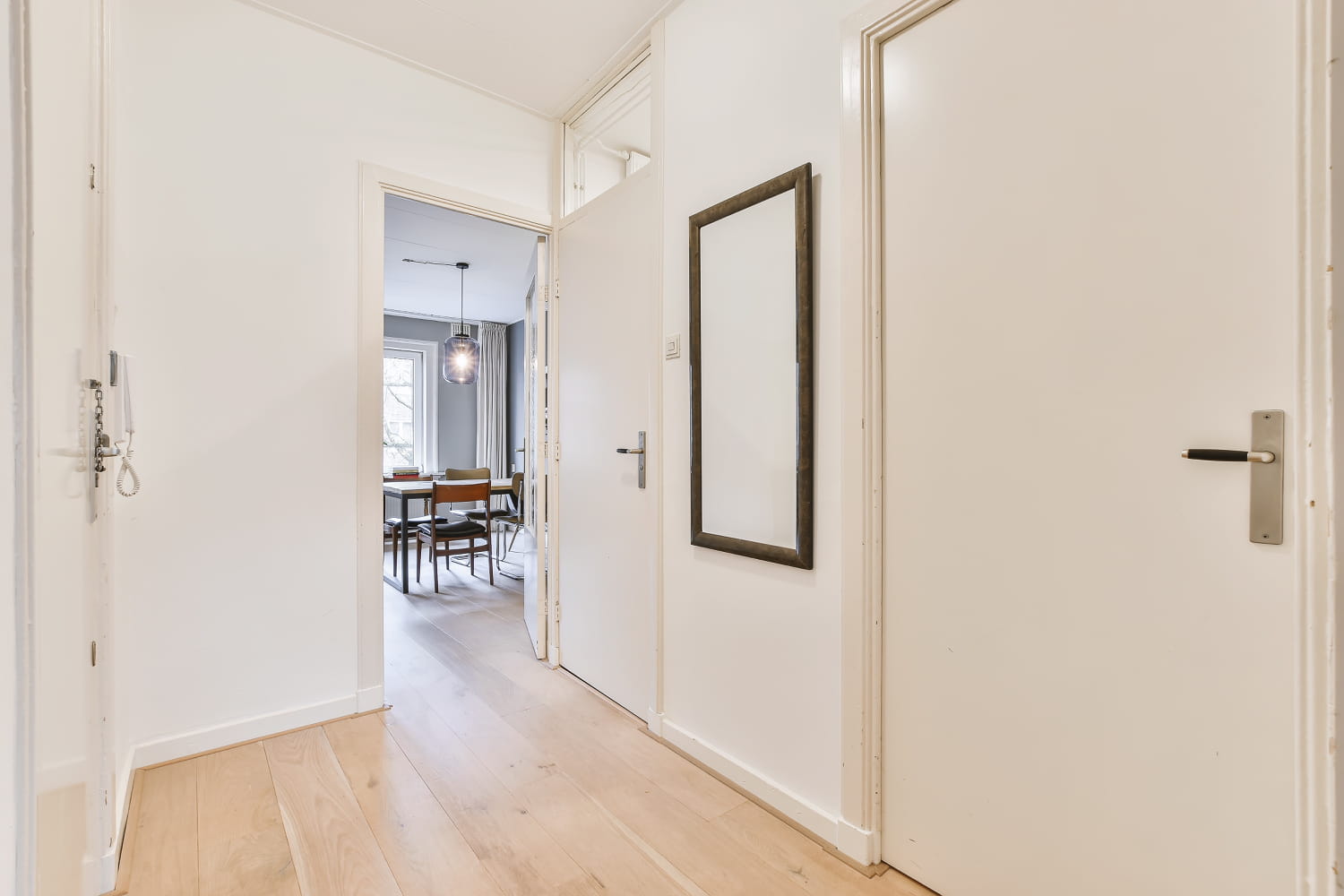





A solid door often limits the circulation of natural light and plunges passage areas into darkness. However, it is possible to restore luminous fluidity without undertaking heavy demolition work, by simply rethinking the existing system.
A solid door can turn a room into a dark box. Kitchen separated from the living room, corridor without windows, office isolated behind a solid wood door… The light stops suddenly and even if the room is neat, it disappears completely once the door is closed.
That’s exactly what was happening to Lauren Jansen of Farmhouseish. In his house, the laundry room was carefully fitted out with optimized storage and elaborate decoration. However, from the corridor, we could see nothing of it. The wooden door, completely solid, completely blocked the view and the light.
Rather than modifying the walls or replacing the door with a new model, she chose to rework the one that was already in place. His idea? Transform the space by focusing only on the door with the aim of bringing light and character to the whole.
To remedy the problem, the door was removed from its hinges and laid flat. A border of approximately 11 centimeters was drawn around the entire perimeter in order to maintain a sufficiently wide frame. The central panel was then cut out with a jigsaw, leaving only a wooden frame.
To reinforce the structure, 2.5 centimeter square battens were fixed inside the frame. They form the support intended to accommodate what will change everything: a transparent panel. A fine molding was added to cleanly outline the opening, then a wooden strip was added to finalize the contours. After sanding, the whole thing was painted matte black, which accentuates the lines and modernizes the door.
In place of the removed panel, she inserted a custom-cut clear acrylic sheet. Lighter and more resistant than glass, it allows light to pass through while maintaining separation between spaces. This solution is also more economical and much easier to DIY. A black vinyl tape applied to the surface creates a regular grid, reinforcing the glass effect.
In his case, it was a laundry room. But the principle can be adapted to any solid door that cuts off the light: that of a closed kitchen, an office or a dark corridor. The structure remains the same, only the material in the center changes.
For her, a single modification was enough to transform the perception of volumes. The room remains distinct, but it is no longer isolated behind an opaque panel. It is now an integral part of the decor while gaining comfort thanks to the added light.