




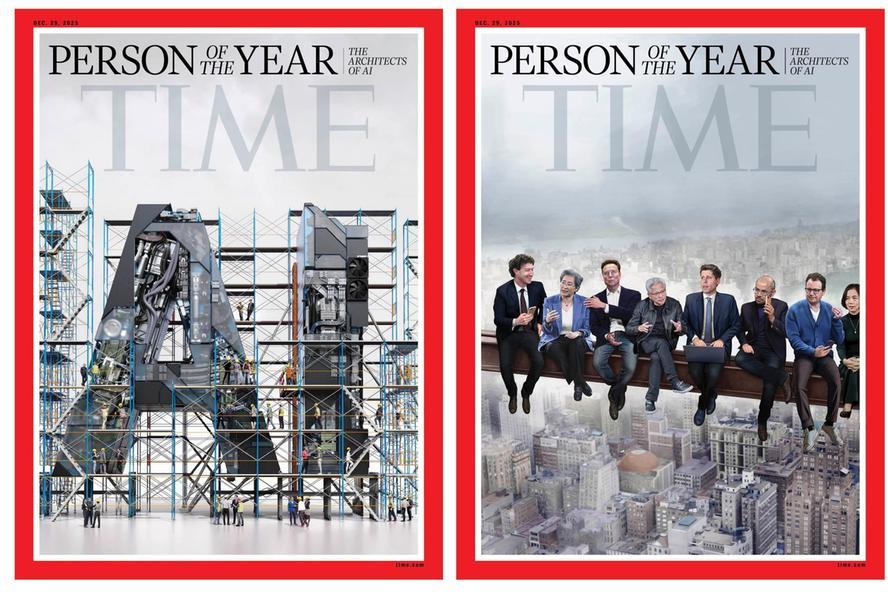
On the glossy cover that has been certifying the protagonists of history for almost a century, this time there is not a glance to meet, there are not the wrinkles of a political leader, nor the smile of an activist or the charisma of a pop star.
The choice of the weekly Time to elect Artificial Intelligence (or rather, AI Architects) as Person of the Year for 2025 it is a provocation, of course, but above all it is the formal ratification of a change of era: the engine of history, today, pulsates in silicon servers.
The decision of the prestigious American magazine does not come unexpectedly (on Wednesday it was anticipated by some agency launches) and it is not even the first time that the person of the year is not a person.
Already in 1982 the computer had been elected “Machine of the Year”, but then an object was being celebratedtoday, by giving the algorithm the title that would belong to a “person”, a dizzying semantic and ontological leap is made. It is recognized that these systems are agents capable of generating language, art, decisions and, as the award motivation states, entities that “have most influenced the news and our lives, for better or for worse”.
The symbolic equation between human consciousness and the capacity for statistical calculation is the real issue that this cover forces us to face.
If, on the one hand, Artificial Intelligence is curing previously incurable diseases, optimizing energy resources and opening unexplored frontiers of knowledge, on the other, however, elevating it to the paradigm of the year means admitting that technology has ceased to be a means to become an environment, an ecosystem that envelops and sometimes suffocates human specificity.
The risk, subtle and pervasive, is that of abdicating the effort of critical thinking and moral judgment, delegating not only the solution of problems, but the very definition of questions to the machine. In this scenario, the voice of the Church and the commitment to an “algor-ethics”, referred to several times by Pope Francis and Pope Leo, appear as necessary barriers to protect humanity.
Technology, however advanced, lacks that something that makes life worth telling: vulnerability, compassion, the ability to dream the impossible and forgive the unforgivable. The algorithm does not know doubt, it does not feel pity, it does not have a face to offer to the other; elaborates probabilities, not truths.
The cover of Time he therefore puts us in front of a mirror: if Artificial Intelligence is the person of 2025, it is because we have given way to it, fascinated by its speed and frightened by our slowness.
This “investiture” must then transform itself into an appeal to the collective conscience of all of us: we must not allow efficiency to replace wisdom, nor that calculation take the place of care and proximity.
Artificial Intelligence may be the “Person of the Year” for statistics and media impact, but it is up to us, women and men of flesh and blood, remain the true protagonists of the story, guardians of that unpredictable spark that no machine will ever be able to replicate.