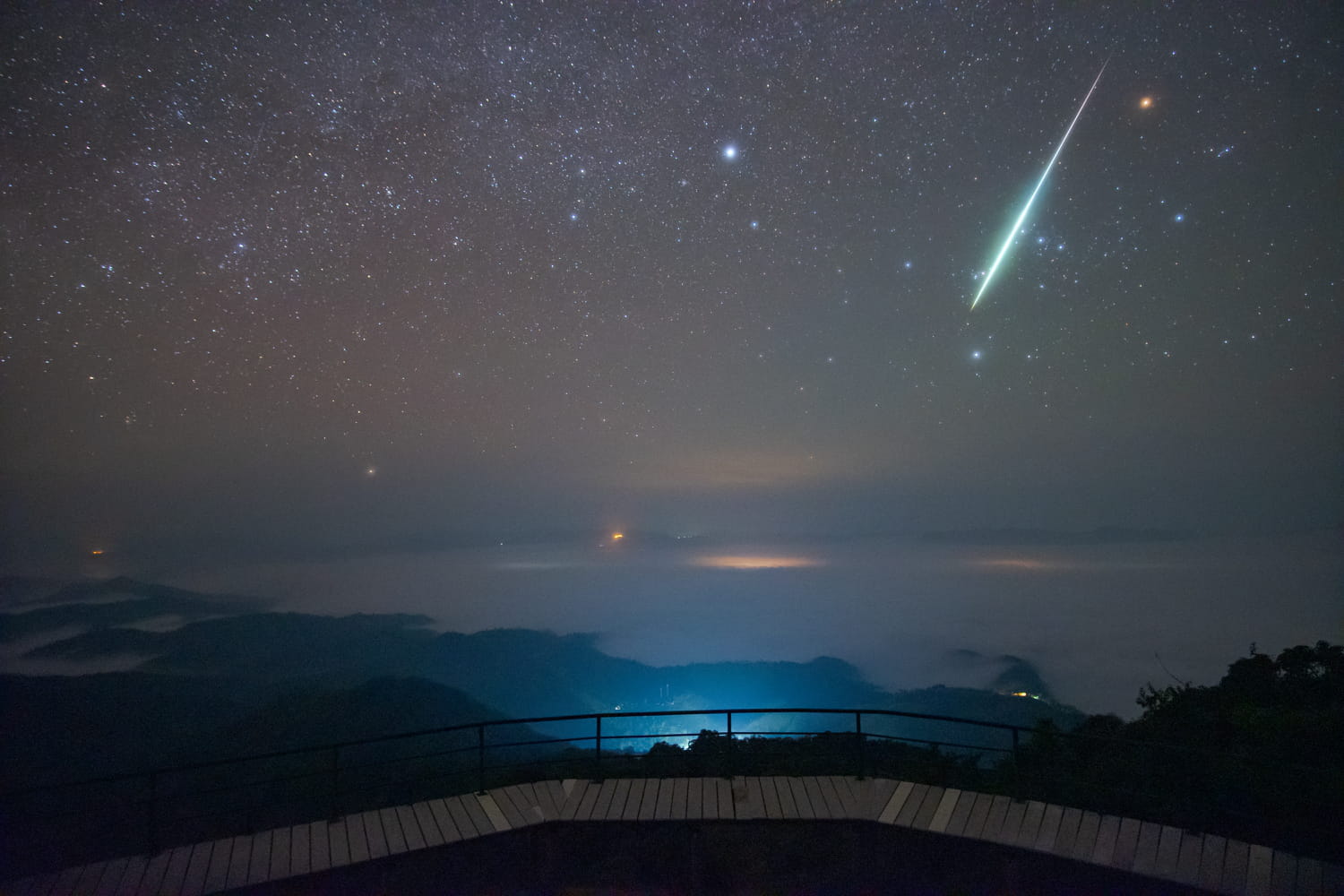
The big summer astronomy event is making a comeback throughout France. This year, scientists are panicking: the observation conditions promise to be historic for admiring the Starry Night. Date, time, spots and explanations.
Take out your blankets and prepare your wishes. Organized each year by the French Astronomical Association (AFA) with the support of the CNES (National Center for Space Studies), the Night of the Stars returns to light up the summer sky. If the event always attracts many curious people, the 2026 edition is already shaping up to be a legendary vintage. Astronomers are unanimous: we are going to experience the purest and most spectacular night in more than 10 years. We can admire hundreds of shooting stars there, as we were able to admire the Delta Aquarids in July, but also fixed stars and certain planets.
If the scientific community is impatient, it is thanks to an incredible stroke of luck from the lunar calendar. The peak of shooting star activity this year almost coincides with the New Moon. Concretely, the Moon will be completely invisible in the sky. Without this strong natural light pollution which usually spoils the spectacle, the night sky will be plunged into absolute inky black. This perfect contrast will make it possible to distinguish even the smallest and most discreet meteors with the naked eye. Specialists predict an exceptional rate of up to 100 shooting stars per hour, or more than one per minute.
The Night of the Stars will take place over three days, from Friday August 7 to Sunday August 9, 2026, a few days before the long-awaited solar eclipse. It is during this weekend that hundreds of free events, conferences and guided observations are organized by astronomy clubs throughout France. To join one of the 500 free events organized in France, you can consult the interactive map updated in real time on the official AFA website.
The show will begin at dusk. CNES astronomers point out that a surprise guest will be invited to the party: the planet Venus. Very bright, it will be observable with the naked eye towards the western horizon as soon as the sun sets. For shooting stars, the best viewing windows are between midnight and 4 a.m. This is when the constellation Perseus is highest in the sky, offering the greatest concentration of meteors.
To make the most of this magical night, no expensive equipment is required (no need for special glasses like for the eclipse). Everything can be seen with the naked eye. The French Astronomical Association advises avoiding city lights and moving away as much as possible from urban light pollution in favor of natural parks, beaches or mountain areas which remain the best spots. But also to put away your phone (iIt takes about 15 to 20 minutes for the human eye to fully adapt to the darkness) and to simply remain lying on a deck chair or blanket to embrace the entire sky.