
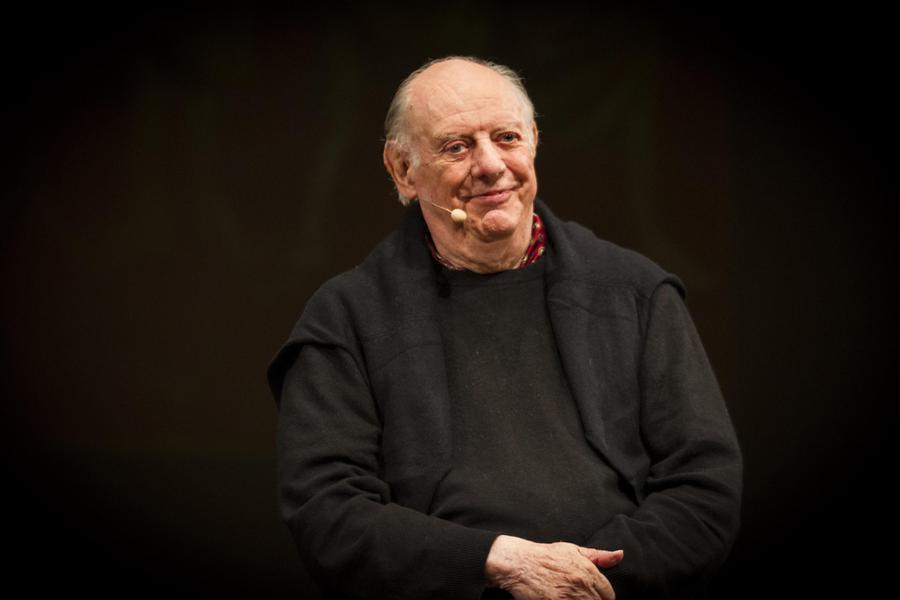




100 years after the birth of Dario Fo (he came into the world on 24 March 1926 in Sangiano, in the Varese area), Nobel Prize for Literature in 1997almost thirty years ago, his text Mary at the cross it remains “a trap work” to be reread. This is the expression chosen by father Gian Matteo Roggioprofessor at the Pontifical Theological Faculty Marianum and director of the department at the Pontifical International Marian Academy (Pami), who we asked to reread this story with uswhich closes the best-known of Fo’s theatrical works, Funny mysteryreviewing together the video of the masterful interpretation of his wife, Franca Rame, when it was first released in 1969. It is about a representation that gives voice to the image of the Virgin on Golgothaof which the Gospel of John tells, “remaining open to different interpretations”.
Certainly, the emphasis on the humanity of the Mother of Christ emerges, but it goes beyond the spiritual dimension, with disruptive elements typical of feminismwhich also combine with the expressive technique in the wake of the medieval tradition. Also in this case, the typical cultural depth of the texts of the “jester” recognized among the greatest contemporary writers remains undisputed.
Born in Sangiano, a small village overlooking Lake Maggiorethe teenager who will become a playwright, actor, director, writer, author, illustrator, painter, he arrived in Milan in 1940 to study at the Brera Academy. And here, in the Lombard capital, he will die on 13 October 2016. This year, therefore, we will remember the tenth anniversary of his death. His father Felice, a socialist, is station masterbut also an actor in an amateur company. THEMother Pina Rota is the author of a book autobiographical about the rural world in which she grew up from the title The land of frogs (published by Einaudi). Both participate in the Resistance: the father, head of the area’s liberation committee, organizes the clandestine passage of the wanted Jews to Switzerland; the mother takes care of the wounded partisans. Dario, recalled to the army in the Republic of Salò, manages to escape and spends the last months before the Liberation from the Nazi-Fascists hidden in an attic.
From all this humus of rural reality and cultural suggestions takes off the multifaceted work Funny mystery for which he won the Nobel Prize in 1997 with the following motivation: «Following the tradition of medieval jesters, he knew how to flog power by restoring dignity to the humiliated and oppressed».
And it is precisely on the value of the “denunciation” that Father Roggio focuses. Certainly in the Virgin described by Dario Fo and staged by Franca Rame there is a certain social value that feminism expressed in those years and a female figure champion of rebellion and atheism seems to be emerging, but the Mariologist explains: «It’s not all there. In the cultured mastery of narrative construction and in the effectiveness of a reinterpreted dialect, there is more. There is a clear expression of the heart of the Christian message of faith: Mary is not at all stripped of the dimension of faith, but rather “obeys”, that is, she accepts the logic of the Son’s Salvation.”
Furthermore, it is interesting to focus on the dialogue conceived by the writer between Mary and Jesus. In Fo’s text, the Mother, certainly in an unexpected way, tries to save Christ from the Cross: “I come up, to take you down from these beams, to take out the nails slowly, slowly.” But her Son himself calls her back to the truth of faith to be fulfilled: “I must consummate fate.” It is here that Mary obeys, abandons her intentions, follows Jesus. And in this regard Father Roggio reminds us of a fundamental concept: «The faithful are none other than those who, like the Mother of God, beyond the expression of their pain, do what Jesus asks them to do. And this is what emerges from Fo’s words.”
In Darius’ story, the Mystery of Salvation is entrusted, with poetic license, to the words of the archangel Gabriel, who does not appear in the biblical story of the Crucifixion. «The point», underlines the Mariologist, «is that in any case the archangel explains very true things, announcing that “through Christ the door of Heaven will be reopened”, as we read in the text». Therefore, among imaginative expressions, a message strongly adherent to the figure of the Mother of Christ is outlined: in the Virgin Mary the story of Salvation of the New Testament begins and in her we are also transported to the end of history, since she is able to testify to what the angel promised her: that the Kingdom of her Son will never end.
Looking again at the story, we speak of a “disgusting land”, evidently marked by human miseryand of a dimension in which it “expands again and there will be no crying, no wars, no prisons, no hanged men, no violated women, no hunger, no famine, no one sweating and tiring their arms, no children without smiles”.
Part of the text belongs to the experience and narrative of Dario Fo and his life partner Franca Rameand those seventies full of highly ideological positions. But even in this case, Father Roggio warns that we must start from a fundamental consideration: «First of all, on the subject of the feminine it is important to grasp the denunciation that the Gospel itself teaches us: in the time of Jesus for those condemned to crucifixion there could not be the comfort of the presence of a woman and, therefore, it is Mary who first breaks the law, who imposes her presence of love and sharing against the written and unwritten rules that wanted to condemn them to death alone”.
The “trap” becomes evident: the risk of stopping only at some aspects of Dario Fo’s text dedicated to Maria e that of losing sight of the fact that Mary, Mother of God, is truly a “rebel”because it follows the wonderful logic of God’s love in following the Son.
In Mary’s dialogue with the angels, which we would not expect, the references to the transcendent dimension and to Paradise are precise and correct.
The reference to tradition is also interesting: Mary’s crying is not an inventionbut it takes us back to the various Planctus Mariae of the Middle Ages, of which the Stabat Mater attributed to Jacopone da Todi, later set to music in a baroque version by Pergolesi and Vivaldi and in a romantic version by Rossini, is only the best known. But the most significant thing is that even in Fo’s text the same catechetical value is released, according to Father Roggio.
The references to the text to be commented on would be many and lend themselves to various interpretations. Faced with the nucleus of meaning, in Mary at the cross undoubtedly there are some strong expressions attributed to Virgo which are striking and which we feel are far from his sensitivity. We mention the harshness of denouncing “these murderers, butchers, cursed, mangy pigs”. But even in this case a reflection must be made, recommends Father Roggio. The expression refers to the soldiers who contributed to the killing of Jesus “with the arrogance of claiming to be strangers as mere executors”. They say, “I can’t do anything about it.” Just as, Father Roggio recalls, «many Nazis tried to explain that they were not responsible for the terrible actions in the concentration camps against the Jews, even if, exactly like the soldier from Fo, they have been complicit in small and large acts of corruption that make evil possible». Regardless of the expressions, therefore, the complaint remains valid, underlines the Mariologist.
Then there is another meaning to highlight. In the text considered, the word is taken by a woman and her cry is the cry of pain of a Mother who does not accept the pain of her Son who says: «Let them suffocate each other together». It is also a cry of rebellion against the domination of patriarchy which certainly belongs to the experience and narrative of Dario Fo and his life partner Franca Rameand those seventies full of highly ideological positions.
In an unforgettable interview with Christian family of 2014 to the question: because an avowed atheist like him would continue to return often and willingly to sacred themesFo replied: «I am an atheist, but I leave the doubt open. The idea of a love realized in incredible details, such as the insects that look for the flower, which has “made up” to attract them, then they unite and run away full of humus… It is something wonderful, paradoxical and inexplicable. And not even science, of which I am fanatical, can explain it. I am passionate about popular culture and great poets, who are never remembered today… this led me to greatly respect people’s faith and above all their unscrupulousness.”
It is easy to deduce that in this irresistible call of love which Fo himself mentioned Mary’s love was also decisive and his choice to dedicate a time to the Mother of God willing, always for that love, to experience immense pain for a much greater good.