
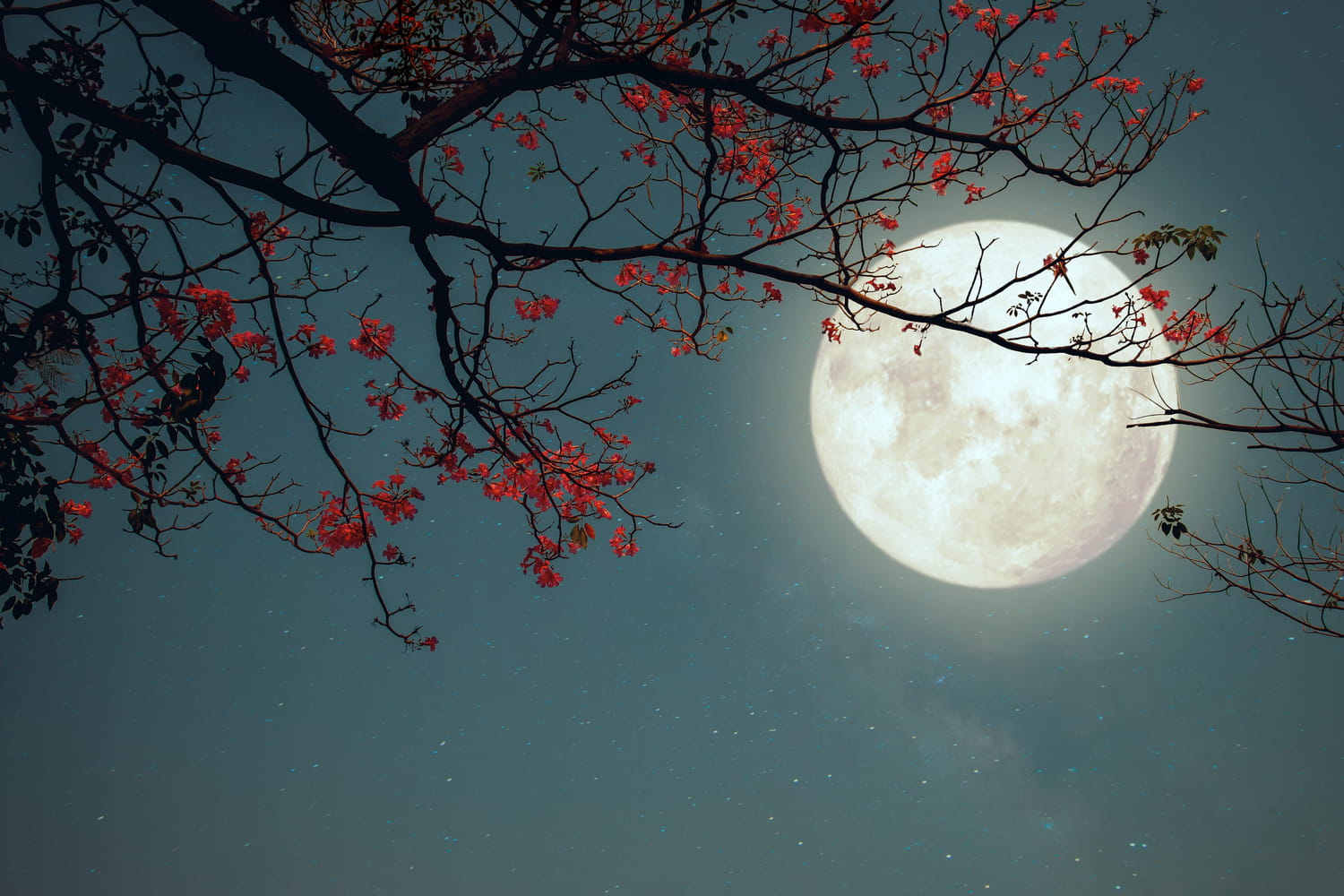





An unmissable monthly event, the Full Moon is a perfect alignment between the Sun, Earth and Moon. It fascinates as much as it disrupts our internal clock and our sleep. Here is the date of the next Full Moons in 2026.
Generally, there are 12 Full Moons per year, or about one per month. This is the moment when the nocturnal star reveals its most spectacular side to us: a perfectly round, silvery-white disk that illuminates our landscapes with an almost supernatural clarity. But if the Full Moon is a feast for the eyes, it is also often accused of disrupting our nights.
What is a Full Moon?
Scientifically speaking, the Full Moon is a lunar phase where the Moon is opposite the Sun in relation to the Earth. This is the moment when its visible side is fully illuminated. The Full Moon is a “creature of the night”: it rises at sunset and stays there until dawn. There are approximately 29.5 days between two full moons (called a lunation or synodic month). Although it appears very bright, the Moon is actually quite dark. Its shine comes only from the reflection of sunlight on its gray rock.
Why do we see her all night?
The Full Moon follows a very regular cycle:
- Rising: It rises in the East almost at the time the Sun sets in the West.
- The zenith: It is highest in the sky around midnight.
- Sunset: It sets in the West when the Sun rises.
Calendar: dates and times of the next Full Moons in 2026
| Month | Date 2026 | Hour | Traditional name |
|---|---|---|---|
| January | Saturday January 3 | 11:04 a.m. | Full Wolf Moon |
| FEBRUARY | Sunday February 1 | 11:10 p.m. | Full Snow Moon |
| March | Tuesday March 3 | 12:39 p.m. | Full Plow Moon |
| April | Thursday April 2 | 04:13 | Full Pink Moon |
| May | Friday May 1st | 7:24 p.m. | Full Flower Moon |
| May | Sunday May 31 | 10:46 a.m. | Blue Moon (2nd Full Moon of the month) |
| June | Tuesday June 30 | 01:58 | Full Thunder Moon |
| July | Wednesday July 29 | 4:37 p.m. | Full Deer Moon |
| August | Friday August 28 | 06:19 | Sturgeon Full Moon |
| September | Saturday September 26 | 6:50 p.m. | Full Harvest Moon |
| October | Monday October 26 | 05:13 | Full Hunter’s Moon |
| November | Tuesday November 24 | 3:55 p.m. | Full Beaver Moon |
| December | Thursday December 24 | 02:29 | Full Cold Moon |
Is it safe to look at the Full Moon with the naked eye?
Yes. Unlike the Sun, looking at the Full Moon with the naked eye poses no danger to your eyes. Although it appears very bright at night, its brightness is thousands of times weaker than that of the Sun. If you observe it with binoculars or a telescope, the glare can be a little tiring for the eye (like looking at a light bulb from afar), but it is still safe for the retina.
Why do we sleep poorly on Full Moon evenings?
Sleeping poorly on Full Moon nights is a feeling shared by millions of people. True or false? Science is still somewhat divided between biology and psychology. Here are the three main avenues that explain this phenomenon. First of all, the most obvious reason is high light. The Full Moon reflects a lot of sunlight and even through curtains and shutters, this light can disrupt the production of melatonin (the sleep hormone). The brain interprets this clarity as a wakefulness signal, which delays falling asleep or makes sleep lighter.
Furthermore, a famous study from the University of Basel (Switzerland) suggested that there is a sort of internal clock based on the Moon, inherited from our ancestors: brain activity linked to deep sleep drops by 30% during the Full Moon and oIt would take on average 5 minutes longer to fall asleep. Finally, there is also a psychological explanation: if you are having a bad night and you see the Full Moon through the window, you will immediately make the connection: “Ah, this is why I sleep badly!”.