



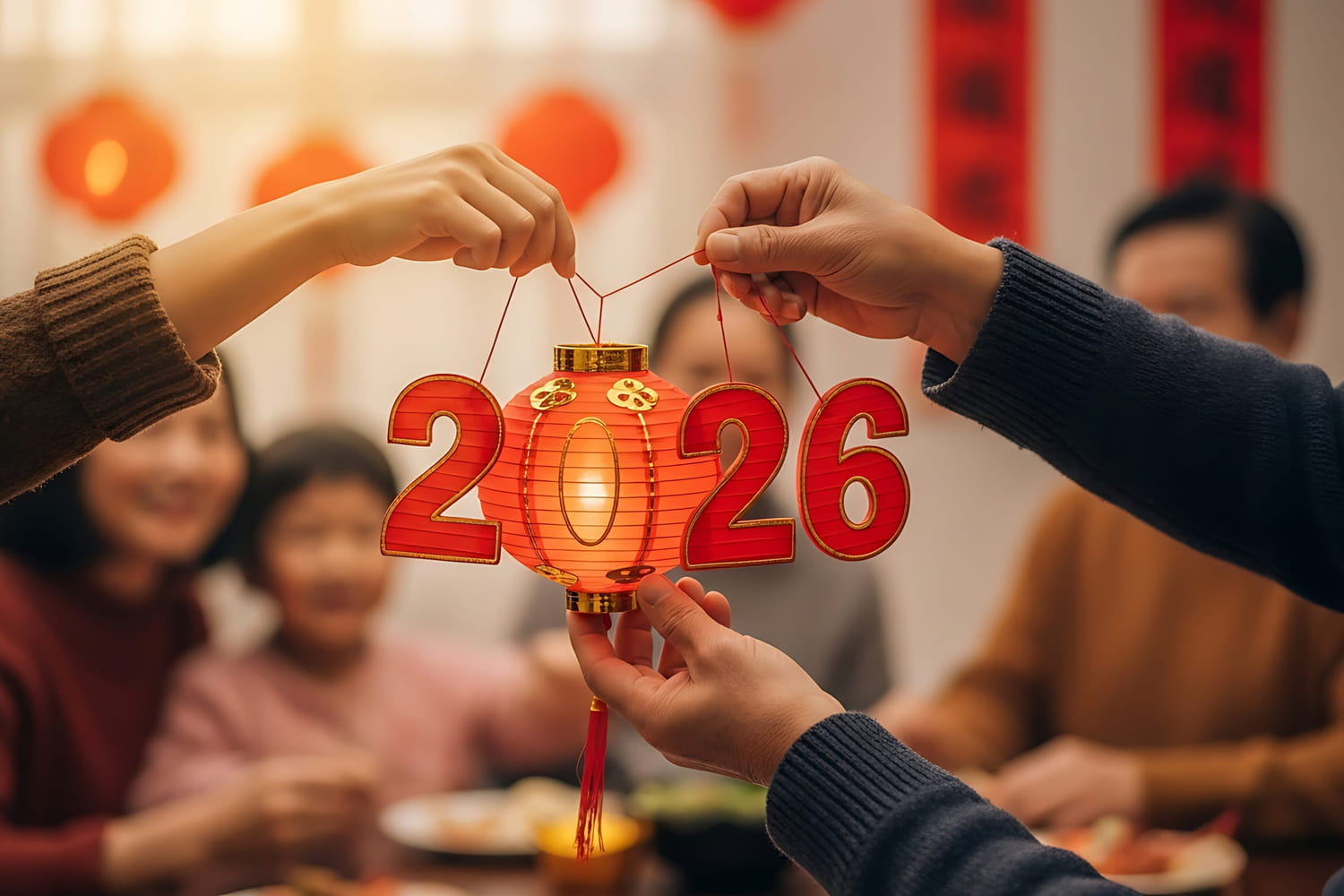
Very different from our Western celebration, the Chinese New Year opens 15 days of celebrations, punctuated by ancestral rites and traditions. Here is the animal that will dominate the year 2026 and the essential information to understand this extraordinary celebration.
In February, Chinese communities around the world will begin a lunar new year with Chinese New Year, also known as “Spring Festival”. This deeply symbolic celebration draws on very ancient agricultural practices. Originally, it marked the arrival of spring and brought the hope of generous harvests. Today, this lunar festival still brings families together around rites passed down for centuries and a new emblematic animal, honored for two weeks, until the Lantern Festival.
This year, Chinese New Year begins on Tuesday February 17, 2026 and ends two weeks later with the Lantern Festival, Tuesday March 3, 2026.
What is the Chinese New Year animal in 2026?
After a year 2025 placed under the sign of the Wood Snake, 2026 will be the year of the Horse, associated with the element of Fire. In Chinese culture, this rare combination (which only happens every 60 years) is synonymous with power. The Horse is the seventh sign of the zodiac, and indeed represents boldness, vitality, independence, determination and freedom. It is also associated with travel and professional success. By coupling it with Fire, all its qualities (but also its faults) are amplified: the Fire Horse is a symbol of leadership, ardor, passion and charismabut also impatience and impulsiveness, and difficulty controlling one’s emotions.
Why does Chinese New Year last 15 days?
China uses the lunar calendar (unlike most countries in the world, such as France, which uses the Gregorian calendar), the Chinese New Year is therefore timed according to the phases of the Moon. This is why it is celebrated every year on a different date. According to tradition, it is celebrated from the second new Moon after the winter solstice, until the first full Moon, the Lantern Festival, 15 days later. During this period, festivities honor the deities and allow us to chase away the negative energies of the past year, to start again under better auspices. In China, it is also the longest holiday period of the year.
What are the traditions of Chinese New Year?
If you are lucky enough to travel to a country or neighborhood in a city celebrating Chinese New Year, you will observe many traditions. The streets and houses are adorned with red decorations. Dinner is marked by symbolic dishes, followed by an exchange of red envelopes containing money or wishes. Firecrackers, fireworks, dragon and lion dances liven up the festivities.
Our manual activities around Chinese New Year
To keep the children busy and get them involved in preparing for the Chinese New Year, Hugo the Snail offers you manual activities to carry out as well as coloring on the theme of Chinese New Year. A dragon to make with toilet paper rolls, dragon heads to cut out, Chinese New Year calendars to print or even a lantern making workshop… Find all our craft ideas for young and old:
Our decorating tips for Chinese New Year
Decorating your house and its interior is part of the customs of Chinese New Year. Here are all our decorating tips:
What do we eat for Chinese New Year?
The Chinese New Year meal, or “spring banquet”is shared with family with symbolic dishes to bring luck and prosperity. Fish, a sign of abundance, is essential, often accompanied by noodles for longevity. Chinese fondue, Peking duck, caramel pork, jiaozi ravioli and imperial rolls often complete the menu. For dessert, fruits, like clementines, symbolize health and happiness. Nian gao, a traditional cake, is also in the spotlight, sometimes with nougat or “fortune cookies”. Leftovers are seen as a guarantee of success for the year to come.
The Lantern Festival, which also goes by the name “Little New Year”, ends the Chinese New Year festivities. During this festival, the Chinese meet with family or friends to eat yuanxiao, stuffed rice balls, served in a soup whose rounded shape symbolizes the reunited family. The evening, they go out into the street with lanterns by hand to watch the Moon, admire the fireworks, and play riddles written on the lanterns.
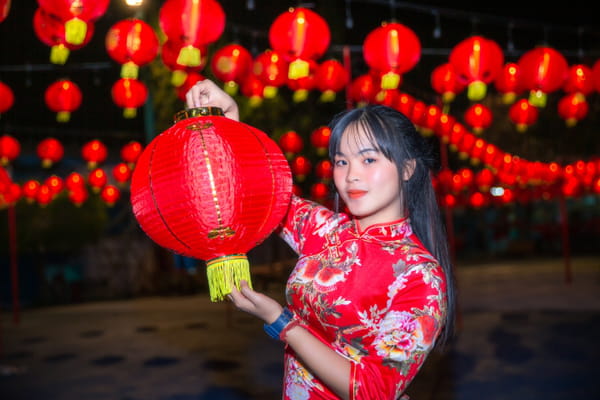
During the day, different dances and stilt walks are also organized. This custom dates back to the time of Emperor Qin Shihuang, who unified China around three centuries BC. Lantern riddles appeared later during the Song Dynasty (960-1279).