






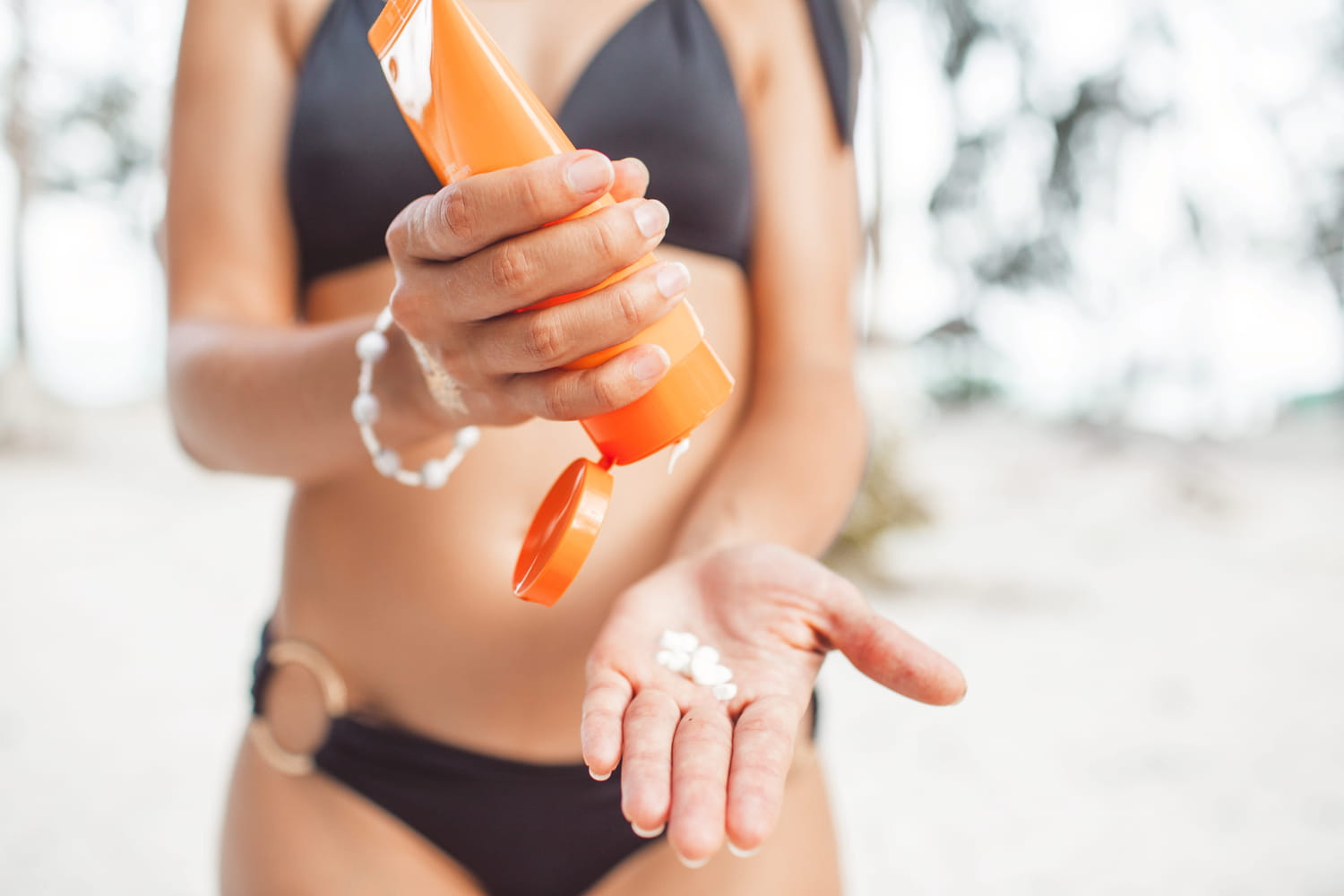
The sun returns and the tubes of sunscreen finally come out of the cupboard. But be careful: a very common mixture in bathrooms could reduce the effectiveness of your protection.
We are still a few weeks away from summer, but clearly, summer habits have already resumed. First lunch outside, first heatstroke in the metro, first legs out in the air… and obviously, back in the sunscreen in the bag. With it, another product is also making a big comeback. The problem is that many have gotten into the habit of mixing it directly with their sunscreen. To save time in the morning or to have a prettier finish on the skin. Except that for dermatologists, it’s frankly a bad idea.
What specialists point out is that sunscreen doesn’t work just because you use “a little”. To properly protect the skin, it must form a regular and uniform layer. It is this protective film that allows UV filters to do their job. When you start mixing the texture with another product, the protection can become much less consistent. In short: some areas are well covered, others much less, and the SPF displayed on the tube no longer necessarily corresponds to the real protection.
Dr Derrick Phillips, consultant dermatologist, explains it very simply: “Self-tanner does not offer effective protection against UV rays; it is therefore essential to apply sunscreen separately, and not to mix it with another product.” Indeed, many people think they can kill two birds with one stone: a slightly more golden complexion and protected skin. On paper, it seems clever. In practice, it is much less so.
The concern mainly comes from the fact that sun protection products are tested alone, under very specific conditions. Texture, quantity, spreading on the skin: everything is calculated to guarantee a certain level of protection. As soon as you mix the formula with something else, the result becomes much less predictable. “Mixing them with another product can alter their distribution on the skin and, therefore, reduce their real effectiveness”specifies the dermatologist. And contrary to what some still imagine, having more tanned skin absolutely does not mean that you are better protected from the sun.
However, dermatologists are not saying that you should abandon this type of product until September. In reality, you just need to separate the steps carefully. The ideal is to apply the self-tanner several hours before the sunscreen, often the evening before, then let the product develop slowly before using its protection the next day. Most formulas need six to eight hours to work properly. And if there’s one rule to remember, it’s this: sunscreen should always be the last step.