


Many of us dry laundry in our homes without measuring the impact on our rooms. Doctor Gérald Kierzek warns of this little-known danger which degrades indoor air quality.
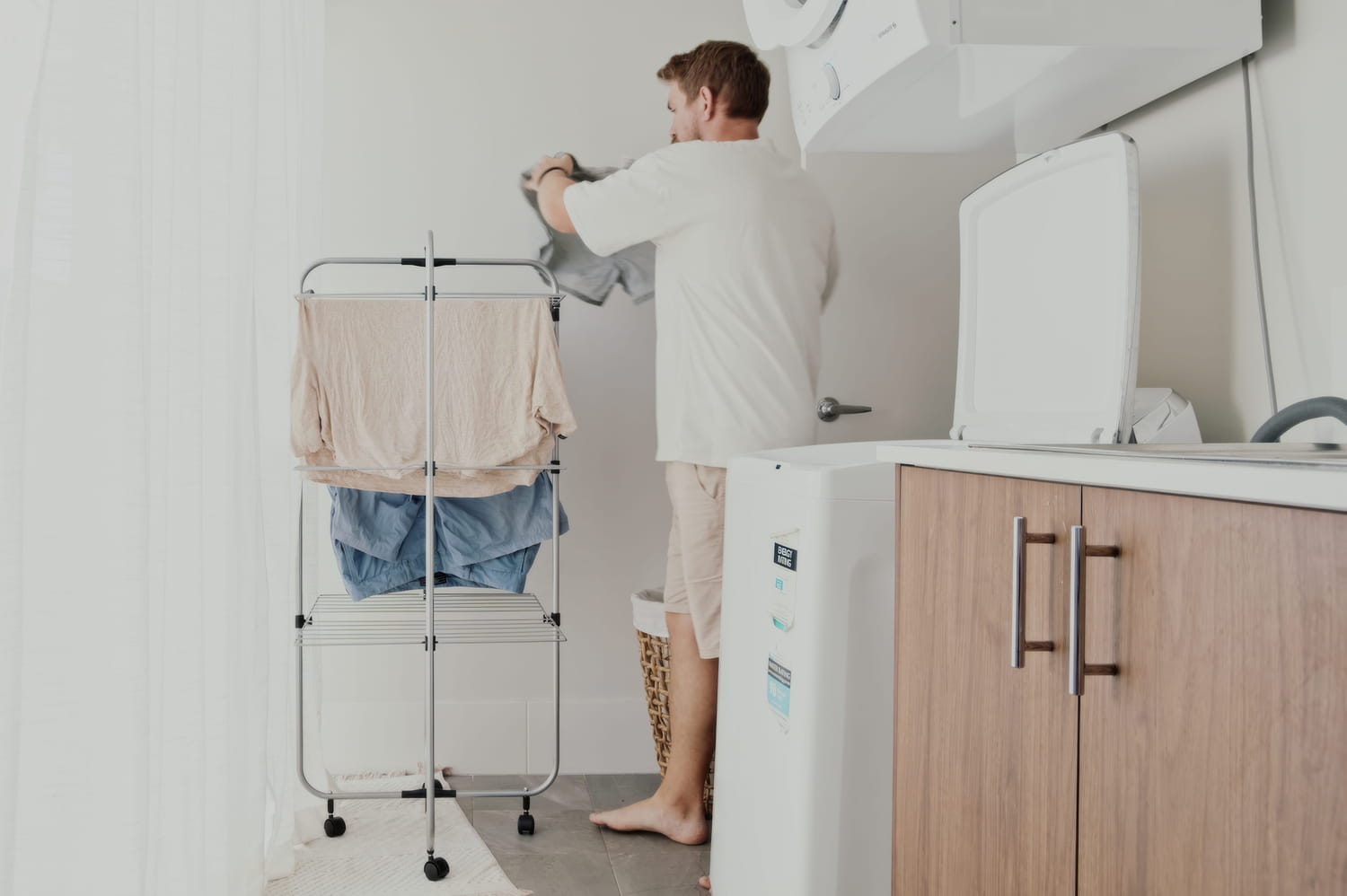
In winter and on rainy days, it is impossible to hang your laundry outside. When you live in an apartment and you don’t have a terrace or balcony, the question doesn’t even arise. Washed clothes dry on a drying rack. Some people are sometimes lucky enough to have a dryer. Very practical especially in winter when clothes take longer to dry. However, not everyone has one. It takes up space and is an expensive purchase.
And even for those who own one, not all clothes can be dried in this machine. This is the case for delicate textiles (wool, silk or lace), clothes with fragile prints whose patterns can crack, those with sequins or pearls, jeans or towels which risk shrinking, leather or imitation leather and finally, waterproof materials.
Several technical parameters make it possible to optimize indoor drying. To promote homogeneous evaporation, the rooms must be arranged in such a way as to maximize the heat exchange surface, avoiding any overlapping which would block air flows. At the end of the spin cycle, mechanical steaming by manual shaking is recommended: this action unclogs the fibers and releases trapped residual moisture. The drying rack load must respect critical spacing between each textile to ensure effective ventilation. Finally, the spatial configuration of the drying zone constitutes a strategic choice for the hygrometric balance of the habitat.
Forget the bathroom especially if it has no ventilation or a garage. Otherwise, beware of bad odors, because the laundry will take longer to dry. Ideally, it’s best to put it in a room with space where air circulates well. It is even recommended to ventilate it well several times during the day. Yes, because apart from the fact that it will take more time, Doctor Gérald Kerziek warns of another dangerous point.
When the laundry dries, the water evaporates and this raises the humidity level. “Very humid air with humidity levels above 60% will transform your interior into a nest of microbes. It is a trap for fungi, mites, mold” alert the doctor. The solution: it is to ventilate the place where the extender is located, but the most effective is to invest in a dehumidifier. “It’s not very expensive. With a few dozen euros, you have things that are interesting.”
The objective is to achieve a humidity level of between 40 to 60% in order to maintain a healthy interior. With an electric or mechanical dehumidifier, the humidity level can be easily controlled.