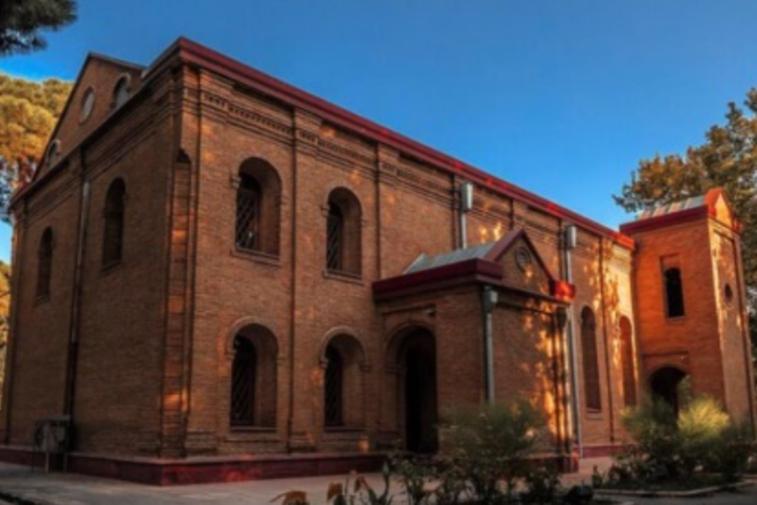
The Evangelical Church of St. Peter in Tehranthe oldest Protestant church in Iran, risks being confiscated by the authorities of the Islamic Republic. The one to report it ETS Open Doorsan organization committed to supporting persecuted Christians around the world, which reports an imminent clearance procedure for the ecclesiastical complex and the homes within it. According to the statement released by the organization, the community leaders were ordered to remove the faithful residing in the structure, with the threat of possible arrest if the measure was not followed up.
The St. Peter complex covers approximately 4 hectares of land in central Tehran and includes, in addition to the building of worship, two schools and dozens of homes where families belonging to the Armenian and Assyrian Christian communities officially recognized in Iran live.
A church born in the nineteenth century in the heart of Tehran
The history of St. Peter’s Church has its roots in the second half of the nineteenth century. It was founded in 1876, when Shah Naser al-Din Shah Qajar, ruler of the Qajar dynasty, granted the land to American missionaries.
The building soon became a point of reference for the Protestant presence in the country, not only as a place of prayer but also as an educational and social centre. Over the decades the complex has represented a meeting space for several generations of Iranian Christians. However, its position, in the center of the capital, has also contributed to increasing the economic value of the area, transforming the property into a particularly attractive asset.
A judicial dispute lasting almost thirty years
At the basis of the current crisis there is an ordinance issued in 1998 by a Iranian Revolutionary Tribunal, according to which the entire complex should have been transferred toOrganization for the Execution of the Order of Imam Khomeini (EIKO), a state body directly linked to the institutions of the Islamic Republic. According to what was reported by Porte Aperte ETS, no public reason for the measure was provided at the time. The Council of Evangelical Churches of Iran, which runs St. Peter’s Church, only discovered the existence of the ruling by chance in 2008when many years had passed and the possibilities for protest were severely limited.
“The Council of Evangelical Churches of Iran was not aware of the ruling and could not challenge it until the ordinance came to light by chance in 2008,” reads the Open Doors ETS statement.
The organization also denounces that, since 1980, the Iranian authorities have prevented the renewal of the registration of the Evangelical Council, effectively blocking any possibility of appeal on the property.
EIKO, Porte Aperte reports, was also responsible for the expropriation of the Assyrian Presbyterian Church of Mashhad, demolished without warning last month as well as the Assyrian Presbyterian Church of Tabriz, from the Assemblies of God Church in Gorgan and the spiritual retreat center in Karaj.
Christian families forced to leave their homes
The situation worsened on June 16, when the families living in the complex were ordered to leave their homes. According to Open Doors ETS, it is about 12 Armenian families and 8 Assyrian families, many of whom have lived in the facility for years and depend on the support of the ecclesial community. “Most of these families, who have lived in the complex for many years, have a modest income and have no chance of surviving without the support of the church,” said the reverend Sargez Benyaminformer pastor of St. Peter’s Church, quoted in the statement. The organization reports that, at the time the complaint was released, eight families had already been evicted. The leaders of the Christian community were also threatened with arrest if the inhabitants did not leave the buildings.
The long-lasting pressure on Protestant Christians in Iran
The story of St. Peter is part of a broader picture of difficulties for Iranian Protestant communities after the Islamic revolution of 1979.
According to Open Doors ETS, at one time there were around 50 Protestant churches in the country, belonging mainly to the Presbyterian, Assemblies of God and Anglican denominations. Today, again according to the organization, only a part of them would still be authorized to operate. Over the years, several communities have suffered restrictions, in particular those that celebrated services in the Persian language, which were also frequented by citizens who converted from Islam to Christianity. «The pressure exerted on St. Peter’s Church it is the latest example of how Protestant Christianity has been slowly and steadily repressed since the establishment of the Islamic Republic in 1979,” says Open Doors ETS. The organization also recalls that St. Peter’s Church had already had to interrupt services in Persian to prevent the participation of converted Christians, considered by the authorities to be a particularly sensitive category.
The alarm of Nobel Prize winner Shirin Ebadi
The Iranian lawyer and Nobel Peace Prize winner also spoke on the matter Shirin Ebadiwhich called St. Peter’s case part of a broader policy toward Iranian Christians.
According to Ebadi, «the attack on St. Peter is a continuation of the same policy pursued for years against Iranian Christians, especially converts to Christianity. The Islamic Republic first considered Persian-language worship a threat. Then he closed the Persian-speaking churches. He later persecuted converts to Christianity for their faith and worship. Now,” he added, “the scope of the pressure has gone beyond converts and reached historic properties, ancient churches and even places where Armenian and Assyrian citizens live.”
The appeal to the international community
Faced with the risk of confiscation, Open Doors ETS joins the appeal of World Council of Churches asking the Iranian authorities to stop any initiative that could lead to the transfer or transformation of the intended use of the property. “We call for an immediate cessation of any action that could lead to the confiscation, transfer, demolition or use for other purposes of ecclesiastical properties, including St. Peter’s Evangelical Church,” reads the document. The organization also calls on the international community to «engage constructively and urgently in support of the protection of Christian heritage sites and assets» and the right of Iranian Christian communities to religious freedom.