




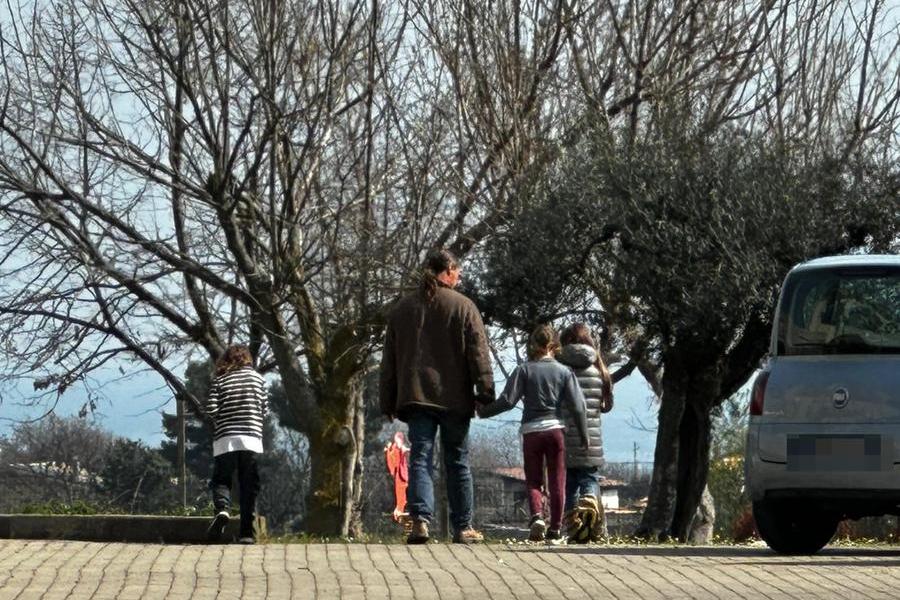
It hurts to know that the children of the forest family, separated from their mother, are desperate. We saw it in the videos, in the interviews, we heard it in the heartbreaking screams of these little ones. We talk about it with Rosa Rosnatifull professor of Social Psychology at the Catholic University of Milan and member of the steering committee of the University Center for Studies and Research on the Family.
Professor, what do you think?
«The pain I feel and that I believe we all feel when thinking about these children is very intense: we imagine them lost, anguished, hugging each other in an attempt to gain strength among themselves».
Don’t you think that, for the overall protection of the family, greater confidentiality would have been needed to better manage this difficult situation?
«Absolutely yes! I must say that the media hype that has surrounded this story for months now, the harshness of the tones and the ideological contrasts on which public opinion has aligned itself – completely in favor of the family or completely against – leave no room for a deep and detailed understanding of the story and its complexity. And this certainly does not help these parents, nor the social and legal operators involved: in a situation as heated as this, making thoughtful and far-sighted decisions will be even more difficult and the risk of being sucked into this conflict grows.”
How could this separation be managed now? What intervention hypotheses should be evaluated?
«We have no elements that allow us to make predictions for the future. The judge today has various tools from which to choose the one best suited to each individual situation. Let’s imagine that we first try to work towards recovering the relationship between mother and children. And if this proves to be an impracticable option, the judge could opt for a family placement through the various forms of foster care and adoption (possibly also open). Solutions that are certainly preferable to inclusion in an educational community, even a small one, which by its nature cannot guarantee the personalized and continuous care that each child needs. On the other hand, the need for family is inherent to human beings.”
In what cases can one reach such an extreme choice? Or that of separating the mother from her children?
«We come to make – not without difficulty – a similar decision when we find ourselves faced with parents who are unable to take care of their children, who are unable to understand and respond to their needs, who are unable to give direction to their growth. In these cases, the services intervene by outlining a path to support parents and recover or build parenting skills. Often these are parents who themselves have not received care, who have been neglected and who therefore have not internalized a “good enough” parenting model. If this path of recovery of parental function does not give positive results, then it may lead to a limitation or forfeiture of parental responsibility. This term indicates precisely how parents have no rights over their children, much less power. Even the legal language has changed: until a few years ago we spoke of parental authority, now instead of responsibility. Children have rights, not parents. Parents are required to respond (which has the same etymological root as responsibility) to the needs of their children, primarily the need to belong.”
Separate instead of mediate? Could it have been an alternative?
“I imagine that social workers and judges have done everything to support the parent-child bond.”
In your opinion, why does this mother insist on maintaining a lifestyle that is incompatible with the training, education and health of her children? What strategies can be imagined to involve her, alongside the father, for the good of the children?
«We have no elements for a deeper understanding. Certainly an aspect often left in the background, even in this case, is the cultural dimension. Let’s keep in mind that the culture of this family is profoundly different, even if it doesn’t immediately catch the eye. It is important to pay attention to this aspect. Separating the cultural aspect from the content of the parent-child relationship is not easy, also because we are necessarily used to evaluating the adequacy of the parent-child bond with our own yardstick. We are better prepared to bring this aspect into play when we find ourselves faced with immigrant families who have educational practices that are very distant from ours and sometimes not compatible not so much with our educational standards, but with suitable responses to the fundamental needs of human beings.”
Can the figure of the father be of support to the children in such a dramatic situation? What could he do? What is his contribution?
«Certainly, he is a fundamental reference figure who can and we hope is helped to act as a bridge with the maternal figure. Social workers must support the parental alliance which can constitute a basis of support for the growth of children.”
Can the trauma of separation be processed by growing up or will it leave indelible marks?
«The interruption of the parent-child bond is a trauma that leaves marks in the short and long term, even more so if it happens suddenly. The accompaniment of an adult figure who knows how to stand by the child’s side in this very painful passage, who knows how to give meaning to what the child experiences, who gives meaning to the emotions he feels, who helps to prefigure the future, who knows how to be a bridge between yesterday and today, preserving memories, photos, and everything that will allow the child to find the red thread of his own story, recompose the chapters and reconstruct the sense of continuity of the self, is fundamental.”
Why do cases of this type involve public opinion so clearly?
«Because it touches the dimensions that constitute the human, the deepest place of our identity which are family ties, because it touches that dimension that everyone has in common, that of being children. Raising children is an even more challenging task nowadays. Parents cannot be left alone: it is essential that the social sector is alongside the families (and not against), that it accompanies them in this increasingly difficult undertaking and that it prevents situations of full-blown hardship. As? By creating support networks, closeness between families, mutual trust between family and school, as well as with other institutions (sports associations, oratories, …) and any other educational place, offering places and times for meeting and exchange, tools to deal with complex situations. The enrichment paths fit well into this panorama. Raising a child is the community’s task.”
The child is a common good.
«We commonly use this beautiful expression “bringing a child into the world”: the child is inserted in a broader horizon, in an interweaving of individual, couple, family and social dimensions. The child is not for oneself, he is not an extension of the adult, nor an object onto which to project one’s desires. Each child is unique, asking to be recognized in his uniqueness and to blossom into life according to his own characteristics. They are children of the family and at the same time citizens of tomorrow, inserted in a specific historical and cultural context. They constitute a social generation, they are the children of our future.”